How Does the Bacterial Flagellar Motor Work?
TL;DR
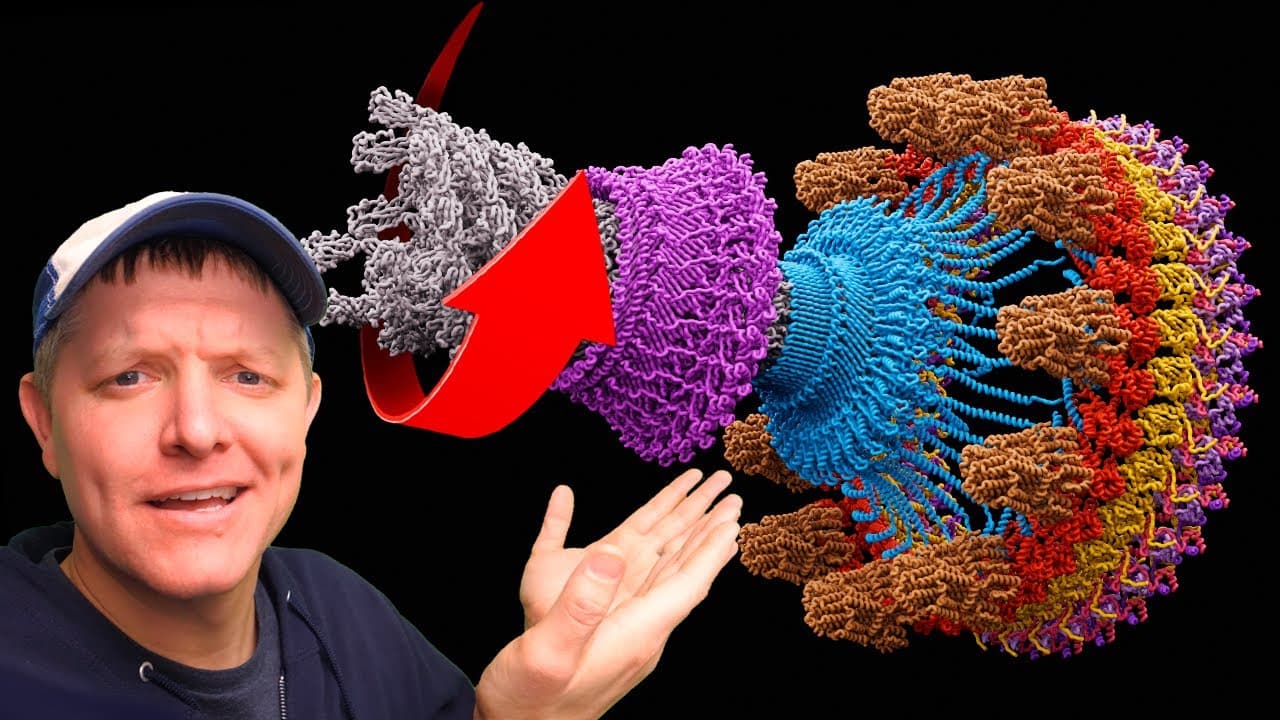
The motor uses a proton gradient across the bacterial membranes to rotate a small rotor called MOT AB, which drives a flagellum to propel the cell. When signals trigger, the rotor switches from counterclockwise to clockwise, opening up the flagellar bundle and causing tumbling to reorient.
Transcript
Hey, it's me, Destin. Welcome back to Smarter Every Day. This is the 300th episode, which is cool. Thank you so much for watching. I was on the internet the other day. I was just scrolling on my phone. I was probably wasting too much time. But I came across this amazing animation that blew my mind. It's a motor that appears to be made out of molecu... Read More
Key Insights
- The bacterial flagellar motor is powered by a proton gradient across the two membranes of the cell.
- A rotor called MOT AB interacts with a protein ring, allowing protons to drive rotational motion.
- The flagella can form a bundle to propel the cell forward when rotating counterclockwise.
- Chemotaxis is the process by which bacteria sense chemicals and bias their movement toward favorable conditions.
- A single motor can adjust torque by employing more than one MOT AB unit, up to 11 or more in some cases.
- The motor switches rotation direction in response to chemical signals, causing the bundle to open and reorient the cell.
- Counterclockwise rotation produces straight swimming, while clockwise rotation causes tumbling and reorientation.
- High-resolution observations reveal the motor structure as a multi-component system with a central rotor, stator, and engaging protein interactions.
Install to Summarize YouTube Videos and Get Transcripts
Explore YouTube Video Summarizer or Get YouTube Transcript Extractor
Questions & Answers
Q: How does the proton gradient power the flagellar motor?
The proton gradient creates an electrochemical potential across the bacterial membranes where protons flow through the motor components. This flow drives the MOT AB unit, which acts as a rotor that converts chemical energy into mechanical rotation. The energy transfer from protons to the rotor enables continuous turning of the flagellum.
Q: What is MOT AB and why is it important?
MOT AB is the small gear-like component that receives protons and drives the rotor. It serves as the primary driver of rotation in the flagellar motor by converting proton flow into mechanical torque. Its interaction with the surrounding protein ring determines the motor’s speed and torque, and it can function with multiple units for increased force.
Q: How does the motor change direction and what causes it?
Direction change is controlled by chemotaxis signaling, where external chemical cues trigger a cascade including CheY. When CheY binds, it biases the motor to rotate clockwise, causing the flagellar bundle to unbundle and the cell to tumble, effectively reorienting the cell toward favorable conditions.
Q: What is chemotaxis and how does it affect movement?
Chemotaxis is the bacterial response to chemical gradients that guides movement. It involves sensing environmental signals, processing them through signaling proteins, and adjusting the rotation of the flagella. The result is a biased random walk that helps bacteria move toward nutrients or away from harmful substances.
Q: Why does the flagellum sometimes form a bundle and other times not?
When the motor rotates counterclockwise, multiple flagella bundle into a single propeller, producing straight swimming. If the rotation switches to clockwise, the bundle opens up, causing tumbling and reorientation. This dynamic bundling and unbundling underlies smooth swimming versus exploratory turning.
Q: How many MOT AB units can participate in driving the motor?
The exact number can vary, with evidence of two to eleven units potentially engaging the rotor. Additional units can be recruited if higher torque is needed due to load or environmental conditions, allowing flexible control of rotation speed and force.
Q: What is the significance of observing bacteria as a mechanical system?
Viewing bacteria as a system with sensors, actuators, and feedback highlights emergent behavior shaped by limited inputs. The motor responds to chemical cues, adjusts torque, and coordinates with other protein complexes to achieve rapid, directionally biased movement, illustrating how simple components create complex locomotion.
Q: What did Prashant Singh contribute to this discussion?
Prashant Singh provided expert explanation of the flagellar motor architecture, describing the proton-driven MOT AB rotor, the interaction with the protein ring, and how these components enable rotation, direction changes, and torque modulation. His insights connect high-resolution structural details with functional motion in living cells.
Summary & Key Takeaways
-
The video explains a molecular motor in bacteria powered by proton flow that turns a rotor and drives a whip-like flagellum, enabling locomotion.
-
The discussion covers how the motor can reverse direction by switching the rotor from counterclockwise to clockwise, changing motion from smooth swimming to tumbling.
-
The narrative connects the engineering analogy of gears and rotors to the biological flagellar system, highlighting emergent behavior and sensory signaling in bacteria.
Read in Other Languages (beta)
Share This Summary 📚
Summarize YouTube Videos and Get Video Transcripts with 1-Click
Try YouTube Summary with ChatGPT & Claude or YouTube Transcript Generator
Explore More Summaries from SmarterEveryDay 📚





Summarize YouTube Videos and Get Video Transcripts with 1-Click
Try YouTube Summary with ChatGPT & Claude or YouTube Transcript Generator