How to pursue de extinction and scalable gene editing
TL;DR
Colossal aims to blend AI with biology to advance de-extinction efforts and scalable gene editing, relying on experts like George Church and a global bios system. The conversation covers business models, open collaboration, and the role of AI in designing experiments while stressing the need for wet lab validation and ethical considerations.
Transcript
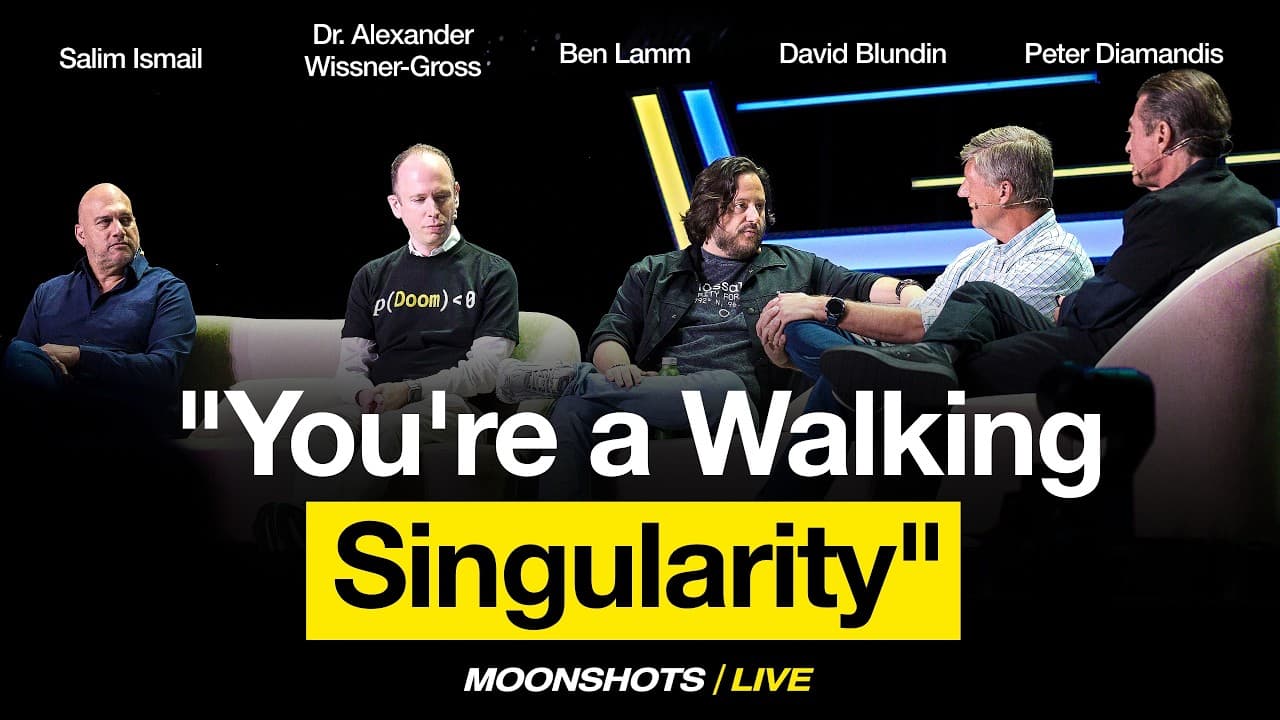
I was a little terrified backstage when Palmer's like, "There's something on the screen that says I'm not supposed to say this." I was like, "For the love of God, whatever it is, please not be please don't make it about colossal. >> Please don't say it." Uh, so I remember at uh at Abundance 360 last March um just before you came on, Elon was there.... Read More
Key Insights
- Mammoth de extinction is framed as a moonshot driven by Colossal that combines AI, ancient DNA research, and synthetic biology to re shape the biology landscape, while acknowledging the ethical and technical challenges involved.
- The key to entrepreneurial success in biology is surrounding oneself with the top scientists and asking the right questions, enabling non experts to contribute meaningfully and learn through collaboration.
- Foundation models and AI will not replace wet lab work entirely, but will streamline middleware, data integration, and experimental design, accelerating discovery while preserving the need for empirical testing.
- Biology business models are shifting toward enabling large scale data driven insights, leveraging AI to interpret complex genetic data and coordinate distributed labs and sequencing efforts.
- Genotype to phenotype mapping is a central focus, with efforts to map genetic information across species to guide editing strategies and understand trait expression, while mitigating unintended consequences.
- Ethics and governance are critical as de extinction and artificial womb discussions arise, requiring thoughtful design of experiments, regulatory compliance, and stakeholder engagement to avoid harm.
- A global, distributed biosystem approach is proposed to collect and analyze sequencing data at scale, supporting faster hypothesis testing and cross jurisdiction collaboration while addressing biosecurity concerns.
- AI assisted discovery will co exist with bench work, enabling exploration of thousands of potential edits and experiments that would be impractical to test manually.
Install to Summarize YouTube Videos and Get Transcripts
Explore YouTube Video Summarizer or Get YouTube Transcript Extractor
Questions & Answers
Q: How could AI influence the early stage of de extinction projects without replacing wet lab work?
AI can help by handling data integration from diverse sources, suggesting experimental designs, and highlighting potential gene targets for further validation. It can also assist in standardizing nomenclature across studies and simulating numerous design variants before any lab testing, thus reducing wasted effort. However, real validation must occur in wet labs where hypotheses are empirically tested.
Q: What role does George Church play in Colossal’s approach to synthetic biology?
George Church is described as a collaborative figure whose work with ancient DNA and sequencing technologies informs Colossal’s strategy. Ben Lamm notes that Church’s openness and deep expertise inspire iterative discussion and idea generation, enabling rapid exploration of possibilities and validation through expert guidance.
Q: Why is the business model for AI and biology described as evolving rather than fixed?
The business model is evolving because biology combines long development timelines with data rich discovery cycles. AI accelerates hypothesis generation and data interpretation, while wet lab validation remains essential. The synergy creates opportunities for scalable experimentation, cross company collaboration, and new services that connect AI tools with bench work.
Q: What is meant by a global bio system and how would it function?
A global bio system refers to a distributed network of sequencing, data rights, and local bios labs coordinating to perform high throughput analysis at scale. The idea is to gather diverse genomic data, enable local testing, and share insights while ensuring privacy and biosecurity, enabling faster, global collaborative research.
Q: What are the ethical considerations mentioned regarding de extinction and artificial wombs?
Ethical considerations include the potential impacts on ecosystems, animal welfare, and societal implications of creating or maintaining extinct or engineered organisms. Discussions emphasize designing experiments responsibly, engaging stakeholders, and ensuring proper governance to prevent harm and unintended consequences.
Q: How does the panel view the possibility of artificial wombs within 24 months?
The discussion signals cautious optimism about rapid advances in biotechnology and reproductive technologies, but emphasizes that timelines are uncertain and contingent on safety, regulatory approval, and ethical acceptance. The panel frames it as a future possibility that requires rigorous testing and oversight.
Q: What is the significance of genotype to phenotype mapping in their work?
Genotype to phenotype mapping is viewed as crucial for predicting how edits will express traits, guiding editing strategies and reducing unpredictable outcomes. By mapping genetic information across species, researchers aim to identify stable, beneficial edits and understand potential side effects, improving the reliability of de extinction and gene editing efforts.
Q: How do the speakers describe handling multiple disciplines in biology and tech?
They describe a collaborative approach where software, AI, and wet lab expertise converge. By having the top scientists around, they can ask the right questions, test ideas iteratively, and integrate insights from genetics, computation, and business strategy to accelerate breakthroughs while maintaining ethical and scientific rigor.
Summary & Key Takeaways
-
Colossal is pursuing de-extinction and scalable gene editing by combining AI, sequencing, and a global bios system to enable more efficient experimentation and discovery.
-
The discussion emphasizes the value of hiring top talent and asking the right questions, using collaboration with leaders like George Church to push synthetic biology forward.
-
The guests stress that AI will assist in bridging data gaps and design exploration, but real validation requires controlled wet lab experiments and responsible development.
Read in Other Languages (beta)
Share This Summary 📚
Summarize YouTube Videos and Get Video Transcripts with 1-Click
Try YouTube Summary with ChatGPT & Claude or YouTube Transcript Generator
Explore More Summaries from Peter H. Diamandis 📚


Summarize YouTube Videos and Get Video Transcripts with 1-Click
Try YouTube Summary with ChatGPT & Claude or YouTube Transcript Generator