Is Titan Stock a Buy After Its Recent Price Fall?
TL;DR
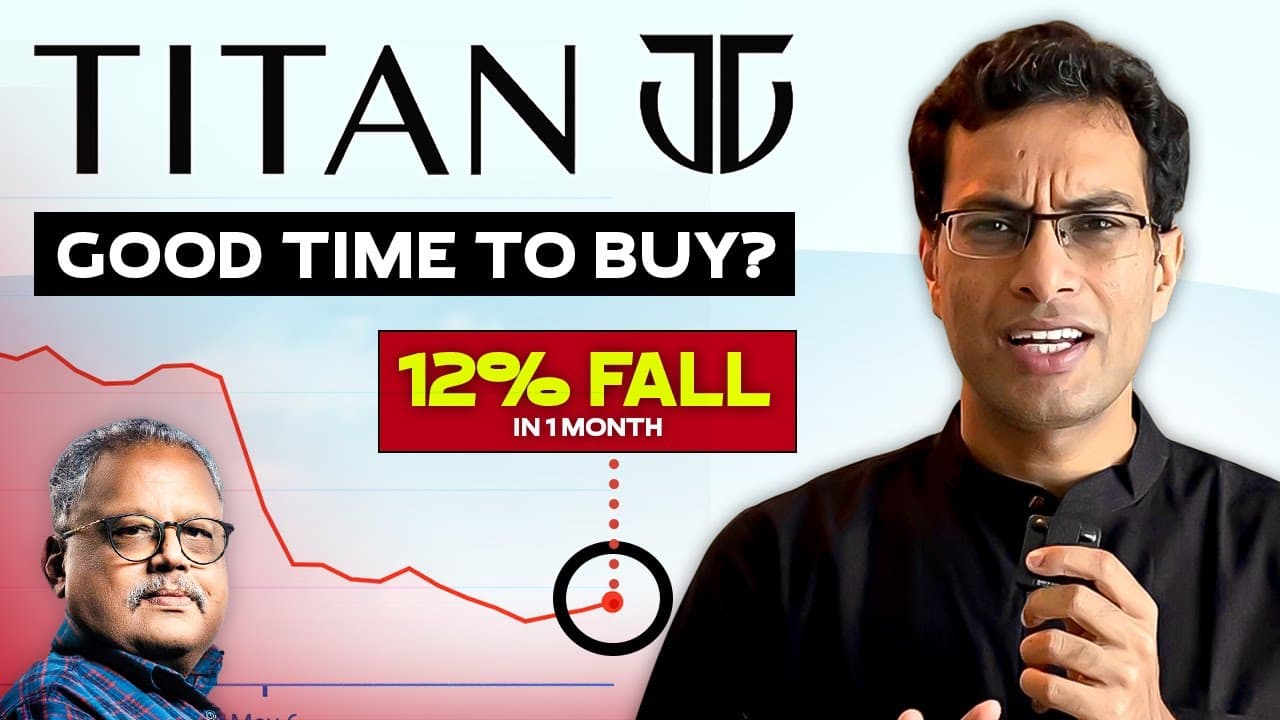
Titan’s recent decline does not automatically make the stock attractively valued, according to the analysis. Its roughly ₹3 lakh crore market capitalization, strong prior rally, jewelry-market competition, and dependence on favorable gold trends limit the perceived upside. The preferred approach is to wait for a substantially deeper correction, even if that means missing a rebound.
Transcript
Hi, everyone. Welcome to today's video. On today's video, I'm going to speak about Titan because the stock has fallen by roughly 7, 7.5% as I'm tracking the market. Is this a great buying opportunity or should you avoid this stock? What is it that I'm precisely doing? I will share all that information in a very point-wise manner. The easy language ... Read More
Key Insights
- A modest price decline does not establish an attractive valuation. Titan had fallen roughly 7–12%, but the analysis emphasizes comparing that discount with the company’s previous gains, near-peak valuation, and approximately ₹3 lakh crore market capitalization before treating it as a buying opportunity.
- Titan’s potential return depends partly on whether its market capitalization can grow substantially. The speaker asks whether a company already valued near ₹3 lakh crore can double within four or five years and concludes that this outcome does not appear likely from the current level.
- Titan’s earliest wealth-creation phase was linked to India’s jewelry business moving from the unorganized sector to organized companies. Rakesh Jhunjhunwala reportedly bought the stock around 2002 or 2003 at roughly ₹3–₹4, capturing a structural trend that cannot simply be replayed today.
- Titan’s more recent rally coincided with a major increase in gold prices. The stock rose roughly 200% from around 2019, while gold prices approximately doubled over four to five years, raising the value of gold-related assets and strengthening sentiment around its jewelry business.
- Future returns depend partly on whether gold can repeat its earlier performance. The speaker expects gold to deliver decent growth but not double again over the next four or five years, weakening one factor that supported Titan’s recent rise.
- India’s jewelry market is divided across fashion, gold, diamond, and lower-tier offerings. Titan operates multiple brands, including Tanishq and CaratLane, but the analysis rejects the assumption that one company can maintain leadership and rapid growth across every segment.
- Titan faces meaningful competition rather than operating as a monopoly. The transcript cites 382 Tanishq stores, 150 Malabar Gold stores, 126 Senco Gold stores, and 116 Kalyan stores, while also identifying Reliance as an incoming competitive force.
- A deeper correction would make Titan’s valuation more attractive to the speaker. Technical support analysis is used to identify a lower buying zone, with a possible 30–40% decline considered sufficient to create a position, while a rebound would simply mean missing the opportunity.
Install to Summarize YouTube Videos and Get Transcripts
Explore YouTube Video Summarizer or Get YouTube Transcript Extractor
Questions & Answers
Q: Is Titan stock a buy after its recent price decline?
The analysis does not treat Titan as a buy merely because its price fell roughly 7–12%. Titan remains a large company with a market capitalization near ₹3 lakh crore, a valuation close to its historical high, and roughly 200% gains since around 2019. The speaker prefers waiting for a much deeper correction before building a position.
Q: Why is a 7–12% fall in Titan stock not necessarily a bargain?
A percentage decline must be evaluated against the stock’s earlier appreciation and current valuation. Titan had already risen strongly, including a roughly 200% increase over about four years. A 7–12% pullback therefore represents only a limited reversal of that advance. The speaker argues that the company can remain expensive even after such a decline.
Q: Can Titan’s market capitalization double in four or five years?
The speaker considers a doubling unlikely from the analyzed level. Titan’s market capitalization is described as approximately ₹3 lakh crore, so doubling the stock would generally require the company’s market value to double as well. Competitive pressure, reduced market dominance, and fewer powerful growth drivers make that outcome difficult to justify in the presented assessment.
Q: What caused Titan’s long-term stock growth?
Titan’s long-term rise is divided into separate phases. The earlier phase reflected India’s jewelry trade shifting from unorganized sellers toward organized companies, a trend captured by Rakesh Jhunjhunwala after buying around 2002 or 2003. The later phase, beginning around 2019, coincided with rising gold prices and continued optimism about organized jewelry businesses.
Q: How did rising gold prices support Titan’s recent performance?
Titan earns most of its money from jewelry, including products connected with gold and diamonds. Gold prices roughly doubled over four to five years, so the value of gold held within the business also increased. The analysis treats this rise as an important contributor to Titan’s asset value, market sentiment, and approximately 200% stock gain since around 2019.
Q: What competitive risks does Titan face in jewelry?
Titan competes across a segmented market containing gold, diamond, fashion, and lower-tier jewelry offerings. Tanishq and CaratLane address different portions of this market, but rivals such as Malabar Gold, Senco Gold, Kalyan, and Reliance create pressure. The analysis says Titan cannot reasonably be expected to dominate every segment while preserving rapid growth and market leadership.
Q: Why does the analysis compare Titan with HDFC Bank?
The comparison illustrates the difference between buying recent growth and buying after a prolonged valuation correction. Titan had delivered roughly 200% over four years, while HDFC Bank had experienced about four years of price correction and negative returns over that period. The speaker therefore views HDFC Bank as more reasonably valued and potentially closer to a breakout.
Q: At what price correction would Titan become attractive?
The transcript does not provide a specific rupee purchase price, but the speaker identifies a lower technical support zone and estimates that Titan could correct by approximately 30–40%. That deeper decline would make the valuation sensible enough for the speaker to build a position. If the stock rebounds first, the stated response is to accept missing the rally.
Summary & Key Takeaways
-
Titan’s share-price decline is assessed in relation to its valuation, market capitalization, and earlier gains. A fall of roughly 7–12% from recent levels may look attractive, but the analysis argues that a large company near its historical valuation peak needs credible prospects of doubling its market capitalization to justify buying.
-
Titan’s historical success came from identifiable trends. The early phase benefited from India’s jewelry trade moving from unorganized sellers toward organized companies. More recently, the jewelry-focused business benefited as gold prices roughly doubled over four to five years, increasing the value associated with its gold holdings and supporting market sentiment.
-
The outlook is presented as less favorable because Titan faces strong jewelry competitors, segmentation across gold, diamonds, and fashion products, and signs of weakening dominance in its largest business. The speaker expects lower growth and would consider buying only after a deeper correction of approximately 30–40%, while accepting that a rebound could be missed.
Read in Other Languages (beta)
Share This Summary 📚
Summarize YouTube Videos and Get Video Transcripts with 1-Click
Try YouTube Summary with ChatGPT & Claude or YouTube Transcript Generator
Explore More Summaries from Akshat Shrivastava 📚





Summarize YouTube Videos and Get Video Transcripts with 1-Click
Try YouTube Summary with ChatGPT & Claude or YouTube Transcript Generator