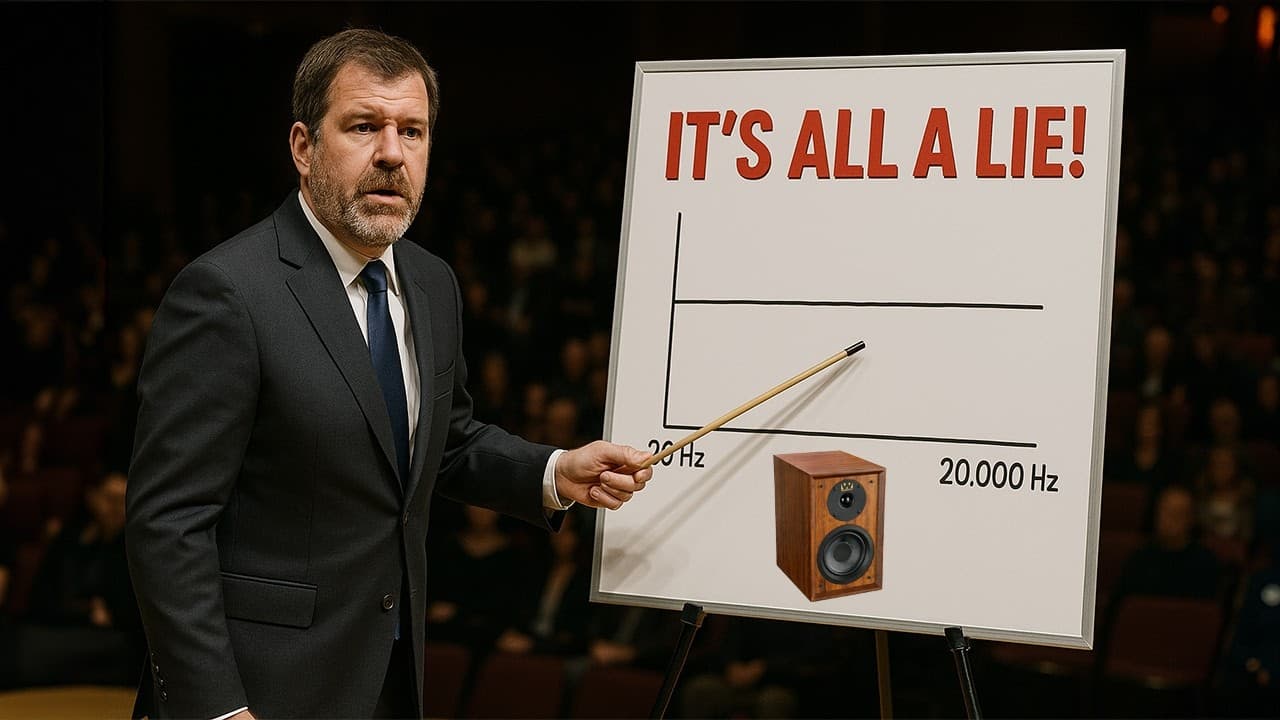
Why Do Flat Speakers Sound Different to Everyone?
TL;DR
A flat frequency response does not guarantee that a speaker will sound neutral or match what an audio engineer heard. Individual ear anatomy, hearing loss, body shape, room acoustics, and small frequency differences alter perception, so measurements should inform rather than replace listening. Hearing tests, tone generators, pink noise, and EQ can help identify personal sensitivities and guide speaker choices.
Transcript
what if I told you that speaker measurements are lying to you come on this one is going to be very juicy it's going to trigger a lot of people but it's all true I have the proof from your unique ear shape to how our brain evolved so we didn't get eaten by a saber-tooth tiger or at least our an ancestors you might not even be here had it not been he... Read More
Key Insights
- Speaker measurements are incomplete predictors of perceived sound because every listener has different ear anatomy, hearing ability, body shape, and room conditions. A flat frequency-response graph can describe measured output, but it cannot show exactly how a particular person will experience that output.
- The human ear has three main sections: the outer ear, middle ear, and inner ear. Each section affects sound before the brain interprets it, so differences across these structures can change perceived loudness, tonal balance, clarity, brightness, warmth, and spatial presentation.
- The outer ear shapes incoming sound like a funnel, and its orientation, width, depth, and size influence perception. Forward-facing ears may emphasize high-mid frequencies, wider ears may soften highs, a deeper concha may strengthen mids, and larger ears may contribute to a larger perceived soundstage.
- The middle ear contains the malleus, incus, and stapes, which transmit vibration from the eardrum. Variability, stiffness, abnormal bone growth, infections, or trauma can affect their movement, potentially changing perceived loudness, clarity, muffling, and the balance between a listener’s ears.
- The inner ear contains hair cells that convert vibrations into signals for the brain, and those cells do not regenerate. Loud-noise exposure and aging can damage them, often reducing high-frequency hearing and making cymbals, sparkle, shimmer, and other upper-frequency details seem diminished.
- Small frequency-response differences can have strong perceptual effects for sensitive listeners. The presenter reports heightened sensitivity from about 1 kHz to 3 kHz, finds a 1 or 2 dB change near 2.8 kHz annoying, and associates a 4 kHz to 6 kHz rise with sibilance.
- A neutral speaker cannot guarantee the mastering engineer’s intended experience because the listener’s ears and room are unlikely to match the engineer’s ears and studio. The same flat-measuring speaker may therefore sound balanced to one person, bright to another, and dull to someone else.
- Personal listening tests can complement measurements through online hearing tests, pink noise, tone generators, silent group comparisons, and EQ experiments. These approaches can expose perceived rises or drops, but headphone tests and simple sweeps do not fully account for ear shape, posture, chest, shoulders, or room effects.
Install to Summarize YouTube Videos and Get Transcripts
Explore YouTube Video Summarizer or Get YouTube Transcript Extractor
Questions & Answers
Q: Why can a flat speaker sound different to each listener?
A flat-measuring speaker can sound different because measured output is only one part of the listening chain. The listener’s outer-ear shape, middle-ear bones, inner-ear hair cells, hearing loss, shoulders, chest, posture, and room all affect perception. Even a small change of 1 or 2 dB in a sensitive frequency region may sound significant to one person and less noticeable to another.
Q: How does ear shape affect the sound of a speaker?
The outer ear shapes sound before it reaches the middle and inner ear, functioning somewhat like a funnel. According to the presenter, forward-facing ears can make high-mid frequencies easier to hear, wider ears can make the same speaker seem warmer or smoother, a deep concha can strengthen mids and vocal clarity, and larger ears can contribute to a larger perceived soundstage.
Q: How do the middle-ear bones influence hearing?
The middle ear contains three bones: the malleus, incus, and stapes. These bones transmit vibrations, but their structure and ability to move can vary. Excessive stiffness may affect perceived loudness or create muffling, while abnormal bone growth can fix the stapes in place. Chronic infections and physical trauma can also damage or erode these structures and alter hearing.
Q: Why can aging make a neutral speaker sound dull?
Aging can damage the inner ear’s hair cells, which convert vibrations into signals for the brain and do not regenerate. The transcript states that most people over age 50 begin losing hearing above 8 kHz. When high-frequency information becomes harder to hear, cymbals, sparkle, shimmer, and air may fade, causing a flat-measuring speaker to seem dull, lifeless, or lacking energy.
Q: Does a neutral speaker reproduce exactly what the artist intended?
A neutral speaker does not guarantee that a listener will hear exactly what the artist or mastering engineer heard. That result would require the listener’s ears to match the engineer’s ears and the listening room to match the studio. Unique anatomy, hearing loss, body shape, placement, and room acoustics change perception, even when the speaker itself has a flat measured response.
Q: How can I test my hearing before choosing speakers?
You can begin with a free online hearing test using headphones and a phone, including the WHO or Mimi apps mentioned in the transcript. You can also play pink noise or move through frequencies with a tone generator, noting where sound appears to rise or fall. These methods provide clues about hearing sensitivities, although they do not fully capture ear shape or body-related effects.
Q: How can EQ help match a speaker to personal hearing?
EQ can be used after a hearing test or tone sweep identifies frequency regions that seem unusually strong or weak. A listener can make adjustments through a compatible device, such as the WiiM Ultra mentioned by the presenter, and evaluate whether the result is more enjoyable. However, hearing-test results do not fully represent ear shape, torso anatomy, posture, or room acoustics, so listening remains necessary.
Q: Should speaker measurements be ignored when buying speakers?
Speaker measurements should not be ignored, because they provide useful information and help manufacturers create neutral starting points. The presenter also acknowledges preference research such as Harman curves. The caution is against choosing solely from graphs or feeling obligated to like a highly rated speaker. Measurements are best treated as guidance alongside hearing tests, room conditions, direct listening, and personal preference.
Summary & Key Takeaways
-
Speaker measurements provide useful information, but they cannot predict every listener’s experience. The outer, middle, and inner ear shape sound before the brain interprets it. Differences in ear shape, ear-bone movement, hearing damage, aging, posture, body anatomy, and listening rooms can make the same speaker sound different to different people.
-
The claim that a neutral speaker reproduces music exactly as the artist intended is questioned because listeners rarely share the mastering engineer’s ears or studio environment. Even changes of 1 or 2 dB can affect perceived brightness, presence, or sibilance, while age-related high-frequency loss may make a flat speaker seem dull or lifeless.
-
Listeners can explore their hearing through online hearing tests, pink noise, tone generators, careful comparisons, and EQ experiments. These methods may reveal frequency regions that seem unusually strong or weak, although they cannot fully account for ear and body anatomy. The practical recommendation is to use measurements as guidance while trusting personal listening preferences.
Read in Other Languages (beta)
Share This Summary 📚
Summarize YouTube Videos and Get Video Transcripts with 1-Click
Try YouTube Summary with ChatGPT & Claude or YouTube Transcript Generator
Explore More Summaries from cheapaudioman 📚



Summarize YouTube Videos and Get Video Transcripts with 1-Click
Try YouTube Summary with ChatGPT & Claude or YouTube Transcript Generator