How to Generate Subsets and String Subsequences
TL;DR
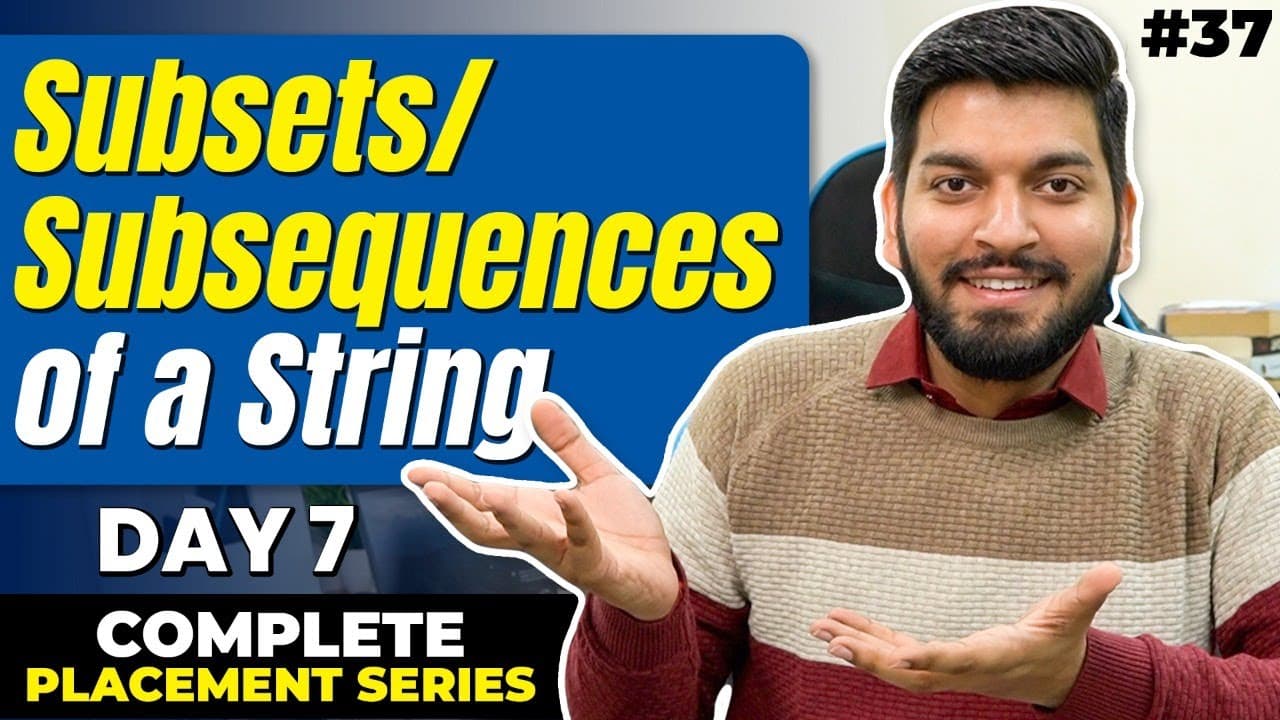
Generate every subset or subsequence by making two recursive calls for each element: one excludes it, and the other includes it in the current output. When the index reaches the end of the array or string, store the completed output, excluding the empty result when the problem requires only nonempty subsequences.
Transcript
Hello ji, how are you all ? this is Love Babber and welcome to the channel Code help , today is 7th lecture of 10 days series of recursion, total lecture no. 37 here we will talk about two very important questions , subset and sub sequences , we are going to have fun Approach in a way is going to remain the same , lets start with the question if I ... Read More
Key Insights
- A power set is the set of all subsets of an input array. For the array containing 1, 2, and 3, the power set contains the empty subset, every single-element subset, every valid pair, and the complete three-element subset.
- The number of generated subsets is 2^n, where n is the number of array elements. Each element creates two recursive possibilities because it can either be excluded from the current output or included in it.
- The recursive state for subset generation consists of the input array, a temporary output vector, the current index, and the answer collection. These values describe what remains to process and which elements have already been selected.
- The base case occurs when the index reaches or passes the input size. At that point, the temporary output represents one completed subset, so it is added to the answer collection before the function returns.
- The exclusion branch advances the index without modifying the temporary output. The inclusion branch appends the element at the current index and then advances, allowing recursion to generate every combination of selection decisions.
- A subsequence is produced by deleting zero or more characters while keeping the remaining characters in their original order. For abc, valid results include a, b, c, ab, ac, bc, and abc.
- String subsequences follow the same recursion tree as integer subsets. Every character creates an exclusion call and an inclusion call, producing 2^n possibilities when the empty string is counted, where n is the string length.
- Nonempty subsequence output requires filtering at the base case. The recursive process can still generate the empty string, but it is added to the answer only when the temporary output has a length greater than zero.
Install to Summarize YouTube Videos and Get Transcripts
Explore YouTube Video Summarizer or Get YouTube Transcript Extractor
Questions & Answers
Q: How do you generate all subsets of an array using recursion?
Track the input array, a temporary output vector, the current index, and a collection of completed subsets. At each index, first recurse without adding the current element, then append that element and recurse again. When the index reaches or passes the array size, add the temporary output to the answer and return.
Q: What is the power set of an integer array?
The power set is the set containing every subset that can be formed from the array. For an array containing 1, 2, and 3, it includes the empty subset, the three single-element subsets, the three two-element subsets, and the complete subset containing all three elements, for eight results in total.
Q: Why does an input of length n produce 2^n subsets?
Each of the n elements has two independent recursive choices: exclude it from the current subset or include it. The recursion explores both choices at every position. For three elements, this produces 2^3 possibilities, which equals eight subsets, including the empty subset and the subset containing every input element.
Q: What is the base case for recursive subset generation?
The base case is reached when the current index is greater than or equal to the input array size. At that moment, every element has received an inclusion or exclusion decision, so the temporary output is a complete subset. The function adds that output to the answer collection and then returns.
Q: How are the include and exclude branches implemented?
The exclude branch calls the recursive function with the index increased by one and leaves the temporary output unchanged. For the include branch, the element at the current index is appended to the output before another recursive call advances the index. Together, these branches enumerate every possible selection pattern.
Q: What is a subsequence of a string?
A subsequence is a string created by deleting zero or more characters from the original string while preserving the order of the characters that remain. For abc, the nonempty subsequences are a, b, c, ab, ac, bc, and abc. Deleting every character also produces the empty string.
Q: How do you generate string subsequences recursively?
Use a temporary output string and an index into the input string. At every character, make one recursive call that excludes the character and another that appends it before continuing. When the index reaches the string length, store the output. This is the same inclusion and exclusion method used for array subsets.
Q: How do you exclude the empty string from subsequence results?
Allow the recursive process to reach the base case normally, but check the temporary output before adding it to the answer collection. Add the output only when its length is greater than zero. This removes the empty string while preserving every nonempty subsequence generated by the inclusion and exclusion branches.
Summary & Key Takeaways
-
The subset problem asks for the power set of an integer array, meaning the set containing every possible subset. For the array containing 1, 2, and 3, recursion produces eight results because each element has two choices: inclusion or exclusion. The completed output is stored after the index passes the array.
-
The recursive subset function tracks the input array, a temporary output vector, the current index, and a result containing multiple vectors. It first explores the exclusion branch, then appends the current element and explores the inclusion branch. Passing the answer by reference allows completed subsets to be collected across recursive calls.
-
String subsequences use the same inclusion and exclusion pattern as array subsets while preserving the original character order. For the string abc, recursion generates eight possibilities, including the empty string. If the required output contains only nonempty subsequences, the base case adds the output only when its length is greater than zero.
Read in Other Languages (beta)
Share This Summary 📚
Summarize YouTube Videos and Get Video Transcripts with 1-Click
Try YouTube Summary with ChatGPT & Claude or YouTube Transcript Generator
Explore More Summaries from CodeHelp - by Babbar 📚
Summarize YouTube Videos and Get Video Transcripts with 1-Click
Try YouTube Summary with ChatGPT & Claude or YouTube Transcript Generator