How to Improve Memory by Handling Information
TL;DR
Poor memory often reflects ineffective handling of new information, not unusually low memory capacity. Use the first 15–30 seconds after encountering an idea to transform it into something meaningful by identifying key concepts, simplifying it, making analogies, connecting it to prior knowledge, evaluating its importance, or preparing to teach it.
Transcript
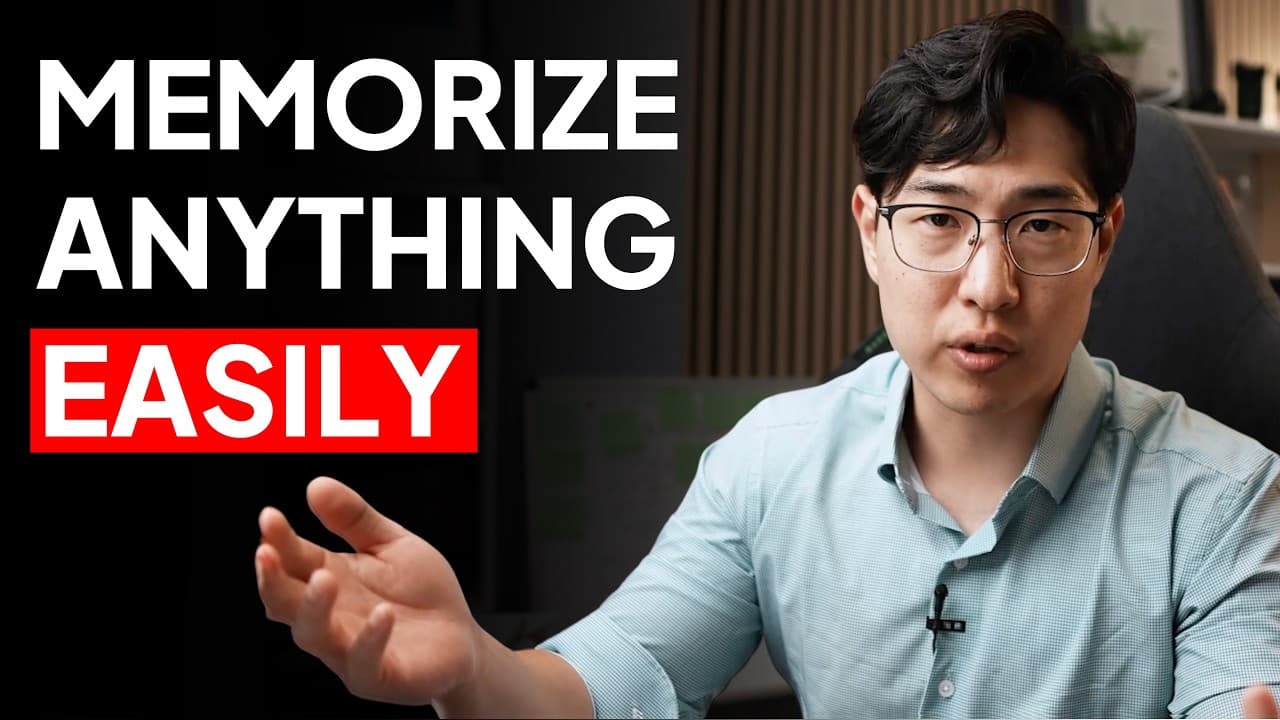
If you think you have poor memory, you're probably wrong. The issue is not that you have poor memory, but poor memory handling. And in this video, I'm going to teach you exactly how your memory really works according to neuroscience and six practical evidence-based strategies that you can use to immediately start improving your memory, even if you'... Read More
Key Insights
- Memory difficulty is often a problem of memory handling rather than raw capacity. New information must be processed in a purposeful way so it becomes meaningful enough to enter long-term memory instead of rapidly decaying and being forgotten.
- Raw memory capacity is described as broadly similar across most people. Exceptional performers, including memory champions, achieve unusual feats by using strategies that other people can also learn, practice, and apply rather than relying solely on naturally superior memory.
- Naturally strong rememberers often use effective strategies instinctively. The transcript says it is rare for someone to possess dramatically better natural memory while doing absolutely nothing differently from an average person who struggles to remember.
- Short-term memory generally lasts about 15–30 seconds. Its duration can vary with the complexity of the information and a person's familiarity with it, but it is much shorter than the hours or days often portrayed in popular media.
- Forgetting information after two minutes is presented as long-term memory decay, not short-term memory failure. Effective handling extends retention beyond the first minutes, potentially delaying forgetting from minutes to days, weeks, or months.
- Working memory functions like a temporary workbench. During the brief period when information remains available, a learner can mold, organize, and interpret it so that it makes sense and has a better chance of reaching long-term memory.
- Passive repetition creates little transformation of information. Reading material repeatedly, rewriting it several times, or simply intending to understand requires less active processing than reorganizing, explaining, connecting, or applying the ideas.
- Complex processing can strengthen memory by making information meaningful. Extracting keywords, finding core concepts, simplifying explanations, forming analogies, connecting prior knowledge, evaluating importance, identifying possible problems, and preparing to teach are all suggested techniques.
Install to Summarize YouTube Videos and Get Transcripts
Explore YouTube Video Summarizer or Get YouTube Transcript Extractor
Questions & Answers
Q: How can I improve my memory when learning new information?
Handle new information actively during the first 15–30 seconds after encountering it. Identify keywords and central concepts, restate the idea in simpler language, create an analogy, connect it with something you already know, assess why it matters, consider problems it could solve, or process it as though you must teach it. These transformations give the information meaning and support long-term storage.
Q: What is memory handling?
Memory handling is the deliberate process of doing something useful with new information so it can be stored as memory. Instead of assuming that success depends on having a good or bad memory, the concept focuses on how information is shaped, organized, connected, simplified, or interpreted while it is available in working memory. Effective handling supports retention, while ineffective handling permits rapid decay.
Q: How long does short-term memory last?
Short-term memory generally lasts about 15–30 seconds, although the duration depends partly on how complex the information is and how familiar a person is with it. This means that forgetting something after a couple of minutes is not described as a failure of short-term memory. At that point, the problem is framed as rapid decay from long-term memory.
Q: Why do I forget the beginning of a page while reading?
Forgetting the top of a page by the time you reach the bottom is presented as rapid long-term memory decay, especially when reading takes longer than the usual 15–30-second short-term memory window. Information may disappear because it was not actively transformed into something meaningful. Extracting concepts, simplifying them, connecting them to prior knowledge, or preparing to explain them can improve retention.
Q: Why is short-term memory also called working memory?
Short-term memory is also called working memory because it functions like a temporary workbench. New information remains available briefly, giving a person an opportunity to work with it by organizing, transforming, and interpreting it. What happens during this short window influences whether the material becomes meaningful enough to enter long-term memory or instead decays and is forgotten.
Q: Do memory champions naturally have better memory capacity?
Memory champions are described as using particular strategies to accomplish feats such as memorizing hundreds or thousands of numbers in sequence. Their performance does not necessarily mean they possess fundamentally different raw memory capacity. The transcript argues that other people could develop similar abilities by learning, practicing, and consistently applying the same kinds of memory strategies.
Q: Why does repeating information fail to make it memorable?
Passive repetition involves little transformation of information. Repeatedly reading a passage, writing it several times, or merely intending to understand it does not require the brain to create much additional meaning. More involved processing, such as identifying concepts, simplifying explanations, forming analogies, making connections, or considering applications, engages the learner in a more intricate and purposeful handling process.
Q: What active learning strategies can improve long-term memory?
Active strategies include extracting keywords, identifying the main concepts, explaining an idea with simpler and more intuitive words, creating analogies, connecting new material to existing knowledge, evaluating its importance, and asking what problems it might solve. Reading with the intention of teaching the material to another person is also suggested because it encourages purposeful processing rather than passive exposure.
Summary & Key Takeaways
-
Memory performance depends heavily on how information is handled. Most people have similar raw memory capacity, while memory champions and naturally strong rememberers use effective strategies, either deliberately or instinctively. By learning and practicing comparable methods, people can improve what enters long-term memory instead of treating forgetting as a fixed personal limitation.
-
Short-term memory generally holds information for about 15–30 seconds, depending partly on complexity and familiarity. Forgetting the beginning of a page after two minutes is therefore presented as rapid long-term memory decay, not short-term memory failure. The brief short-term window functions as a workbench for processing information before storage or forgetting.
-
Active, complex processing makes information more meaningful and memorable than passive repetition or merely intending to understand. Useful approaches include extracting keywords, identifying key concepts, simplifying explanations, creating analogies, connecting ideas to existing knowledge, judging relevance, considering possible applications, and reading with the goal of teaching the material to someone else.
Read in Other Languages (beta)
Share This Summary 📚
Summarize YouTube Videos and Get Video Transcripts with 1-Click
Try YouTube Summary with ChatGPT & Claude or YouTube Transcript Generator
Explore More Summaries from Justin Sung 📚

Summarize YouTube Videos and Get Video Transcripts with 1-Click
Try YouTube Summary with ChatGPT & Claude or YouTube Transcript Generator