How to Grow an AI Newsletter to 2M Subscribers
TL;DR
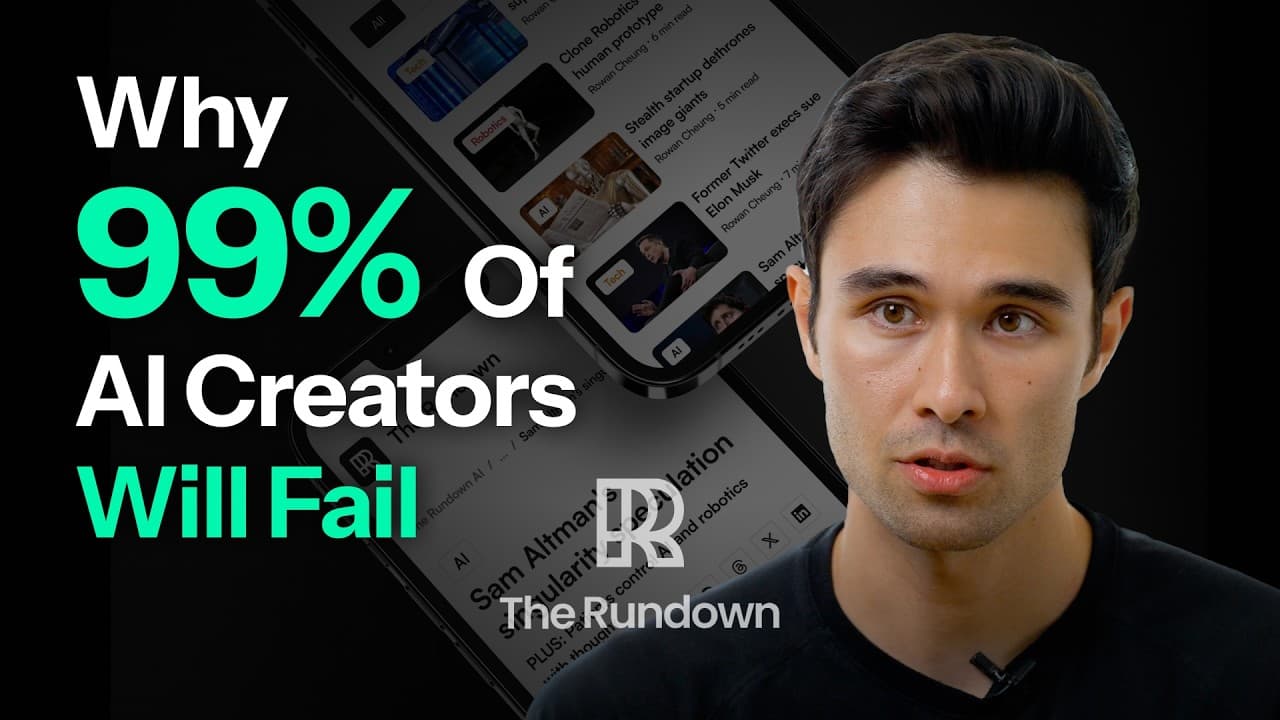
The Rundown AI reached over 2 million subscribers and nearly 50% open rates by becoming the go-to source for no-noise AI news with quick takes on why each update matters to everyday tech workers. The core edge is staying human: real personal takes, faces behind the brand, and AI used only for structuring and research, never the creative human part.
Transcript
When we first started, everyone was afraid of AI replacing everyone. There was a famous quote, "AI won't replace you, but people who use AI will." I realized my audience really wanted the latest AI news. The biggest problem they face see something that goes viral and they say, "I want to try that." And they try it and they're like, "Cool, I tried i... Read More
Key Insights
- The Rundown is described as the largest daily AI newsletter in the world, with nearly 50% open rates across all newsletters and over 2 million subscribers, positioned as the go-to source for no-noise AI news and quick takes.
- The biggest audience problem was noise and lack of stickiness: people saw viral AI tools, tried them once, found no real use, and had no reason to stay subscribed, so Rowan focused on explaining why AI news actually matters.
- Verticalized content creators are an overlooked opportunity: everyone funds verticalized AI SaaS like AI for law or accounting, but few talk about verticalized creators, so specializing in a niche like AI news is advised.
- Rowan is a college dropout who self-taught coding, design, and writing through YouTube and by posting on Twitter, then went all in after his first ChatGPT thread went viral a day or two after ChatGPT launched publicly.
- Staying human is the differentiating strategy: while many AI newsletter competitors used AI to write content, The Rundown put faces behind the newsletter, kept takes clearly human, and used AI only for structuring and some research.
- Content will split into Walmart and Whole Foods: mass AI-generated content that is accessible, addictive, and personalized, versus the human 1% who keep humanity and personal takes, earning more trust, bigger brands, and wider reach.
- A talking-to-writing workflow lets non-writers start: ramble raw ideas into an AI transcription tool like Whisper Flow on a walk, then feed those human thoughts into a Claude project trained on your best posts to get a 90% ready draft.
- Rowan clones his face and voice with AI for short-form video using his real writing as script, plus editing and B-roll, growing an Instagram account to over 160,000 followers in a year despite working 80 hours a week.
Install to Summarize YouTube Videos and Get Transcripts
Explore YouTube Video Summarizer or Get YouTube Transcript Extractor
Questions & Answers
Q: How did The Rundown AI grow to 2 million subscribers?
The Rundown grew by becoming the go-to source for no-noise AI news and quick takes on why updates actually matter to the average everyday tech worker. Rowan solved the biggest audience problem, which was overwhelming noise and viral tools people tried once but found no lasting use for. He started on Twitter after a viral ChatGPT thread, then built an email list, kept content clearly human, and reached over 2 million subscribers with nearly 50% open rates.
Q: Why does The Rundown avoid using AI to write its content?
Many AI newsletter competitors used AI to write their content, but The Rundown deliberately did the opposite, putting faces behind the newsletter and keeping takes clearly human. Rowan says AI-generated content has no soul and people are smart enough to know when something is AI-generated. They use AI for structuring and some parts of research but never for the human creative part, because the human loop for creativity will always remain until brain chips arrive, which he expects is many years away.
Q: What is the Walmart and Whole Foods theory of content?
Rowan predicts content will split into two sides. The Walmart side is AI-generated content that is easily accessible, all over social media, funny, personalized, and addictive, and it is still good content. The Whole Foods side is for people who want to know the human behind things, the personal takes, and the person creating it. The human 1% who keep their humanity will have more trust, bigger brands, and wider distribution, while everything in the middle dies.
Q: How can non-writers start creating content using AI?
Rowan shares a workflow for people whose best ideas come from talking rather than writing. Use an AI transcription tool like Whisper Flow, go on a walk, and ramble raw ideas into notes with all the ums and uhs. These transcribed raw thoughts are your human ideas and insights, not AI-generated ones. Then feed them into a Claude project trained on over 20 of your best-performing posts, which spits out a draft that is about 90% ready and matches your writing style.
Q: How does Rowan create short-form videos without being on camera?
About a year ago Rowan's audience pushed him to do video, but as a founder and content creator working 80 hours a week he lacked time. So the team clones his face and voice with AI, using his real writing and real takes as the script. They add storytelling, research, B-roll, and editing to build compelling stories for Reels and Shorts. This AI avatar workflow grew his Instagram account to over 160,000 followers in a year.
Q: What platform should beginners start on for AI content creation?
Rowan advises beginners to first ask whether they enjoy talking or writing. He was the writing archetype, so he started with Twitter, which he considers a good spot for AI content. Research breakthroughs, demo videos, and papers often get published only on Twitter and nowhere else, so you have to be very active there to keep up with what is happening if you want to get deep in the weeds on AI developments.
Q: How does Rowan use Claude to write ad copy?
Rowan's team takes their best-performing ad copies and trains a Claude project on them. When they need to create new ad copies for some of their partners, they run the request through that trained project and ask what would make the best ad copy. Claude gives them a good draft, and then they still fully revise off that draft. This mirrors his broader approach of AI-assisted writing that stems from human ideas rather than fully AI-generated output.
Q: How can someone start learning to use AI in daily work?
Rowan says AI is taught through habits, and offers three ways to learn, where doing just one makes you a major early adopter. The first is to ask yourself every day, while doing a task at work, could AI do this. If you do not know, you can literally ask ChatGPT, could AI do this task, as a simple prompt. A pro tip is to write it on a sticky note on your laptop screen so you constantly ask yourself during tedious work.
Summary & Key Takeaways
-
Rowan Cheung, a college dropout, built The Rundown into the world's largest daily AI newsletter with over 2 million subscribers and nearly 50% open rates. He became the go-to person for no-noise AI news and quick takes on why updates matter to everyday tech workers, solving the audience problem of overwhelming noise and tools that lacked real stickiness or use.
-
His defining strategy is being as human as possible. While competitors used AI to write entire newsletters, The Rundown put faces behind the brand and kept takes clearly human, using AI only for structuring and research. He argues AI content has no soul, people can tell, and the human creative loop will remain until brain chips arrive many years away.
-
For creators, he recommends picking writing or talking, then starting on Twitter for AI since research and papers appear there first. Non-writers can ramble ideas into a transcription tool, then feed them into a Claude project trained on their best posts. He also clones his face and voice for video and teaches AI through the daily habit of asking, could AI do this.
Read in Other Languages (beta)
Share This Summary 📚
Summarize YouTube Videos and Get Video Transcripts with 1-Click
Try YouTube Summary with ChatGPT & Claude or YouTube Transcript Generator
Explore More Summaries from EO 📚
Summarize YouTube Videos and Get Video Transcripts with 1-Click
Try YouTube Summary with ChatGPT & Claude or YouTube Transcript Generator