What Is the 5% Rule in Renting vs. Buying a Home?
TL;DR
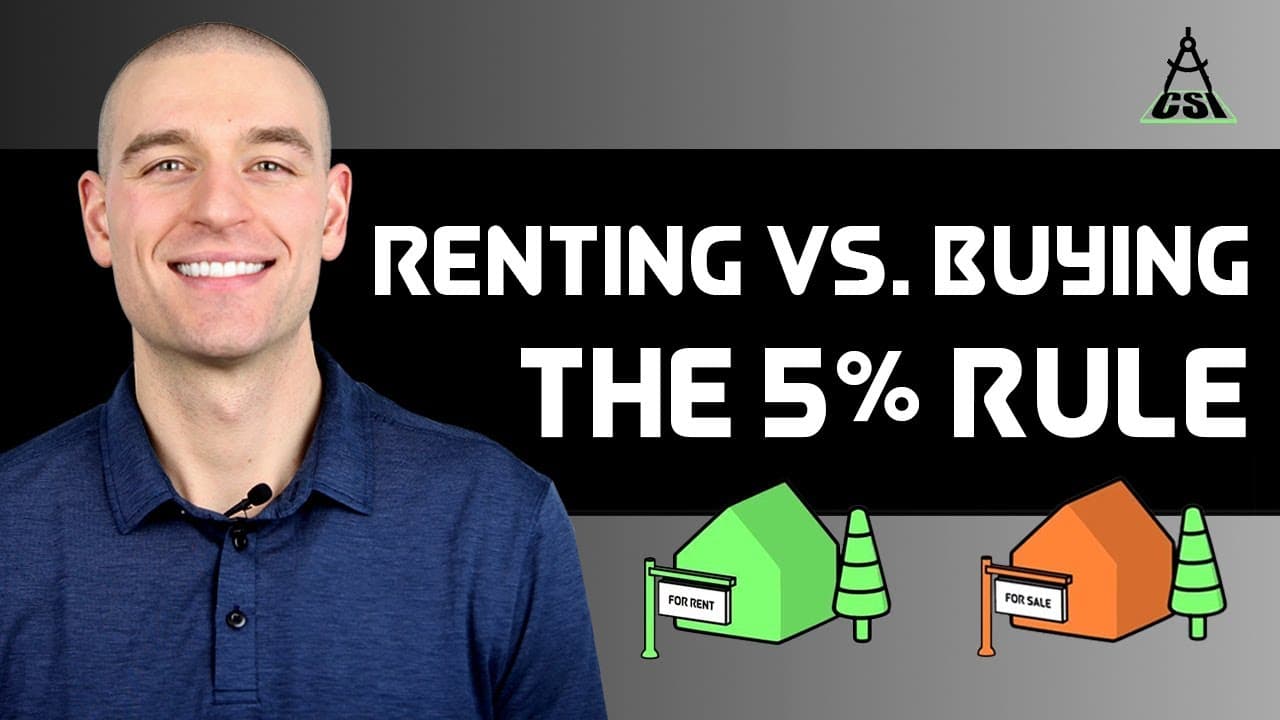
The 5% rule helps assess the financial decision between renting and buying a home by estimating total unrecoverable costs. To apply it, multiply the home's value by 5% and divide by 12; if rent is lower than this amount, renting is financially wiser. Key costs include property taxes, maintenance, and opportunity costs of capital.
Transcript
- I have talked about the decision around renting versus buying a home before. But in this video I wanted to take a bit of a different angle. The common perception is that if you can purchase a home with a mortgage payment that is equal to or less than what you would otherwise pay in rent then buying is a good decision. This way of thinking about t... Read More
Key Insights
- 👪 Comparing mortgage payment to rent is not an accurate way to assess the rent vs. buy decision because it doesn't consider the total unrecoverable costs of owning.
- 🙃 The 5% rule provides a simple calculation to estimate the total unrecoverable costs of owning a home.
- 🙁 Factors like tax rates and portfolio asset mix can affect the 5% rule and potentially reduce the total unrecoverable cost of owning.
- 🇨🇷 The cost of equity capital, including the opportunity cost of not investing in stocks, is an important factor to consider in the rent vs. buy decision.
- 📏 The 5% rule can be a useful tool for aggressive investors and those who haven't maxed out their registered accounts.
- 😘 For more conservative investors and taxable investors, a lower percentage may be used in the 5% rule.
Install to Summarize YouTube Videos and Get Transcripts
Explore YouTube Video Summarizer or Get YouTube Transcript Extractor
Questions & Answers
Q: Why is comparing mortgage payment to rent not a meaningful comparison?
Comparing mortgage payment to rent doesn't consider additional costs of owning, such as property taxes, maintenance costs, and the cost of capital, which are unrecoverable costs for homeowners.
Q: What is the 5% rule used for?
The 5% rule estimates the total unrecoverable costs of owning a home by multiplying the home value by 5% and dividing by 12. If the rent is lower than this estimate, renting is financially more sensible.
Q: What factors can affect the 5% rule?
Tax rates and portfolio asset mix can affect the 5% rule. For example, if investments are taxed, the after-tax return might be lower, reducing the cost of equity capital and potentially decreasing the total unrecoverable cost of owning.
Q: How does the 5% rule help in the rent vs. buy decision?
The 5% rule provides a simplified way to compare the financial aspects of renting and owning a home. If the rent is less than the estimated total unrecoverable costs of owning, it may be more financially sensible to rent.
Summary & Key Takeaways
-
Comparing mortgage payment to rent is not a meaningful comparison because it doesn't account for total unrecoverable costs of owning a home, such as property taxes, maintenance costs, and the cost of capital.
-
The 5% rule suggests estimating the total unrecoverable costs of owning a home by multiplying the home value by 5% and dividing by 12. If the rent is lower than this estimate, renting is financially more sensible.
-
Factors like tax rates and portfolio asset mix can affect the 5% rule, potentially reducing the total unrecoverable cost of owning a home.
Read in Other Languages (beta)
Share This Summary 📚
Summarize YouTube Videos and Get Video Transcripts with 1-Click
Try YouTube Summary with ChatGPT & Claude or YouTube Transcript Generator
Explore More Summaries from Ben Felix 📚





Summarize YouTube Videos and Get Video Transcripts with 1-Click
Try YouTube Summary with ChatGPT & Claude or YouTube Transcript Generator