How to Learn Python Programming for Beginners in Hindi
TL;DR
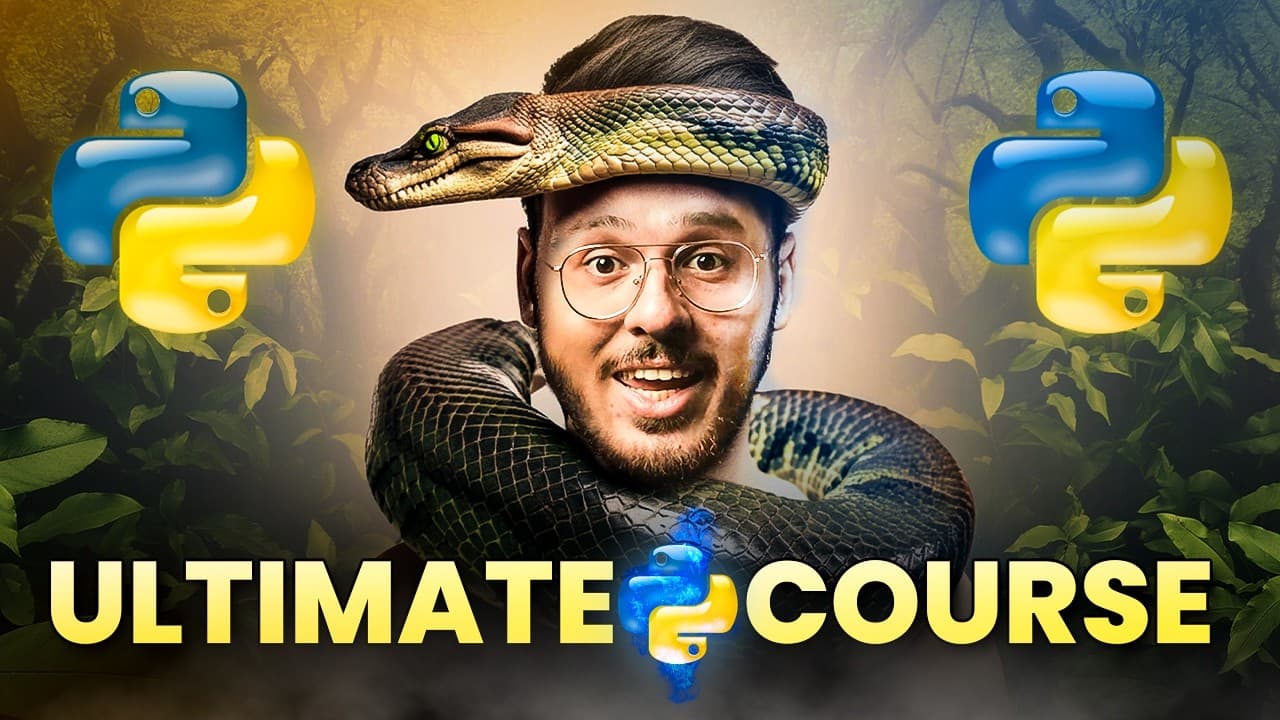
To learn Python programming as a beginner, follow a structured course that covers fundamental concepts like variables, data types, and functions using hands-on projects. This course is designed to facilitate job readiness by focusing on practical applications and industry-relevant skills, ensuring that even those with no prior experience can succeed.
Transcript
This is Sallu Bhai's son, Ballu. Ballu didn't get a break in Bollywood. That's why he learned Python from the internet in 2 days. He thought that by learning Python in 2 days, he'll get a 90 LPA job. He didn't get a 90 LPA job. All he got was frustration. Why do I get an error every time? I don't want to do the recording. Harry, you? What happened?... Read More
Key Insights
- 👻 Functions are core to Python’s modular programming, allowing code reuse and organization.
- 🤭 OOP concepts such as encapsulation and inheritance enhance code structure and maintainability.
- 😚 Python's rich ecosystem of built-in functions and libraries (like
math,os,random) facilitates complex operations with minimal code. - 🍵 Exception handling with "try" and "except" improves program robustness by handling errors gracefully.
- ❓ Decorators and static methods offer advanced capabilities to manage function behavior and attributes dynamically.
- ✍️ File operations, including reading and writing, are essential for data persistence in Python applications.
- ❓ Comprehensions provide concise and readable syntax for creating complex data structures easily.
Install to Summarize YouTube Videos and Get Transcripts
Explore YouTube Video Summarizer or Get YouTube Transcript Extractor
Questions & Answers
Q: What is a function in Python?
A function in Python is a reusable block of code that performs a specific task. It is defined using the "def" keyword followed by the function name and parameters, if any. Functions can return values and are used to organize code effectively.
Q: How does inheritance work in Python?
Inheritance in Python allows a class (child or derived class) to inherit attributes and methods from another class (parent class). This promotes code reuse and helps create a hierarchical relationship between classes, enabling flexibility and easier maintenance of code.
Q: What is the difference between a class method and a static method?
A class method receives the class as its first argument (typically named "cls") and can modify class state that applies across all instances. A static method does not receive an implicit first argument and cannot modify class or instance state; it behaves like a regular function but belongs to the class's namespace.
Q: What does the "with" statement do in file handling?
The "with" statement in Python simplifies file handling by ensuring that files are properly closed after their suite finishes, even if an error is raised. It reduces the risk of conflicting file access and resource leaks, making the code cleaner and safer.
Q: How can I check if a key exists in a dictionary?
You can check if a key exists in a dictionary using the "in" keyword. For example, if you have a dictionary my_dict, you can check with if 'my_key' in my_dict:. This returns True if the key exists, and False otherwise.
Q: What is the purpose of the "try" and "except" blocks in Python?
The "try" and "except" blocks are used for handling exceptions in Python. Code that might raise an exception is placed in the "try" block, and the "except" block contains code that executes if an exception occurs, allowing the program to continue running gracefully.
Summary & Key Takeaways
-
This guide covers foundational Python concepts like functions, OOP principles, and data structures such as lists and dictionaries through detailed examples.
-
Key topics include creating and manipulating classes, methods, and attributes while exploring advanced features like decorators, recursion, and virtual environments.
-
Real-world projects, including a simple game and a utility for string processing, provide practical applications for the discussed concepts.
Read in Other Languages (beta)
Share This Summary 📚
Summarize YouTube Videos and Get Video Transcripts with 1-Click
Try YouTube Summary with ChatGPT & Claude or YouTube Transcript Generator
Explore More Summaries from CodeWithHarry 📚

Summarize YouTube Videos and Get Video Transcripts with 1-Click
Try YouTube Summary with ChatGPT & Claude or YouTube Transcript Generator