How Stephen Fry Faced Mental Illness and Success
TL;DR
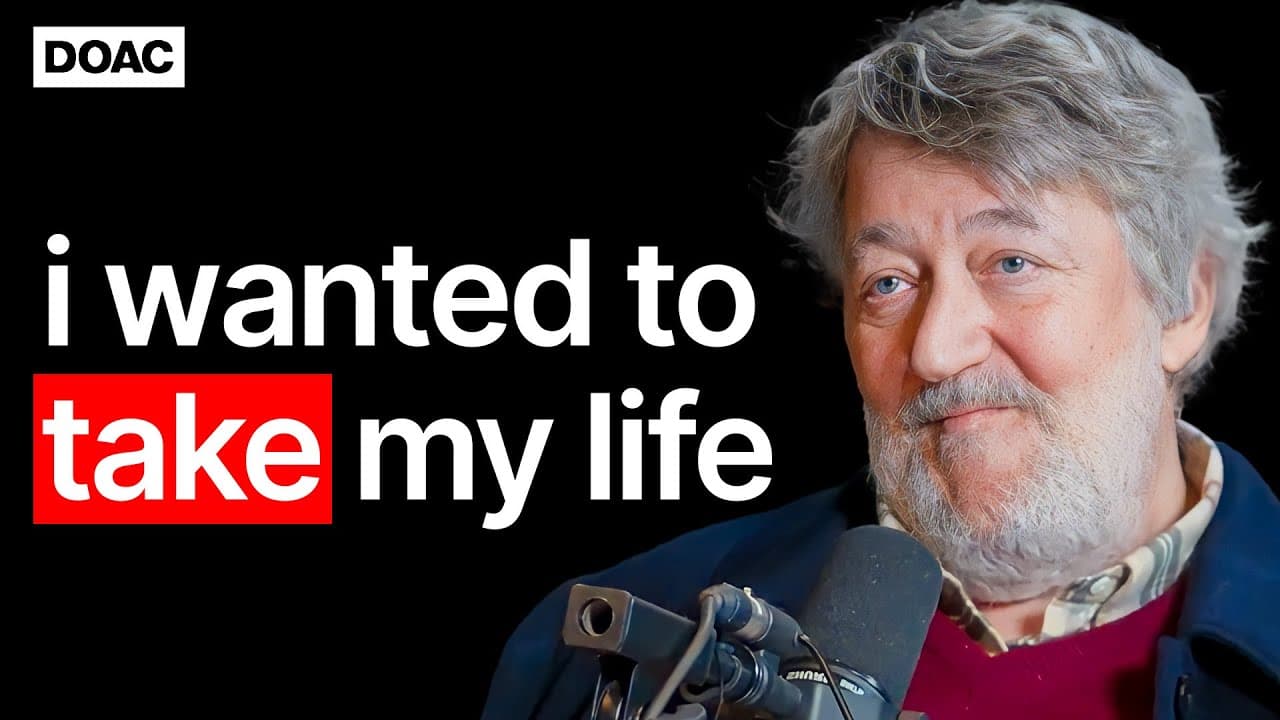
Stephen Fry says his journey toward understanding his mental health began after he felt lost, considered taking his life, and disappeared while leaving letters for friends. He connects his later struggles and success to a childhood marked by intellectual ability, social isolation, disruptive behavior, expulsion, imprisonment, love of language, and the life-changing opportunity to attend Cambridge.
Transcript
I was lost and adrift. And really what I first wanted to do was to take my life. Stephen Fry. He's a comedian, an actor, and a national treasure. He's a director, he's a writer. I, I, well, I've probably missed things out. A master of language. And tonight's my night. I was a deeply difficult child. My parents took me to a psychiatrist when I was 1... Read More
Key Insights
- Stephen Fry's childhood combined exceptional verbal ability with serious difficulties involving attention, stillness, social belonging, and physical coordination. He believes that, in later years, his behavior might have been diagnosed as attention deficit hyperactivity disorder, although no such childhood diagnosis is stated.
- Boarding school was normal within Fry's childhood environment because his father, mother, brother, and other children he knew had comparable experiences. He argues that children initially accept repeated circumstances as normal because they lack alternative experiences against which to compare them.
- Language was Fry's principal childhood strength and refuge. Because he could understand, remember, and pass exams without much revision, he had substantial spare time, which he filled through reading, wordplay, storytelling, and humor intended partly to reduce his social unpopularity.
- Fry's experience of falling in love with another boy at 13 destabilized his already fragile relationship with school. He understood the attraction as socially unacceptable, stopped successfully pretending to be a conventional, well-behaved pupil, climbed school buildings, and was expelled repeatedly.
- Fry's criminal behavior culminated when he stole a coat, found credit cards in its wallet, and used them to travel, shop, and stay in grand hotels around Britain. Police eventually arrested him in a Swindon hotel, and he was held on remand at 17.
- Cambridge represented a decisive redirection after Fry's disastrous childhood, expulsions, theft, and imprisonment. He says that concentrating on gaining admission changed everything, marking a transition from destructive outsider behavior toward the acting and creative career discussed throughout the interview.
- Fry's desire to please other people makes criticism emotionally consequential. At 37, harsh reviews of a play contributed to a period when he felt lost and adrift, wanted to take his life, disappeared, and left letters for friends.
- Mental-health struggles continued despite Fry's extensive work as a writer, actor, director, and comedian. The interview states that he experienced depressive lows, manic depression, and three suicide attempts, with the third attempt occurring when he was 55.
Install to Summarize YouTube Videos and Get Transcripts
Explore YouTube Video Summarizer or Get YouTube Transcript Extractor
Questions & Answers
Q: How did Stephen Fry describe his childhood difficulties?
Stephen Fry describes himself as a disruptive and deeply difficult child who struggled to remain still, focus, coordinate his body, and fit in with other children. Although he was quick with language, speech, observation, and memory, he felt inadequate at sports, music, and drawing. He believes his childhood behavior might have received an attention deficit hyperactivity disorder diagnosis in later years.
Q: Why did Stephen Fry feel like an outsider at school?
Stephen Fry felt like an outsider because his strongest abilities were not the qualities most valued among the children around him. He could use language well and pass exams easily, but he could not catch a ball, disliked physical activity, and felt physically uncoordinated. Falling in love with another boy at 13, while believing that attraction was unacceptable, intensified his isolation and rebellious behavior.
Q: How did boarding school shape Stephen Fry's early life?
Stephen Fry was sent to boarding school at seven, roughly 200 miles from his family home, and remained in that system through his preparatory-school years. He did not initially regard the arrangement as unusual because his relatives and the other children he knew also boarded. The experience placed him in a restrictive social environment where he became disruptive and used reading, language, stories, and humor as outlets.
Q: Why was Stephen Fry expelled from school?
Stephen Fry says his behavior deteriorated after he fell in love with another boy at 13 and felt unprepared for the emotional upheaval. He stopped being able to act like a conventional, well-behaved schoolboy and began doing unusual things, including climbing the roofs of chapels, churches, classrooms, and other buildings. That conduct led to one expulsion, followed by expulsions or departures from additional schools.
Q: How did Stephen Fry get arrested for credit card fraud?
At 17, Stephen Fry stole a coat from a pub and discovered that it contained a wallet and two credit cards. He used the cards around Britain for hotels, purchases, and travel, taking advantage of a payment system that relied on carbon imprints rather than magnetic strips. Police eventually confronted him in a Swindon hotel room, after which he was held on remand in a young-person's institution.
Q: How did Cambridge change Stephen Fry's life?
After what he calls a disastrous childhood involving disruptive conduct, repeated school trouble, theft, arrest, and imprisonment, Stephen Fry decided to concentrate on getting into Cambridge. He says that decision changed everything. The interview presents Cambridge as a turning point that redirected his intellectual and verbal abilities toward acting and the creative work that later defined his career as a writer, actor, director, and comedian.
Q: What triggered Stephen Fry's mental-health crisis at 37?
At 37, Stephen Fry starred in a play that received harsh reviews. He says he became lost and adrift, and his first desire was to take his own life. He then disappeared on a Monday and left several letters for friends. Fry identifies that crisis as the event that began his journey into understanding and addressing his mental health, rather than as a struggle erased by professional achievement.
Q: What does Stephen Fry's story show about success and depression?
Stephen Fry's account shows that extensive professional achievement can coexist with severe mental-health struggles. Although he became a successful writer, actor, director, and comedian, criticism could still affect his strong need to please others. The interview discusses manic depression, depressive lows, suicidal thinking, and three suicide attempts, including a third attempt at 55, alongside questions about creativity, happiness, social media, and a good life.
Summary & Key Takeaways
-
Stephen Fry describes himself as an intellectually advanced but deeply difficult child who struggled to focus, remain still, coordinate physically, and fit in socially. Sent to boarding school at seven, he relied on language, stories, and humor while feeling unsuccessful at many activities valued by other children, especially sports, music, and drawing.
-
At 13, Fry fell in love with another boy and believed those feelings were socially unacceptable. His behavior became increasingly disruptive, leading to several expulsions. At 17, after stealing a coat containing a wallet and credit cards, he traveled around Britain using the cards fraudulently before being arrested and held in a young-person's institution.
-
Fry later concentrated on reaching Cambridge, an opportunity he says changed everything. Yet professional success did not remove his vulnerability to criticism or depression. At 37, harsh reviews of a play preceded a crisis in which he felt lost, wanted to die, disappeared, and left letters. He identifies this experience as the beginning of his mental-health journey.
Read in Other Languages (beta)
Share This Summary 📚
Summarize YouTube Videos and Get Video Transcripts with 1-Click
Try YouTube Summary with ChatGPT & Claude or YouTube Transcript Generator
Explore More Summaries from The Diary Of A CEO 📚






Summarize YouTube Videos and Get Video Transcripts with 1-Click
Try YouTube Summary with ChatGPT & Claude or YouTube Transcript Generator