What Happens When Ammonium Chloride Is Heated or Dissolved in Water? | Periodic Table of Videos
TL;DR
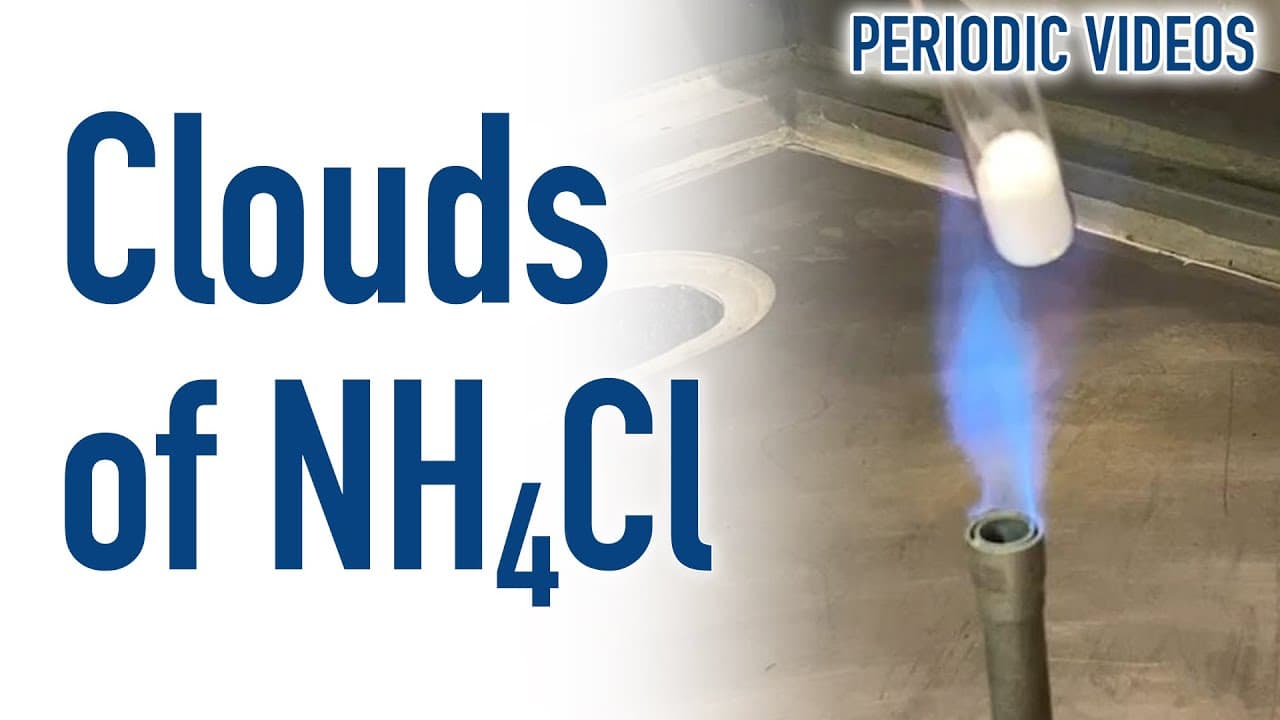
Ammonium chloride separates into ammonia and hydrogen chloride gases when heated, reforms as solid crystals on a colder surface, and cools water when dissolving because breaking apart its ionic crystal requires more energy than hydration returns. The demonstration also creates dramatic white smoke by mixing ammonia and hydrogen chloride gases. Read on for the mechanisms behind all three effects and the warning attached to JBS Haldane's dangerous self-experiment.
Transcript
today's video is about ammonium chloride sounds not very exciting but there are some wonderful clouds of white smoke and quite a surprising effect when you put the compound in water let's begin with ammonium chloride and what happens when you heat it most things when you heat them either melt or occasionally decompose but ammonium chloride is unusu... Read More
Key Insights
- Apparent sublimation has two steps: Heating does not merely transport unchanged ammonium chloride molecules from one place to another. The ionic solid becomes ammonia and hydrogen chloride gases in the hot region. After those gases reach a colder section of the test tube, they react with each other again and produce the original solid crystals.
- Crystal movement reveals temperature differences: The test tube makes the process visible through location. Ammonium chloride leaves the hotter portion, while white crystals accumulate farther up on the colder surface. The presenter compares this disappearance and reconstruction to a Star Trek teleporter because the solid seems to move and reform while retaining its original identity.
- The formula explains the products: Ammonium chloride is presented as NH4 positive paired with Cl negative. Heating produces ammonia, NH3, and hydrogen chloride, HCl. This relationship connects the initial ionic crystal, the two gases moving through the tube, and the reconstructed solid found on the cooler glass.
- Dissolution pulls heat from water: Ammonium chloride becomes colder when placed in water because energy is needed to break up its crystal. That required energy comes from the water, so the measured temperature falls. The experiment contrasts this behavior with salts that release enough heat during dissolution to make water extremely hot or even cause it to boil.
- The solution drops below zero: The measured temperature goes below zero degrees Celsius, the stated freezing point of water. The liquid still does not freeze because a large amount of ammonium chloride has dissolved in it by then. The observation combines substantial cooling with the separate effect of the dissolved material on whether the resulting solution freezes.
- Hydration repays only part: Breaking the attraction between positive and negative ions consumes energy. Interactions between water molecules and the dissolved ions return some energy after separation, but the recovered amount is smaller than the amount needed to dismantle the crystal. That unfavorable balance accounts for the net withdrawal of energy from the water and its falling temperature.
- Entropy enables continued dissolving: The cooling energy balance does not prevent ammonium chloride from dissolving. The presenter attributes this to entropy, contrasting a highly ordered crystal with ions dispersed in a disordered solution. The change toward disorder helps the process proceed even though separating the crystal costs more energy than ion-water interactions give back.
- Nitrogen transports both reactants: The smoke apparatus does not mix the original aqueous solutions directly. Ammonia and HCl are each dissolved in water, and nitrogen gas is introduced into both liquids. The nitrogen carries the two substances out of separate flasks, through opposing nozzles, and into the gas phase where their streams can meet.
- Tiny crystals create white smoke: When gaseous ammonia meets gaseous hydrogen chloride, ammonium chloride forms as crystals small enough to remain visibly suspended. The cloud therefore consists of tiny solid particles rather than the starting solutions. Their size and movement make the newly formed solid appear as billowing white smoke rising toward the fume hood.
- Airflow strengthens the demonstration: Neil allows the fumes to enter the hood before switching on its fan. Once the hood is filling, activating the fan makes the suspended ammonium chloride crystals swirl, improving their visibility. This staging highlights the physical movement of the cloud while the underlying chemistry remains the straightforward combination of ammonia and hydrogen chloride.
- Simple chemistry can look dramatic: The presenter values this experiment precisely because an uncomplicated reaction creates a strong visual result. Two familiar reactant gases meet and immediately generate a conspicuous white cloud of minute crystals. The demonstration supports his point that chemical beauty does not require a complicated series of reactions or elaborate transformations.
- Haldane's experiment is a warning: Physiologist JBS Haldane reportedly injected himself with a large amount of ammonium chloride because he wanted to make his blood acidic. The presenters say they are not brave enough to demonstrate it, would not dare repeat it, and call it a mad experiment for anyone else to try. The anecdote is presented as dangerous history, not an experimental instruction.
Install to Summarize YouTube Videos and Get Transcripts
Explore YouTube Video Summarizer or Get YouTube Transcript Extractor
Questions & Answers
Q: What happens when ammonium chloride is heated?
Heating ammonium chloride causes it to form ammonia, NH3, and hydrogen chloride, HCl, in the gas phase. The gases rise from the hot part of the test tube toward a colder section. There they react again and reform solid ammonium chloride. This is why white crystals appear to travel up the test tube and condense on the cooler glass.
Q: Why does ammonium chloride cool water when it dissolves?
Pulling apart the positive and negative ions in the ammonium chloride crystal requires energy. That energy is taken from the surrounding water, causing its temperature to fall. Water molecules return some energy when they interact with the separated ions, but they return less than crystal breakup consumed. The resulting energy deficit makes dissolution a cooling process.
Q: Why does the ammonium chloride solution remain liquid below zero degrees Celsius?
The experiment records a temperature below zero degrees Celsius, which is identified as the freezing point of water. By that stage, however, the water contains a large amount of dissolved ammonium chloride. The presenter explains that the resulting solution would not freeze at that temperature. Therefore, reaching a reading below zero does not mean the concentrated solution must become solid.
Q: Why does ammonium chloride dissolve if the process requires energy?
The presenter explains the continued dissolution in terms of entropy. Before dissolving, the ions occupy a very ordered crystal. Afterward, they are dispersed in a more disordered solution. This increase in disorder allows the process to take place even though ion separation requires more energy than interactions with water molecules return.
Q: How is ammonium chloride white smoke made in the demonstration?
Ammonia and hydrogen chloride are first held separately as substances dissolved in water. Nitrogen gas is introduced into both liquids to carry ammonia and HCl out of their flasks. Two nozzles aim the resulting gas streams toward each other. Where the gases mix, they react and create a visible cloud of tiny ammonium chloride crystals.
Q: What is the white cloud actually made of?
The cloud is made of ammonium chloride crystals produced when ammonia gas and hydrogen chloride gas meet. These crystals are extremely small, so together they look like white smoke. They rise into the fume hood and can swirl when its fan is activated. The visible effect is therefore newly formed solid material suspended in the moving gas.
Q: Why is the fume hood fan turned on after the cloud forms?
Neil initially leaves the fume hood switched off while the fumes emerge from the apparatus. This allows the white ammonium chloride cloud to collect and become easy to see. Once the hood begins filling, he turns on the fan. The airflow makes the tiny suspended crystals swirl, which displays the dramatic effect more clearly.
Q: What did JBS Haldane do with ammonium chloride?
The presenter says that physiologist JBS Haldane injected himself with a large amount of ammonium chloride. His purpose was to make his blood acidic, although the presenter cannot remember why he wanted to do so. The presenters refuse to repeat the experiment because of its danger. They explicitly describe it as a mad experiment that nobody else should try.
Summary & Key Takeaways
-
Heating ammonium chloride crystals: Most substances melt or sometimes decompose when heated, but ammonium chloride shows an unusual process described as sublimation. In a heated test tube, white crystals disappear from the hot region, travel upward, and collect again on the colder part. The compound, written as NH4 positive and Cl negative, becomes ammonia, NH3, and hydrogen chloride, HCl. Those gases move away from the heat and react again, rebuilding ammonium chloride as a solid.
-
Cooling water during dissolution: Adding ammonium chloride to water produces a striking temperature decrease rather than the heating seen when some salts dissolve. The temperature in the experiment falls below zero degrees Celsius. The concentrated solution does not freeze at that temperature because it already contains so much ammonium chloride. The cooling occurs because separating the positive and negative ions in the crystal takes energy from the surrounding water, making the water colder as dissolution proceeds.
-
Balancing energy and disorder: Water molecules interacting with the separated ions return some of the energy used to pull the crystal apart, but not enough to match the energy required. The overall dissolution process therefore takes energy from the water and lowers its temperature. Nevertheless, the salt still dissolves because of entropy. An ordered ammonium chloride crystal becomes disordered ions distributed through the solution, so the increase in disorder helps the process occur despite its cooling effect.
-
Making clouds from gases: Neil directs ammonia and hydrogen chloride toward each other through two opposing nozzles. Both gases begin dissolved in separate containers of water. Nitrogen is introduced into the liquids to carry ammonia and HCl out of their flasks and into the gas phase. When the two gas streams meet, they form extremely small ammonium chloride crystals. The suspended crystals look like dense white smoke and rise into the fume hood.
-
Showing drama and danger: The fume hood initially remains off so the ammonium chloride fumes can become visible, then its fan is switched on to make the white material swirl. The presenter emphasizes that a simple reaction can create a beautiful, dramatic effect. He then recounts physiologist JBS Haldane injecting himself with a large amount of ammonium chloride to make his blood acidic. Neither presenter would repeat it, and the experiment is explicitly described as mad and unsafe for anyone else to try.
Read in Other Languages (beta)
Share This Summary 📚
Summarize YouTube Videos and Get Video Transcripts with 1-Click
Try YouTube Summary with ChatGPT & Claude or YouTube Transcript Generator
Explore More Summaries from Periodic Videos 📚
Summarize YouTube Videos and Get Video Transcripts with 1-Click
Try YouTube Summary with ChatGPT & Claude or YouTube Transcript Generator