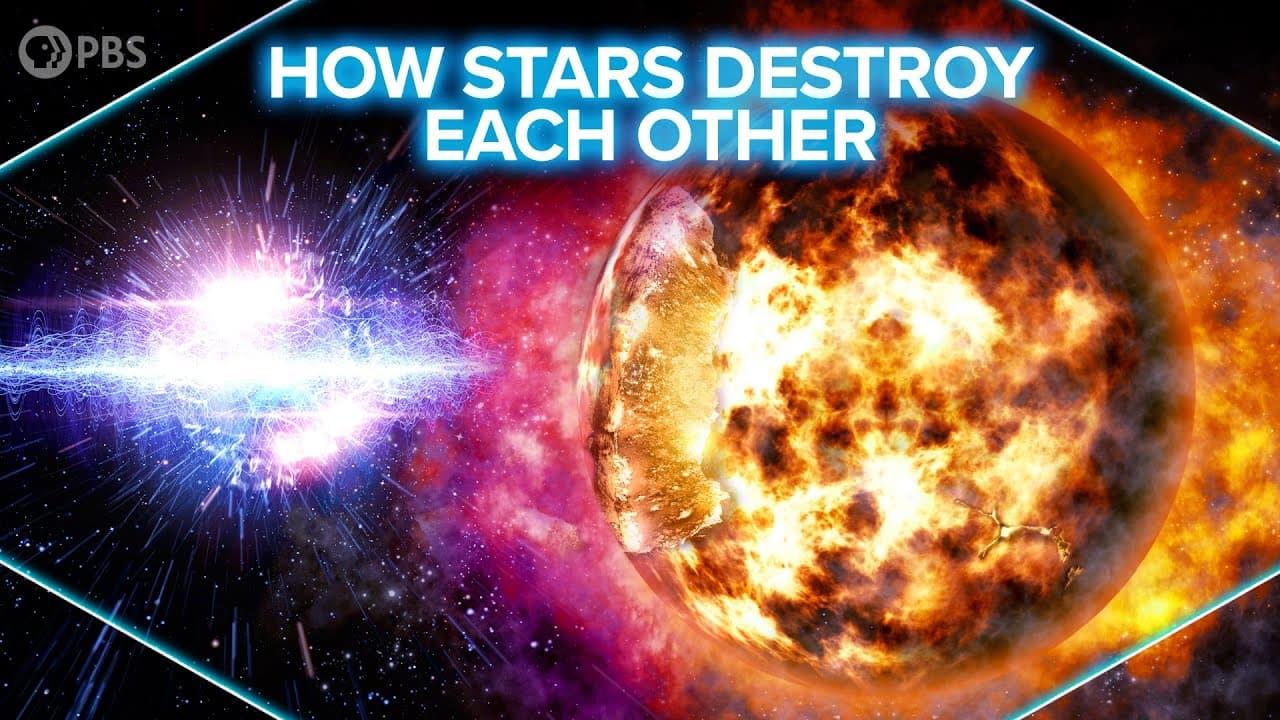
How Stars Destroy Each Other
TL;DR
Exploration of destructive binary star relationships and their cosmic consequences.
Transcript
Want all juicy celebrity gossip? Forget TMZ - Here on Space Time we have all the latest details on the dysfunctional, explosive relationships between the stars. Let me tell you a tale of a pair of star-crossed … well, stars. When our galaxy was a little younger there were two ordinary stars - perhaps not unlike our sun, and they danced together in ... Read More
Key Insights
- Binary star systems are common in our galaxy, with over half of all stars existing in such orbits, leading to complex interactions.
- White dwarfs in binary systems can create novae when they siphon material from a companion star, leading to explosive fusion reactions.
- X-ray binaries, involving neutron stars or black holes, are formed when these dense objects pull gas from a companion, creating intense X-ray emissions.
- Cataclysmic variables are binary systems where a white dwarf accrues hydrogen from a companion, leading to periodic novae.
- The 1437 nova was traced back to a specific white dwarf binary system, illustrating the cyclical nature of such stellar phenomena.
- Black widow systems involve a pulsar eroding a companion star, creating a unique class of binary systems with distinctive light emissions.
- Primordial black holes, formed in the early universe, are a potential explanation for some unusual gravitational wave detections.
- Theoretical understanding of black holes and neutron stars is evolving, with quantum gravity potentially altering current models of singularity formation.
Install to Summarize YouTube Videos and Get Transcripts
Explore YouTube Video Summarizer or Get YouTube Transcript Extractor
Questions & Answers
Q: What causes a nova in a binary star system?
A nova occurs in a binary star system when a white dwarf accretes hydrogen from its companion star. As this hydrogen accumulates on the white dwarf's surface, it reaches a critical temperature and pressure, triggering a runaway fusion reaction that results in a sudden and dramatic increase in brightness.
Q: How do X-ray binaries differ from cataclysmic variables?
X-ray binaries involve a neutron star or black hole pulling gas from a companion star, creating an accretion disk that emits intense X-rays. In contrast, cataclysmic variables involve a white dwarf accreting material from a companion, leading to less energetic novae. The presence of a neutron star or black hole in X-ray binaries results in more extreme gravitational interactions.
Q: What is the significance of the 1437 nova in astronomical history?
The 1437 nova, observed by Korean astronomers, was a significant historical event that provided early evidence of binary star interactions. Modern astrophysics has traced this nova to a specific white dwarf binary system, illustrating the cyclical nature of such phenomena and enhancing our understanding of stellar evolution and binary dynamics.
Q: What are black widow systems in astronomy?
Black widow systems are a class of binary systems where a pulsar erodes its companion star, often a brown dwarf, through intense radiation. This process creates unique light emissions, including gamma rays and visible light pulses, and ultimately leads to the companion losing most of its mass, becoming a mere remnant of its former self.
Q: Could primordial black holes explain unusual gravitational wave detections?
Primordial black holes, formed from the dense matter of the early universe, are a potential explanation for certain gravitational wave detections involving objects with masses that don't fit typical stellar remnants. These black holes could have different mass distributions, offering a possible solution to the mystery of some LIGO detections, though their existence remains unconfirmed.
Q: How do gravitational waves provide insight into black hole mergers?
Gravitational waves, generated by the merger of compact objects like black holes, offer insight into the dynamics of these extreme events. The waves are produced as the objects spiral together at high speeds, revealing information about their masses, spins, and the nature of the merging process, including the deformation of event horizons.
Q: What are the challenges in understanding black hole singularities?
Understanding black hole singularities is challenging because general relativity predicts an infinitely dense point, which is physically problematic. Quantum gravity theories, which are not yet fully developed, are expected to provide a more accurate description, potentially avoiding singularities by incorporating quantum effects that alter the behavior of space-time at small scales.
Q: Why can't regular stars generate detectable gravitational waves in mergers?
Regular stars cannot generate detectable gravitational waves in mergers because they are not compact enough. Gravitational waves are produced when massive objects spiral together at very close distances. Regular stars, being much larger and less dense than neutron stars or black holes, would be torn apart before reaching the necessary proximity for significant wave generation.
Summary & Key Takeaways
-
Binary star systems often lead to destructive interactions as one star siphons material from another, resulting in phenomena like novae and X-ray binaries. These interactions are a fundamental aspect of our galaxy's stellar dynamics.
-
The 1437 nova was a significant historical event, now understood as a classic example of a white dwarf binary system undergoing a nova. Modern astrophysics has traced this event back to its origins, revealing the cyclical nature of such systems.
-
Recent gravitational wave detections challenge current astrophysical models, suggesting the existence of primordial black holes or other exotic objects. These findings are reshaping our understanding of black holes and neutron stars.
Read in Other Languages (beta)
Share This Summary 📚
Summarize YouTube Videos and Get Video Transcripts with 1-Click
Try YouTube Summary with ChatGPT & Claude or YouTube Transcript Generator
Explore More Summaries from PBS Space Time 📚
Summarize YouTube Videos and Get Video Transcripts with 1-Click
Try YouTube Summary with ChatGPT & Claude or YouTube Transcript Generator