Dr. Roman Yampolskiy: What Jobs Will Survive AI’s Rise by 2030?
TL;DR
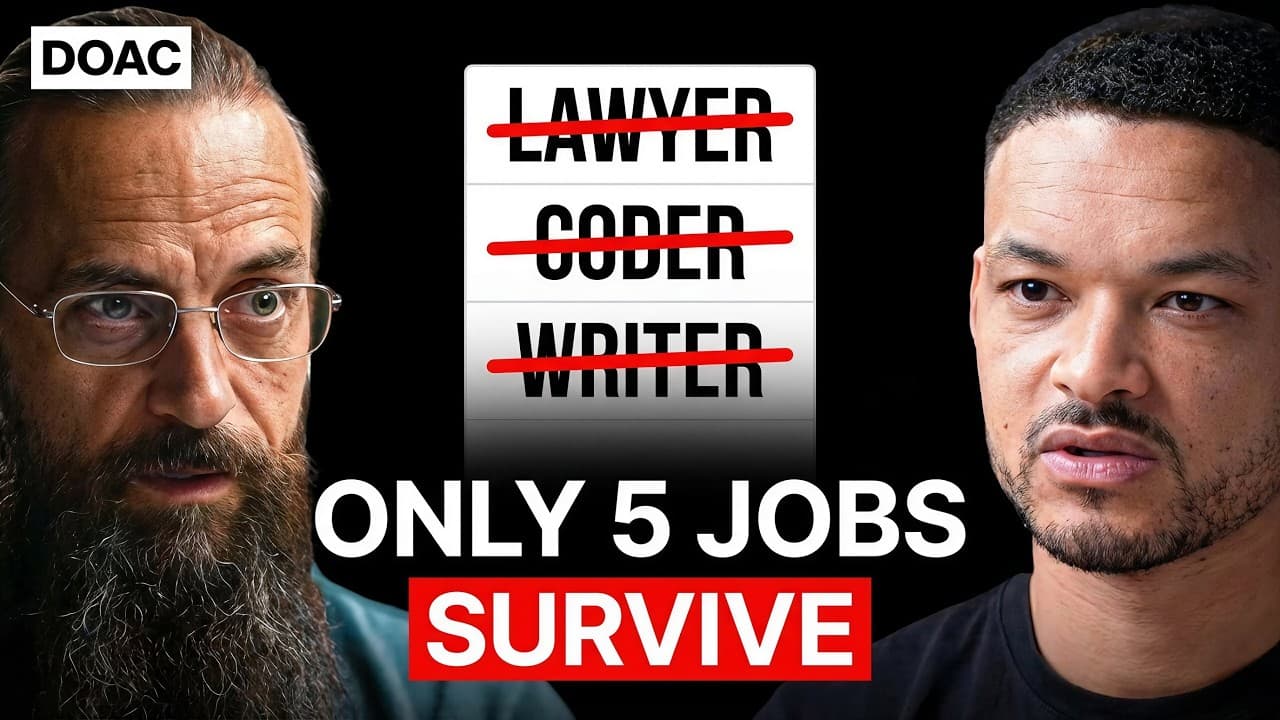
Dr. Roman Yampolskiy predicts that AI could replace most humans in most occupations, producing 99% unemployment by 2030, but the excerpt does not identify the five jobs promised in the original title. He argues that this could happen even before superintelligence and that researchers still do not know how to make advanced systems safe. Read on for his timeline, reasoning, and warnings about control.
Transcript
You've been working on AI safety for two decades at least. Yeah, I was convinced we can make safe AI, but the more I looked at it, the more I realized it's not something we can actually do. You have made a series of predictions about a variety of different states. So, what is your prediction for 2027? Dr. Roman Yimpolski is a globally recognized vo... Read More
Key Insights
- AI advancements could lead to 99% unemployment by 2030, drastically altering the job market.
- Superintelligence is expected to surpass human capabilities in all domains, posing control challenges.
- Current AI safety measures are inadequate, with progress being linear while AI capabilities grow exponentially.
- AI could potentially create novel viruses, posing existential risks to humanity.
- The concept of AI as a tool is outdated; it is now an agent that can make independent decisions.
- The probability of catastrophic outcomes due to AI is uncertain but concerning.
- Simulation theory suggests we might be living in a simulated reality, driven by advanced AI.
- Longevity research, accelerated by AI, could lead to significant life extension breakthroughs.
Install to Summarize YouTube Videos and Get Transcripts
Explore YouTube Video Summarizer or Get YouTube Transcript Extractor
Questions & Answers
Q: What jobs does Dr. Roman Yampolskiy say will survive AI by 2030?
The provided transcript excerpt does not name the five jobs referenced in the original title. It only says that AI could gain the capability to replace most humans in most occupations within 2 years and that unemployment could reach 99% within 5 years.
Q: Why does Dr. Roman Yampolskiy predict 99% unemployment?
He expects AI to acquire the capability to replace most humans across most occupations very quickly. He predicts unprecedented unemployment levels within 5 years and says this could happen even without superintelligence.
Q: What does Dr. Roman Yampolskiy mean by superintelligence?
He defines superintelligence as a system smarter than all humans in all domains. Such a system would also be better than humans at creating new AI, making its behavior and development harder to control.
Q: Why does Dr. Roman Yampolskiy believe advanced AI may be unsafe?
He says researchers know how to improve AI with more compute and data but do not know how to ensure increasingly capable systems behave according to human preferences. He describes current proposals as hoping to solve safety later or using AI to control more advanced AI.
Q: How soon does he expect advanced AI to arrive?
He says prediction markets and CEOs of top AI labs indicate timelines of roughly 2 or 3 years. He compares the situation to having three years to prepare for the arrival of an alien intelligence.
Q: What does he say about the probability of an AI catastrophe?
He says nobody can state the probability with certainty. His concern is that without control, the nearly infinite space of possible outcomes contains only a tiny set of outcomes humans would want.
Q: How long has Dr. Roman Yampolskiy worked on AI safety?
He says he began working on AI safety about 15 years ago, initially through research on controlling bots. He also says he coined the term “AI safety,” while crediting other researchers with important earlier work in the field.
Q: What first led him to worry about AI safety?
His concerns began with a security project involving poker bots. As the bots improved and became better than average players, he projected that the same pattern would eventually extend to other domains and began working to make AI beneficial and safer.
Summary & Key Takeaways
-
AI advancements could lead to 99% unemployment by 2030, with superintelligence surpassing human capabilities in all domains. This raises significant concerns about control and ethical implications, as safety measures lag behind AI's rapid progress.
-
The potential for AI to create novel viruses poses existential risks, highlighting the importance of addressing safety and ethical concerns. The probability of catastrophic outcomes is uncertain, but the implications of superintelligence are profound.
-
Simulation theory suggests we might be living in a simulated reality, driven by advanced AI. Longevity research, accelerated by AI, could lead to significant life extension breakthroughs, altering societal structures and human experiences.
Read in Other Languages (beta)
Share This Summary 📚
Summarize YouTube Videos and Get Video Transcripts with 1-Click
Try YouTube Summary with ChatGPT & Claude or YouTube Transcript Generator
Explore More Summaries from The Diary Of A CEO 📚






Summarize YouTube Videos and Get Video Transcripts with 1-Click
Try YouTube Summary with ChatGPT & Claude or YouTube Transcript Generator