Dave Blundin and Salim Ismail on OpenAI's Valuation
TL;DR
OpenAI's $300 billion valuation is either very cheap or very expensive, depending on whether it ends up a winner. Dave Blundin argues the AI revolution justifies the price, but nobody knows yet whether foundation models will win. The bigger prize is replacing Google as the place consumers go first on the internet. Salim Ismail would personally stay out at $300 billion.
Transcript
Apple's top executive calls AI crisis ugly and embarrassing. I've tweeted this a dozen times. Siri sucks so bad. See, stand up for Apple cuz I'm not going to. Dave Blondon, you run uh an extraordinary incubator and you see hundreds of AI entrepreneurs and you back how many companies per year? Well, normally it'd be 10. Now it's about 30. Open AI is... Read More
Key Insights
- OpenAI is raising money at a $300 billion valuation even though it faces a debate over its nonprofit or for-profit status and several lawsuits. Dave Blundin says the price is either very cheap or very expensive, depending on whether OpenAI becomes a winner.
- The AI economy is expected to have $20 trillion of impact within a couple of years, according to Dave Blundin. He compares it to the early internet, where things had not settled and it was unclear which part of the economy was a safe bet.
- Foundation model leadership keeps changing hands. DeepSeek disrupted the market and hit Nvidia's stock, then Gemini moved to the top of the benchmarks. Whoever released most recently tends to lead, and the rate of improvement is faster than anyone expected.
- The pessimistic case for OpenAI is talent loss to competitors. Former co-founders such as Ilya Sutskever and Mira Murati have started their own foundation model companies, and Ilya's company is now valued at about $30 billion.
- Capital may decide the race. With a $40 billion raise, about half of which goes to compute, being ahead in fundraising can mean being ahead in AI, which counters the worry about talent leaving.
- Displacing Google as a direct consumer brand is one of two main ways a foundation model company can make a fortune. Google is worth a couple of trillion dollars and generates about $300 billion a year of nearly pure cash flow.
- The merger of X and xAI gives Elon Musk's AI the Twitter data set. Real-time information such as sports scores and news makes up a large share of what people search for, so the hosts see xAI as well placed to compete with Google.
- Vertical AI applications are the best investment opportunity Dave Blundin has ever seen. His incubator normally backs about 10 companies a year and now backs about 30, and he says every application rises with the tide.
Install to Summarize YouTube Videos and Get Transcripts
Explore YouTube Video Summarizer or Get YouTube Transcript Extractor
Questions & Answers
Q: Is OpenAI worth a $300 billion valuation?
Dave Blundin says the AI revolution as a whole justifies the price, but nobody knows whether foundation models will be the winners. He calls the $300 billion valuation either very cheap or very expensive, depending on whether OpenAI becomes a winner. Salim Ismail says he would personally stay out at $300 billion, pointing to heavy competition and talent leaving OpenAI.
Q: Why would SoftBank invest $40 billion in OpenAI?
Salim Ismail notes that Masa and SoftBank may see things others do not, and that Masa's counterintuitive bets have been right more often than wrong. Dave Blundin adds that SoftBank makes many ecosystem investments around a core platform. Even a break-even or 2x result on OpenAI could pay off if 20 to 40 related investments in its ecosystem succeed.
Q: How can a foundation model company make a fortune?
Dave Blundin says there are two ways, and one that Sam Altman and Elon Musk both seem to understand is displacing Google as a direct consumer brand. Google is worth a couple of trillion dollars and earns about $300 billion a year in nearly pure cash flow. A company that becomes the first place consumers go online does not need the best model forever.
Q: Why did Elon Musk merge X and xAI?
The hosts say the merger limits downside and combines AI with a massive data set. Dave Blundin points out that Elon now has all of Twitter's data, and that real-time information such as sports scores and daily news is a big part of what people search for. That puts xAI in a strong position to compete as a first stop on the internet, whatever happens with foundation models.
Q: Does talent leaving OpenAI threaten its position?
Former co-founders have started rival foundation model companies. Ilya Sutskever's company is now valued at about $30 billion after a founding valuation of around $9 billion, and Mira Murati's founding valuation was around $3 to 4 billion. The counter-argument is that capital wins the race: with $40 billion raised and about half going to compute, OpenAI may stay ahead simply by being ahead in fundraising.
Q: Why would OpenAI not go public?
Salim Ismail says that if a company can raise this much money in private markets, there is little reason to go public, since companies usually list to raise capital. OpenAI can stay private for a long time. He also observes that almost no public AI companies have more than $10 million in revenue: there are either the very big ones or nothing.
Q: How fast is AI investment and model progress moving?
An estimate shared at the Abundance Summit put AI investment at about a billion dollars a day. Dave Blundin says the models keep leapfrogging each other: DeepSeek disrupted the market, then Gemini moved to the top of the benchmarks. The rate of improvement is beyond what anyone expected, so the total market is bigger and growing faster than estimates from a year earlier.
Q: Where are the best AI investment opportunities right now?
Dave Blundin says vertical AI applications, the use cases built on top of models, are the best investment opportunity he has ever seen, by a wide margin, because every one of them rises with the tide. His incubator, which normally backs about 10 companies a year, now backs about 30. He also suggests SoftBank and Microsoft want application layers built on top of OpenAI.
Summary & Key Takeaways
-
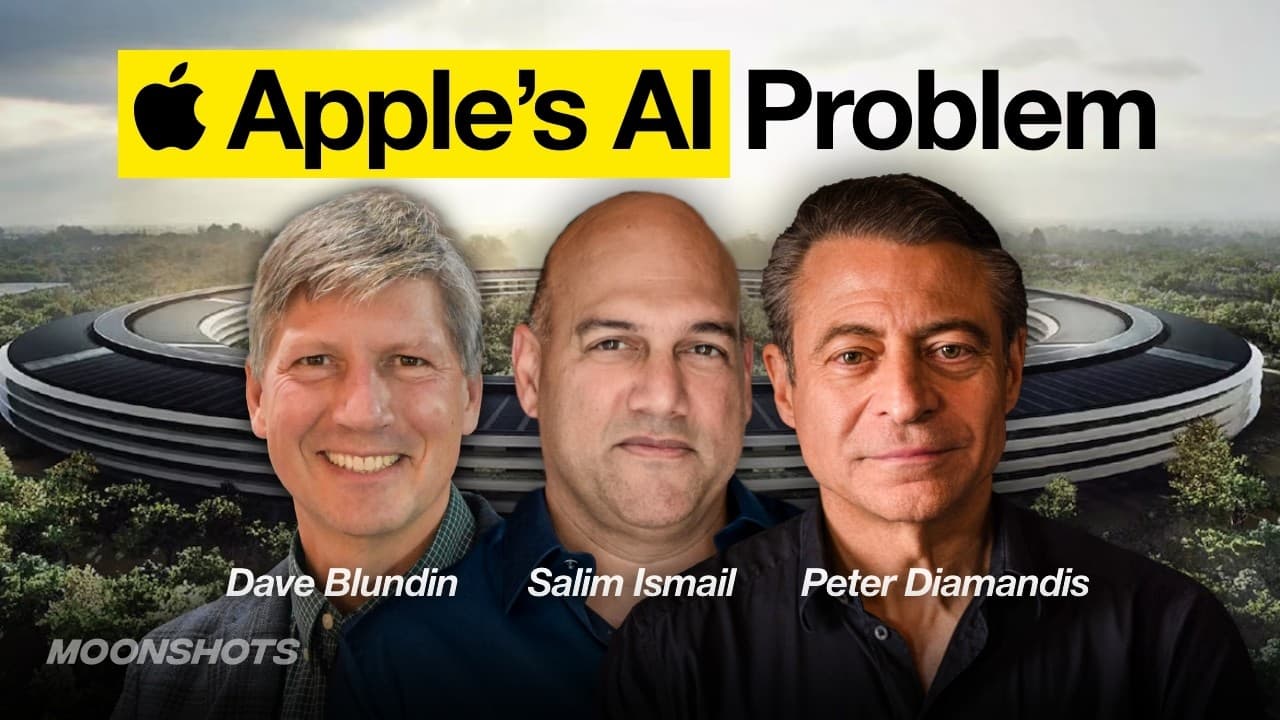
Peter Diamandis, Salim Ismail, and Dave Blundin discuss OpenAI raising money at a $300 billion valuation despite lawsuits and the nonprofit debate. Dave says the AI revolution justifies the price, but it is unclear whether foundation models will be the winners, so the deal is either very cheap or very expensive.
-
The hosts note that model leadership keeps changing, from DeepSeek to Gemini, and that former OpenAI co-founders now run rival labs valued in the billions. Salim would stay out at $300 billion, while also noting that betting against SoftBank's Masa has historically been risky.
-
Dave argues that the real prize is replacing Google as consumers' first stop on the internet. The X and xAI merger gives Elon real-time Twitter data. SoftBank may also profit from building an ecosystem around OpenAI rather than from a 10x return on this one deal.
Read in Other Languages (beta)
Share This Summary 📚
Summarize YouTube Videos and Get Video Transcripts with 1-Click
Try YouTube Summary with ChatGPT & Claude or YouTube Transcript Generator
Explore More Summaries from Peter H. Diamandis 📚






Summarize YouTube Videos and Get Video Transcripts with 1-Click
Try YouTube Summary with ChatGPT & Claude or YouTube Transcript Generator