Logic Families | Introduction | Comparison | PDC | Lec-103
TL;DR
This video explains various digital logic families, their characteristics, and current usage trends.
Transcript
hi everyone in this video I am going to introduce what are the different logic families we have in the digital integrated circuits so what do you mean by Logic family what do you mean by Logic family as we are having family as a human being as we are having families here in digital logic circuits also they are having different different logic famil... Read More
Key Insights
- 😒 Digital logic families serve different purposes in integrated circuits, with each having unique properties and use cases.
- ✋ The transition from obsolete families to modern tech reflects the evolution toward more efficient and high-performance designs like TTL, ECL, and CMOS.
- ✊ Performance metrics such as propagation delay and power dissipation are critical for determining the suitability of a logic family in a given application.
- 🚄 TTL is preferred for small to medium scale integrations due to its balance of performance and cost, while ECL is optimal for high-speed applications.
- 😘 CMOS technology combines low power consumption with high noise margins, making it ideal for many current digital applications.
- 😘 Integrated injection logic (IIL) presents a decent option for niche applications due to its low cost and reasonable performance.
- 💨 Super-fast computer designs rely heavily on ECL systems, favoring speed over energy efficiency despite the cost.
Install to Summarize YouTube Videos and Get Transcripts
Explore YouTube Video Summarizer or Get YouTube Transcript Extractor
Questions & Answers
Q: What are the obsolete logic families mentioned in the video?
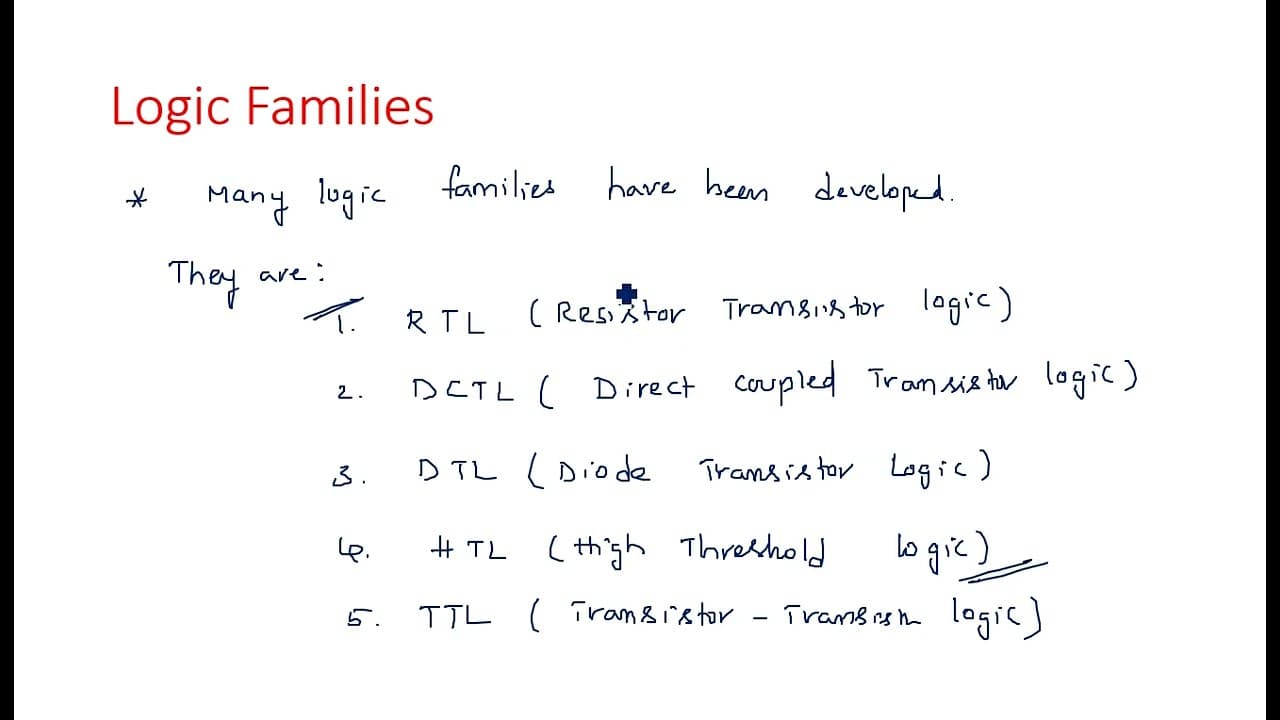
The video identifies four logic families as obsolete: Resistor-Transistor Logic (RTL), Direct Coupled Transistor Logic (DTL), Diode Transistor Logic (DTL), and High Threshold Logic (HTL). These families have fallen out of favor in modern applications due to advancements in technology, and engineers generally do not use them in contemporary circuit designs.
Q: Why is Emitter Coupled Logic (ECL) significant?
Emitter Coupled Logic (ECL) is regarded as the fastest logic family among the discussed options, making it ideal for super-fast computing applications. Despite its high power dissipation and cost, its minimal propagation delay of about one nanosecond allows it to outperform other families, which is critical for high-speed circuits.
Q: How do TTL and CMOS compare in terms of power consumption?
TTL logic families exhibit a higher power dissipation rate of approximately 10 milliwatts compared to CMOS, which operates with significantly lower consumption (around 0.01 milliwatts). This low power dissipation in CMOS makes it highly desirable for battery-operated or low-energy applications, despite having a longer propagation delay than TTL.
Q: What factors should be considered when choosing a logic family?
When selecting a logic family, factors like propagation delay, power dissipation, noise margin, fan-in, fan-out, and cost must be considered. The requirements of the specific application—such as speed or efficiency—will dictate the most suitable logic family, whether it is ECL for speed or CMOS for low power use.
Summary & Key Takeaways
-
The video introduces different logic families used in digital integrated circuits, highlighting their development and applications. Each family serves unique functions in digital design.
-
It categorizes logic families into obsolete (like RTL, DTL) and currently used varieties (TTL, ECL, CMOS), explaining the contexts in which they're applied.
-
The presenter compares these logic families based on key performance metrics such as propagation delay, power dissipation, noise margin, and overall cost, guiding appropriate selections for various applications.
Read in Other Languages (beta)
Share This Summary 📚
Summarize YouTube Videos and Get Video Transcripts with 1-Click
Try YouTube Summary with ChatGPT & Claude or YouTube Transcript Generator