Why Did Quantum Entanglement Win the Nobel Prize?
TL;DR
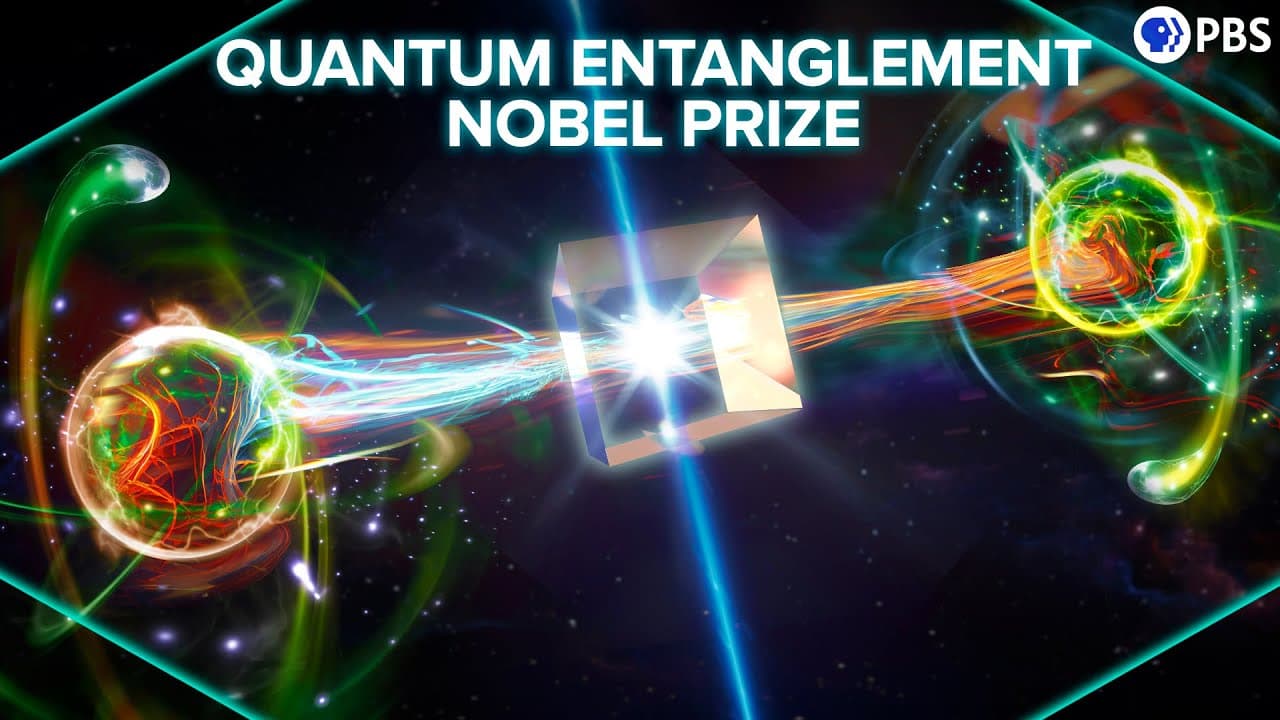
Quantum entanglement won the Nobel Prize because it demonstrates how two entangled quantum systems can influence each other instantaneously, defying Einstein's theory of relativity. The groundbreaking experiments by John Clauser, Alain Aspect, and Anton Zeilinger not only confirmed this strange prediction of quantum mechanics but also laid the groundwork for practical applications in quantum computing and cryptography.
Transcript
The Nobel prize in physics is typically awarded to scientists who make sense of nature; those whose discoveries render the universe more comprehensible. But the 2022 Nobel has been awarded to three physicists who revealed that the universe is even stranger than we thought. This year’s physics Nobel laureates are John Clauser, Alain Aspect, and Ant... Read More
Key Insights
- The 2022 Nobel Prize in Physics was awarded to John Clauser, Alain Aspect, and Anton Zeilinger for their work on quantum entanglement, demonstrating the universe's inherent strangeness.
- Quantum entanglement suggests that two quantum systems can influence each other instantaneously over any distance, challenging Einstein's theory of relativity.
- John Clauser and Alain Aspect conducted experiments proving quantum entanglement, effectively challenging Einstein's views and supporting quantum mechanics' predictions.
- Anton Zeilinger advanced the practical applications of quantum entanglement, contributing to quantum teleportation and quantum computing technologies.
- The concept of hidden variables was explored through Bell's theorem, which tests the statistical relationships of entangled particles, ultimately supporting standard quantum mechanics.
- Despite successful experiments, some loopholes remain, such as superdeterminism and non-local hidden variables, which continue to challenge physicists.
- Quantum entanglement's implications extend to practical applications such as quantum cryptography, which could revolutionize information security.
- The pursuit of understanding quantum mechanics highlights the importance of challenging established theories, leading to technological advancements and deeper insights into the universe.
Install to Summarize YouTube Videos and Get Transcripts
Explore YouTube Video Summarizer or Get YouTube Transcript Extractor
Questions & Answers
Q: What is the significance of the 2022 Nobel Prize in Physics?
The 2022 Nobel Prize in Physics was awarded for groundbreaking work on quantum entanglement, a phenomenon that challenges traditional views of the universe by suggesting that two quantum systems can influence each other instantaneously over any distance. This work highlights the universe's inherent strangeness and supports the predictions of quantum mechanics, challenging Einstein's theory of relativity.
Q: How does quantum entanglement challenge Einstein's theory of relativity?
Quantum entanglement challenges Einstein's theory of relativity by suggesting that two quantum systems can influence each other instantaneously over any distance, seemingly allowing information to travel faster than light. This phenomenon, which Einstein referred to as "spooky action at a distance," contradicts his theory that no causal influence can exceed the speed of light.
Q: What are hidden variables in the context of quantum mechanics?
Hidden variables in quantum mechanics refer to the idea that there may be underlying information not contained in the wavefunction that determines the properties of quantum systems. This concept was explored through Bell's theorem, which tests the statistical relationships of entangled particles. The experiments conducted by Clauser and Aspect supported standard quantum mechanics, suggesting that hidden variables do not exist.
Q: What practical applications arise from the study of quantum entanglement?
The study of quantum entanglement has led to practical applications such as quantum teleportation and quantum computing. Quantum teleportation involves transferring a quantum state between particles, which is crucial for developing quantum computers. Additionally, quantum entanglement has implications for quantum cryptography, offering potential advancements in secure information transmission.
Q: What are the remaining loopholes in the study of quantum entanglement?
Despite successful experiments supporting quantum mechanics, some loopholes remain in the study of quantum entanglement. These include the possibility of superdeterminism, where the universe conspires to hide hidden variables, and non-local hidden variables, where information may exist in the global wavefunction. These challenges continue to intrigue physicists and drive further research.
Q: How did Anton Zeilinger contribute to the field of quantum mechanics?
Anton Zeilinger contributed to the field of quantum mechanics by advancing the practical applications of quantum entanglement. He is known for demonstrating quantum teleportation, a process critical for quantum computing. Zeilinger's work has also impacted quantum cryptography, helping to develop technologies for secure information transmission and manipulation of entangled quantum states.
Q: Why is it important to challenge established theories in physics?
Challenging established theories in physics is crucial because it drives scientific progress and leads to deeper insights into the universe. By testing the limits of existing theories, scientists can uncover new phenomena, refine our understanding of fundamental principles, and develop technologies that were previously unimaginable. The study of quantum entanglement exemplifies how questioning the status quo can lead to significant advancements in both theory and application.
Q: What role did John Clauser and Alain Aspect play in the study of quantum entanglement?
John Clauser and Alain Aspect played pivotal roles in the study of quantum entanglement by conducting experiments that provided evidence for the phenomenon and supported the predictions of quantum mechanics. Their work challenged Einstein's views and helped to establish the validity of quantum entanglement, paving the way for further research and practical applications in fields like quantum computing and cryptography.
Summary & Key Takeaways
-
The 2022 Nobel Prize in Physics was awarded to John Clauser, Alain Aspect, and Anton Zeilinger for their groundbreaking work on quantum entanglement. Their experiments demonstrated the universe's inherent strangeness, challenging Einstein's views and supporting the predictions of quantum mechanics.
-
Quantum entanglement suggests that two quantum systems can influence each other instantaneously over any distance, seemingly violating Einstein's theory of relativity. The experiments conducted by Clauser and Aspect provided evidence for this phenomenon, while Zeilinger advanced its practical applications.
-
The exploration of hidden variables through Bell's theorem and subsequent experiments supported standard quantum mechanics, but some loopholes remain. These findings have significant implications for quantum computing and cryptography, emphasizing the importance of challenging established theories.
Read in Other Languages (beta)
Share This Summary 📚
Summarize YouTube Videos and Get Video Transcripts with 1-Click
Try YouTube Summary with ChatGPT & Claude or YouTube Transcript Generator
Explore More Summaries from PBS Space Time 📚


Summarize YouTube Videos and Get Video Transcripts with 1-Click
Try YouTube Summary with ChatGPT & Claude or YouTube Transcript Generator