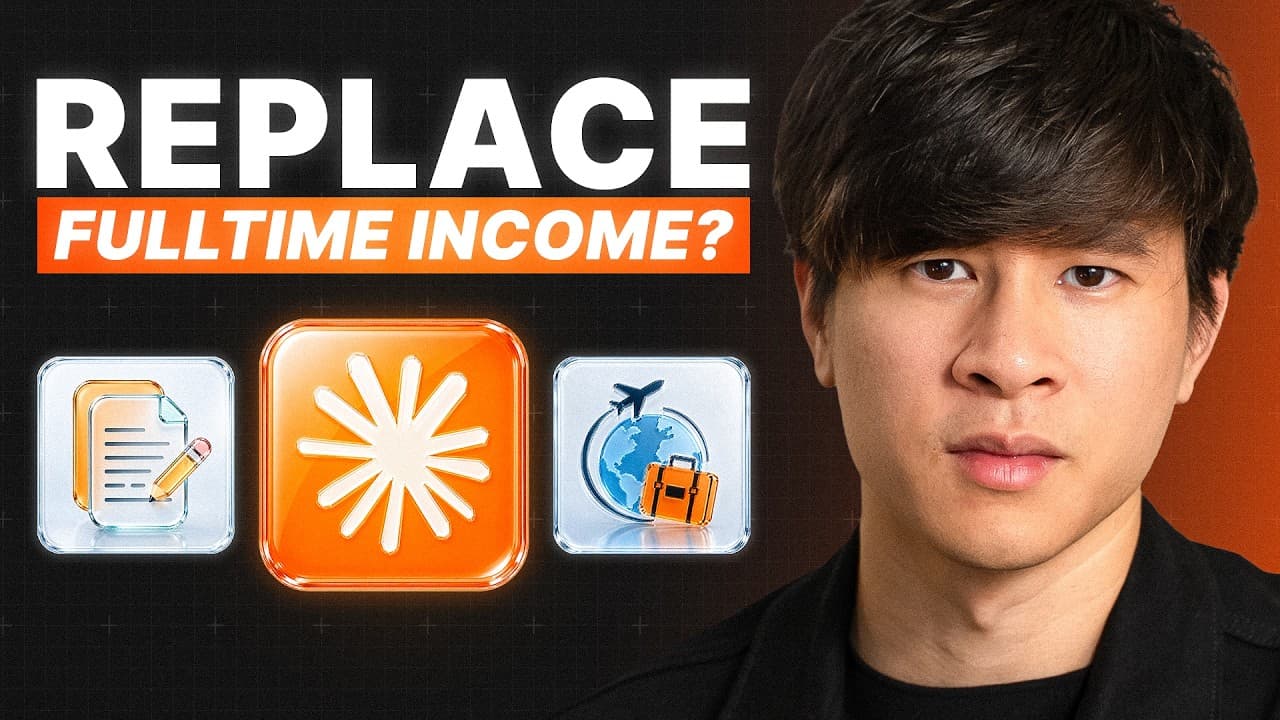
How to Start an AI Creator Side Hustle With Claude
TL;DR
Build an audience by sharing useful AI news, tutorials, and firsthand experiments, then monetize through sponsorships, courses, coaching, consulting, or services. Claude can reduce the work involved in writing scripts, creating course material, and building landing pages, but success still depends on choosing a suitable platform, studying effective creators, differentiating your content, earning trust, and converting attention into paid offers.
Transcript
The creators of Claude Anthropic just hit a valuation of nearly $1 trillion and they're gearing up for one of the biggest IPOs in history. This is the fastest a company has ever grown in tech history. And the crazy part is less than 1% of the world have even used Claude. Isn't it funny that the most powerful money-making tool of our lifetime just s... Read More
Key Insights
- The side hustle scoring system evaluates each idea across four criteria: ease of starting, speed to reaching $10,000 per month, profit margin, and technical barrier. Its purpose is to identify personal fit because different business models suit different personalities, experience levels, and financial goals.
- An AI creator builds an audience by sharing AI news, tutorials, inspiration, and practical ways to save time, save money, or make money. That attention can be monetized through sponsorships, courses, coaching, consulting, or other services connected to the audience's needs.
- Claude can reduce content production work by helping write scripts, develop course material, and create landing pages or simple applications. The creator argues that these capabilities allow one person to produce content at higher volume without assembling a large content creation team.
- The recommended starting process is to study three to five creators on a chosen platform, break down why their work succeeds, and reverse engineer useful patterns. A new creator must then determine what distinctive approach, perspective, or execution will make the content stand out.
- Platform choice should reflect the creator's preferred format and visibility. YouTube is presented as suitable for long-form video, while LinkedIn is suggested for people who prefer written posts or do not want to appear on camera.
- Audience trust can become the foundation for higher-value offers. The creator describes moving viewers from YouTube to landing pages, free resources, booked calls, courses, or coaching, creating a path from useful public content to a paid customer relationship.
- Software is presented as a stronger long-term opportunity than an ideal beginner starting point. Building and managing an application requires development, maintenance, and distribution, while beginning as a creator lets someone establish an audience before introducing tools or software.
- The client examples are presented as evidence that creators can learn publicly instead of beginning as experts. Sandy reportedly went from no Claude experience to about 45,000 subscribers and more than $40,000 per month within six months by sharing what she learned in the AI space.
Install to Summarize YouTube Videos and Get Transcripts
Explore YouTube Video Summarizer or Get YouTube Transcript Extractor
Questions & Answers
Q: How do you start an AI creator side hustle with Claude?
Choose a platform and publish useful content about AI news, tutorials, personal experiments, or practical applications. Study three to five creators you respect, identify the elements that make their work successful, and adapt those patterns while adding a distinct perspective. Claude can help draft scripts, course material, landing pages, and simple applications, reducing the production burden as you build an audience and develop paid offers.
Q: How can an AI creator make money from an audience?
An AI creator can monetize through brand sponsorships, courses, coaching, consulting, and services. The described customer journey begins with useful public content, such as YouTube videos, and directs interested viewers to a landing page, free training, lead magnet, application, or booked call. Revenue depends on connecting the audience's needs with an offer that provides enough value to justify payment.
Q: What criteria should you use to compare AI side hustles?
Compare each opportunity by ease of starting, speed to reaching $10,000 per month, profit margin, and technical barrier. Ease measures how quickly a beginner can become confident enough to sell and deliver results. Profit margin reflects what remains after client delivery costs, while technical barrier indicates whether Claude and basic tools are sufficient. The best choice depends on personal fit rather than a universal ranking.
Q: Which platform should an AI content creator choose?
Choose the platform that matches the kind of content you can produce consistently. YouTube is recommended for long-form video and creators comfortable presenting detailed explanations. LinkedIn is suggested for people who prefer written posts or do not want to show their face. TikTok and Instagram are also mentioned as options, and the decision should reflect your strengths, preferred format, and examples you want to study.
Q: How can Claude help create content for an AI business?
Claude can assist with writing video scripts, developing course materials, generating instructions for landing pages, and creating simple applications. The transcript also describes using it to implement a website through a hosting account after receiving instructions. These capabilities can reduce the need for a large production team, although the creator still needs to choose topics, shape the offer, build trust, and attract customers.
Q: Why should beginners build an audience before creating software?
Software requires more than producing the application. A founder must learn how to build it, manage it, and secure distribution by persuading people to try it. The recommended sequence is to begin as an AI creator, earn attention and trust, and learn what the audience needs. Once that relationship exists, a relevant tool or application can be introduced to people already familiar with the creator's work.
Q: How do you research successful creators before publishing content?
Select three to five creators whose work you genuinely like on YouTube, TikTok, Instagram, LinkedIn, or another suitable platform. Analyze what makes their content effective, including the format, teaching style, topics, and presentation choices. Reverse engineer the patterns that appear to work, then decide how your own content will be different or better instead of copying another creator's identity or exact material.
Q: Can someone create AI content without being an expert first?
The transcript argues that a creator can learn while publishing and remain one step ahead of the people being helped. Sandy is offered as the central example: she reportedly had no Claude experience six months earlier, then grew to about 45,000 subscribers and earned more than $40,000 per month by sharing her developing AI knowledge. The example is a reported client outcome, not a guaranteed result.
Summary & Key Takeaways
-
The proposed scoring system compares AI side hustles by ease of starting, speed to reaching $10,000 per month, profit margin, and technical barrier. The framework is designed to help beginners choose according to their skills, personality, and goals, rather than assuming that one business model is universally superior to every other option.
-
The AI creator model involves building an audience through news, tutorials, education, inspiration, and personal experiments. Potential revenue sources include brand sponsorships, courses, coaching, consulting, and services. Claude can support production by drafting scripts and course material, helping one person create content without relying on a large production team.
-
A beginner can study three to five successful creators on a suitable platform, identify why their content works, and decide how to offer something different. The longer-term strategy is to establish audience trust before creating tools or software, because an existing audience can provide distribution and potential customers when a product launches.
Read in Other Languages (beta)
Share This Summary 📚
Summarize YouTube Videos and Get Video Transcripts with 1-Click
Try YouTube Summary with ChatGPT & Claude or YouTube Transcript Generator
Explore More Summaries from Patrick Dang 📚

Summarize YouTube Videos and Get Video Transcripts with 1-Click
Try YouTube Summary with ChatGPT & Claude or YouTube Transcript Generator