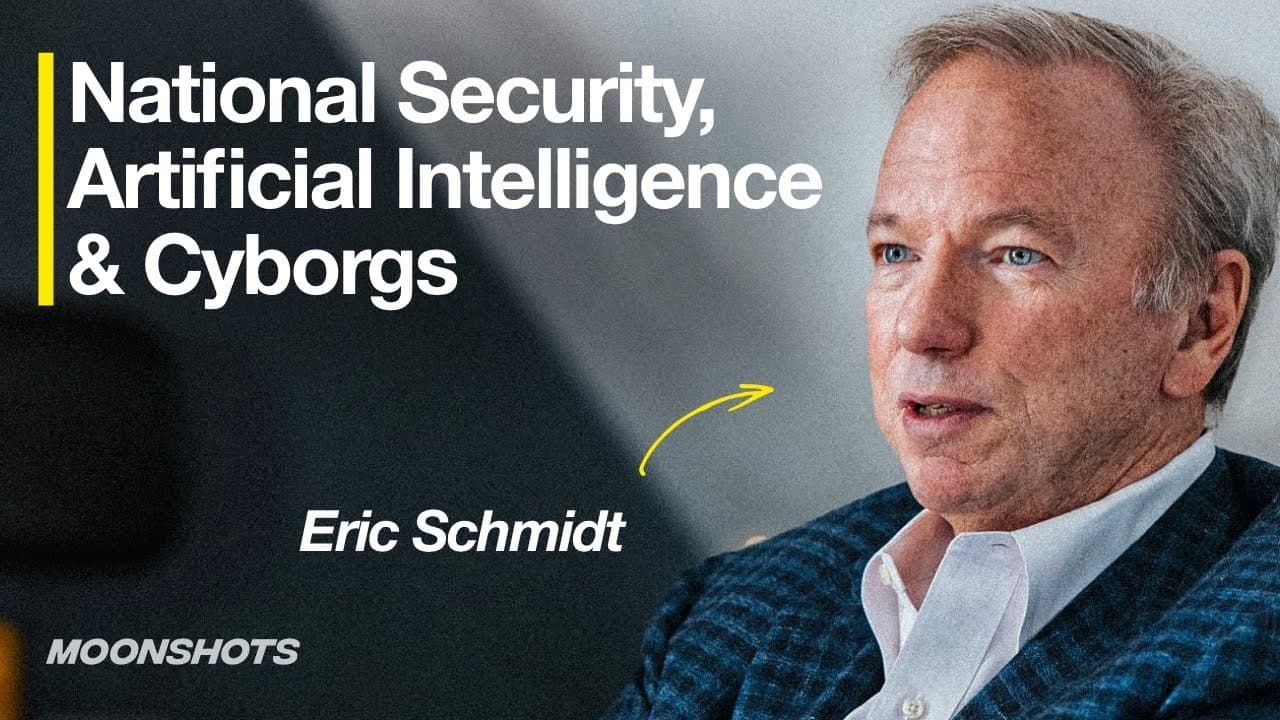
What Does Eric Schmidt Think About AI and Tech?
TL;DR
Technology creates its greatest impact when talented people tackle difficult scientific, economic, and social problems. Eric Schmidt argues that biotechnology could support manufacturing and climate goals, rapid decisions are essential when scaling technology companies, mobile connectivity is foundational for African markets, and Web3 systems must reduce transaction costs before they can support widespread use.
Transcript
given that governments seem to be distracted by other less important things in my opinion um it's the rule for the philanthropists among us including myself to give as much so um we collectively agreed the vast majority of the money that that I was fortunate enough to make at Google will go to science and science related things climate change those... Read More
Key Insights
- Synthetic biology can extend beyond medicine by growing materials through biological production systems, although scaling from small vats to large facilities remains difficult. Schmidt envisions applications such as grown bricks and airport runways, potentially making the grown environment larger than the conventionally built environment.
- Drug development is slowed by regulation, human trials, time, and expense. Schmidt says adding regulatory requirements can add a decade and two and a half billion dollars, which is why he is more interested in non-drug biological technologies that may move faster.
- A circular bioeconomy could combine climate action with employment and industrial development. Biomass is distributed across rural states, so biological manufacturing could create millions of traditional blue-collar manufacturing jobs while attracting innovation, wealth, and venture capital.
- Technology leadership requires fast decisions because digital products and competitors can scale within days or weeks. Schmidt says Google Video launched shortly before YouTube surged ahead, forcing Google to close its competing product and buy YouTube rather than continue pursuing a losing approach.
- Google’s growth depended on combining founder vision with operational execution at scale. Larry Page and Sergey Brin supplied the company’s founding vision, advertising model, and search direction, while Schmidt describes his contribution as implementing that vision across a rapidly expanding organization.
- Web3 is defined as a read, write, and own model built around digital identity, cross-chain activity, and ownership of assets and content. Its central limitation is scalability because Ethereum gas costs rise with demand instead of falling through increased efficiency and use.
- African technology growth begins with communications and phone-based web services. Schmidt’s infrastructure model connects fiber to cities, city networks to cell towers, and towers to users, while affordable phones and universal translation can expand access to information across languages.
- Philanthropic capital can direct talented people toward difficult scientific and social problems when governments focus elsewhere. Schmidt says the vast majority of the money he made at Google will support science, climate change, and related purposes intended to produce meaningful public impact.
Install to Summarize YouTube Videos and Get Transcripts
Explore YouTube Video Summarizer or Get YouTube Transcript Extractor
Questions & Answers
Q: How could synthetic biology affect everyday infrastructure?
Synthetic biology could support production systems that grow useful materials rather than manufacturing everything through conventional construction. Schmidt compares the process loosely to brewing, where organisms produce materials inside vats. The unresolved challenge is scaling production from small vats to large ones. If that challenge is solved, applications could include grown bricks, airport runways, and other parts of the built environment.
Q: Why might non-drug biotechnology advance faster than new medicines?
Non-drug biotechnology may advance faster because medicines intended for humans face regulation, expensive human trials, and long development timelines. Schmidt says regulation can add a decade and two and a half billion dollars. He therefore expresses greater interest in biological applications outside drugs, where useful products may reach practical deployment more quickly while still producing technological spin-offs relevant to patient care.
Q: How could a circular bioeconomy create jobs and address climate concerns?
A circular bioeconomy could use widely distributed biomass as feedstock for biological production and recycle materials through the system. Because much of that biomass is located in rural states, production facilities could create millions of traditional blue-collar manufacturing jobs in the American heartland. Schmidt argues that this model could unite climate benefits, employment, innovation, wealth creation, and venture investment.
Q: What leadership lesson did Eric Schmidt learn from Google’s growth?
Schmidt’s central leadership lesson is that time becomes critical when technology systems and competitors scale extremely quickly. Leaders may have only a week or a day to make an important decision, and delay can make recovery impossible. Looking back, he says he would have pushed even harder for immediate decisions, despite the intense pace at which Google already operated.
Q: Why did Google acquire YouTube after launching Google Video?
Google acquired YouTube because YouTube quickly surpassed Google Video after the competing services launched. Schmidt says Google Video appeared two months before YouTube, but YouTube still accelerated beyond it. Google responded by shutting down Google Video and purchasing YouTube. He describes the acquisition as Google’s best decision and uses it to illustrate how quickly technology markets can change.
Q: What prevents Web3 platforms from scaling successfully?
Web3 platforms face a scalability problem when greater demand increases transaction costs. Schmidt contrasts this with centralized systems, where efficiency and increased use should reduce costs. On Ethereum, he notes that gas becomes more expensive as demand rises because the network devotes substantial effort to preventing the described failure effect. Founders need the underlying system to scale before their applications can achieve comparable scale.
Q: What technology infrastructure does Africa need for digital growth?
African digital growth requires communications infrastructure that connects fiber to cities, city fiber to cell towers, and towers to the population. Schmidt says the first money in African technology will be made through communications and phone-based web services. Dense informal settlements can support tower deployment, while affordable phones, local-language models, and universal translation can broaden access to useful online information.
Q: What role can philanthropy play in science and climate work?
Philanthropy can fund talented people working on difficult scientific, climate, and social problems when governments are distracted by other priorities. Schmidt says philanthropists should give as much as possible and states that the vast majority of the money he made at Google will go to science, climate change, and related purposes. He frames this commitment as choosing a clear public purpose and lasting contribution.
Summary & Key Takeaways
-
Synthetic biology could affect more than patient care because drug development faces regulatory delays, human trials, and major costs. Schmidt is especially interested in non-drug applications that grow useful materials from biomass. He believes a circular bioeconomy could support climate goals, manufacturing, innovation, investment, and millions of jobs in rural American communities.
-
Schmidt describes his Google leadership role as implementing Larry Page and Sergey Brin’s vision at scale. His central lesson is that rapidly growing technology markets leave very little time for decisions. Google Video lost momentum to YouTube, leading Google to shut its service and acquire YouTube, which Schmidt calls its best decision.
-
Emerging markets need dependable communications infrastructure before broad web-service growth can occur. Schmidt recommends connecting fiber to cities, extending city fiber to towers, and bringing populations online through mobile phones. In Africa, affordable phones, local-language capabilities, and translation could place the world’s information on every student’s phone, although government performance remains uneven.
Read in Other Languages (beta)
Share This Summary 📚
Summarize YouTube Videos and Get Video Transcripts with 1-Click
Try YouTube Summary with ChatGPT & Claude or YouTube Transcript Generator
Explore More Summaries from Peter H. Diamandis 📚

Summarize YouTube Videos and Get Video Transcripts with 1-Click
Try YouTube Summary with ChatGPT & Claude or YouTube Transcript Generator