Are the OpenAI Files' Sam Altman Claims Credible?
TL;DR
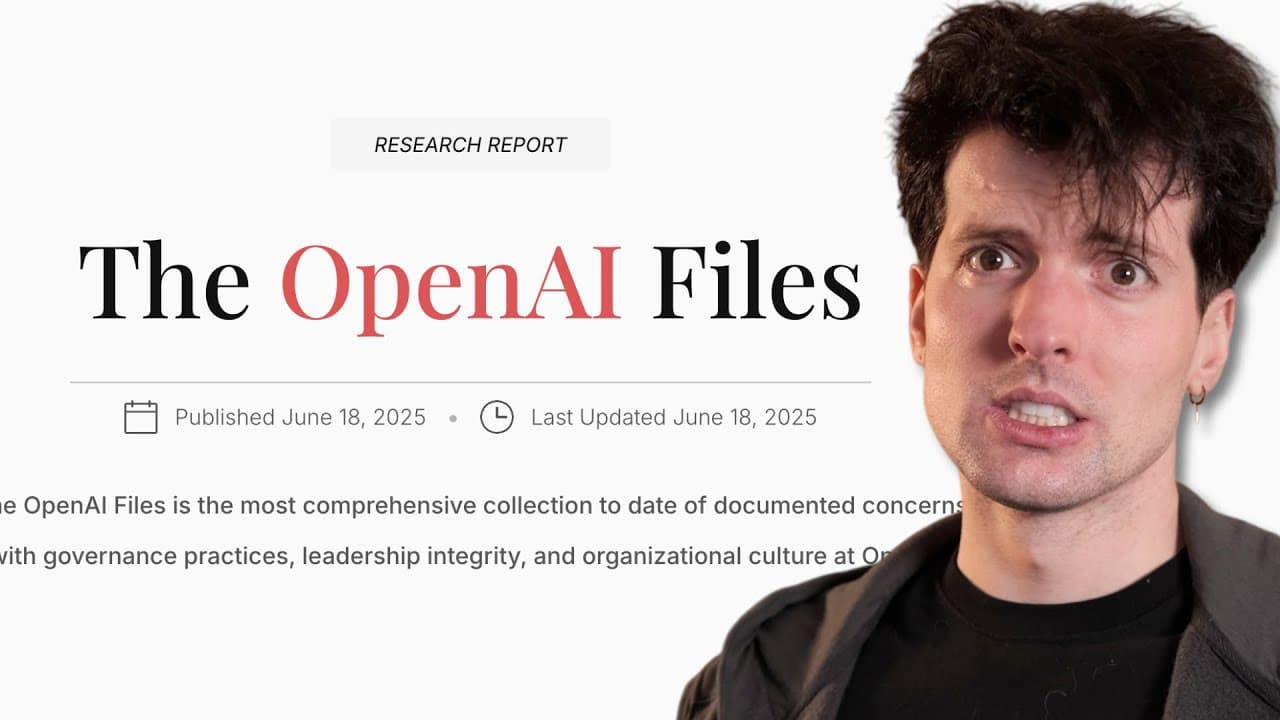
The reviewer finds that most OpenAI Files claims about Sam Altman are overblown, misleading, or too weakly supported to establish intentional wrongdoing. He evaluates allegations by their severity, possible benefit, and apparent intent, applying that framework to the disputed Y Combinator chairman title in SEC filings and introducing a claim about a profit cap increasing 20% annually. Read on for the evidence, caveats, and potential biases behind that conclusion.
Transcript
huge repository of information about OpenAI and Altman just dropped the OpenAI files. There's so much crazy in there. Oh boy, there's yet another crazy set of things that OpenAI and in particular Sam Alman seem to have done really wrong. Or is there? I spent way too much time digging deep on the OpenAI files and I have found a lot of interesting st... Read More
Key Insights
- The review's central conclusion is that most OpenAI Files allegations examined appear overblown, weakly supported, or misleading. The reviewer says the repository contains interesting accusations, but he struggles to identify claims that remain convincing after examining their context and possible explanations.
- The reviewer is potentially biased because he participated in Y Combinator and describes himself as increasingly enthusiastic about AI. He also says OpenAI is a major monthly expense and competitor whose employees can move to or from T3 Chat, creating incentives that do not point in only one direction.
- The proposed evaluation framework is to examine an accusation's severity, the benefit Altman might receive, and the apparent level of intent. This framework distinguishes harmful deception from mistakes that may look serious on paper but offer no identifiable advantage to the accused party.
- The SEC filing allegation is serious because it involves reportedly giving the government an inaccurate leadership title. However, the reviewer sees no clear way that listing Altman as Y Combinator chairman benefited Altman or OpenAI, so he considers a clerical error more plausible than deliberate deception.
- The Y Combinator dispute is described as a breakdown in communication during Altman's increasing involvement with OpenAI. According to the limited reporting discussed, Paul Graham and particularly Jessica Livingston were disappointed that Altman was focusing less on the organization he had been appointed to lead.
- The proposed chairman role is presented as a possible transition that would let Altman leave day-to-day leadership while retaining a senior association with Y Combinator. The reviewer suggests this could have reassured existing investors, but repeatedly notes that the reporting behind these details is not particularly strong.
- The inaccurate title could have persisted through reused filing templates and delegated legal paperwork, according to the reviewer's interpretation. This explanation is explicitly presented as an assumption based on concurrent organizational changes, rather than as confirmed evidence about how the filings were prepared.
- The profit-cap allegation states that OpenAI quietly changed its cap so it could increase by 20% annually and exceed one hundred trillion in 40 years. The transcript introduces this claim and the reviewer's broader defense of OpenAI's research openness, but does not complete his evaluation of the allegation.
Install to Summarize YouTube Videos and Get Transcripts
Explore YouTube Video Summarizer or Get YouTube Transcript Extractor
Questions & Answers
Q: Are the OpenAI Files' claims about Sam Altman credible?
The reviewer concludes that most claims he examined are overblown, misleading, or unsupported by evidence strong enough to establish intentional wrongdoing. He says the repository contains interesting accusations, but he struggles to find claims that hold up after considering their context, motive, and possible explanations.
Q: How does the reviewer evaluate allegations in the OpenAI Files?
He considers three factors: the severity of the alleged conduct, how Sam Altman or OpenAI might benefit, and how intentional the conduct appears. This framework helps him distinguish purposeful misconduct from clerical mistakes, poor communication, and weakly supported interpretations.
Q: What was the controversy over Sam Altman's title in SEC filings?
The OpenAI Files reportedly claim that Altman was listed as Y Combinator chairman in SEC filings even though the partnership had not approved that position. The reviewer considers inaccurate information submitted to the government relatively severe, but he does not see clear evidence that the disputed title produced a benefit.
Q: Did Sam Altman or OpenAI benefit from the disputed Y Combinator chairman title?
The reviewer says he cannot identify any way that Altman or OpenAI benefited from the title appearing in SEC filings. Because an obvious advantage is missing, he considers a clerical and paperwork-management mistake more plausible than intentional deception.
Q: Why did tension reportedly develop between Sam Altman and Y Combinator?
The discussion attributes the tension to Altman's increasing focus on OpenAI while he was supposed to be running Y Combinator. According to the limited reporting presented, Paul Graham and especially Jessica Livingston were disappointed by that shift, though the reviewer warns that these details are not particularly well sourced.
Q: Why might Sam Altman have proposed becoming Y Combinator chairman?
The reviewer suggests that becoming chairman could have let Altman step away from daily leadership while retaining a senior association with Y Combinator. It might also have reassured investors connected to him, but this explanation is presented as a reconstruction from limited reporting rather than a confirmed account.
Q: What does the OpenAI Files allegation say about OpenAI's profit cap?
The allegation says OpenAI quietly changed its profit cap so it could increase by 20% annually and potentially exceed one hundred trillion in 40 years. It also claims OpenAI continued receiving credit for a capped-profit structure without acknowledging that modification, but the provided transcript does not complete the reviewer's assessment.
Q: What potential biases does the reviewer disclose?
The reviewer says he is becoming an AI enthusiast and is part of the Y Combinator circle associated with Altman. He also states that OpenAI does not pay him, that his company pays OpenAI tens of thousands each month, and that OpenAI is one of its biggest competitors and a place employees move to or from.
Summary & Key Takeaways
-
The reviewer investigates claims collected in the OpenAI Files and concludes that most accusations examined are exaggerated, misleading, or insufficiently supported. He acknowledges possible bias because of his Y Combinator background and growing enthusiasm for AI, while noting that OpenAI is both a major expense and competitor for his business.
-
The first allegation concerns SEC filings that reportedly identified Altman as Y Combinator chairman after the organization had not approved that position. The reviewer considers inaccurate government filings serious but finds no clear benefit to Altman or OpenAI, leading him to interpret the issue as a likely clerical and communication failure.
-
The discussion connects the filing controversy to Altman's transition from leading Y Combinator toward focusing on OpenAI. It describes possible internal tension, an unconfirmed chairman proposal, changing organizational responsibilities, and complicated paperwork. The reviewer also introduces a separate allegation that OpenAI quietly modified how its profit cap could increase annually.
Read in Other Languages (beta)
Share This Summary 📚
Summarize YouTube Videos and Get Video Transcripts with 1-Click
Try YouTube Summary with ChatGPT & Claude or YouTube Transcript Generator
Explore More Summaries from Theo - t3․gg 📚






Summarize YouTube Videos and Get Video Transcripts with 1-Click
Try YouTube Summary with ChatGPT & Claude or YouTube Transcript Generator