How to Learn Faster by Connecting New Information
TL;DR
Strong memory and deep understanding come from connecting new information to existing knowledge, not from trying harder to remember isolated facts. Treat learning as the construction of a meaningful schema: identify relationships, patterns, implications, and consequences so each new idea becomes relevant, easier to retain, and more useful in practice.
Transcript
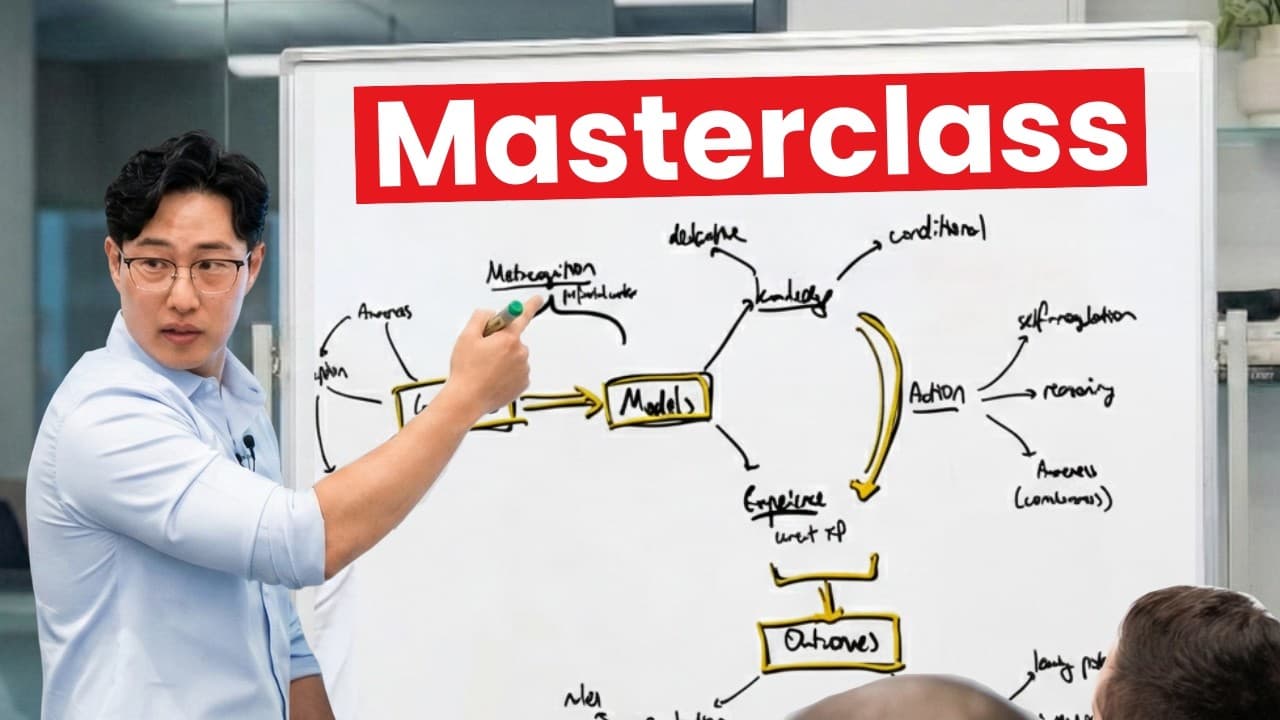
So, back before I was doing YouTube, I used to run workshops like 20 times a year. These days, I only do three or four. So, I held a private workshop a few months ago and the team wanted to record this one to share with you guys as well. We've actually edited this video to be interactive so that you guys can actually follow along later as well. So,... Read More
Key Insights
- Learning quality is determined by information processing. Strong processing creates durable memory, deep understanding, and practical application, while weak processing causes information to be forgotten even after substantial time has been spent reading or studying it.
- Memory and understanding are outcomes rather than directly controllable actions. Trying harder to remember or understand does not guarantee success because both outcomes depend on the mental process used when information first enters and moves through the learner's existing knowledge.
- Information in isolation is likely to be forgotten. The brain rapidly filters sensory data and other inputs that appear unnecessary, as illustrated by the inability to recall an ordinary license plate encountered earlier in the day.
- The brain retains information when it appears connected and consequential. Building links to related ideas, implications, and outcomes signals that a new fact belongs within a meaningful pattern rather than existing as an irrelevant fragment.
- Patterns can make intrinsically meaningless information memorable. A phone number becomes easier to retain when its digits are grouped into a familiar rhythm, and hearing the same digits arranged differently can temporarily make a correct number feel unfamiliar.
- A schema is a connected network of prior knowledge and experience. It can include academic material, professional knowledge, hobbies, books, and other experiences that provide possible attachment points for new information.
- The learner's job is to reconstruct the underlying schema, not merely collect data. Authors and creators organize material according to a larger understanding, and genuine comprehension occurs when the learner identifies that pattern and sees how the individual points fit together.
- The snowball effect occurs as new ideas connect with existing knowledge. Each successful connection expands the schema, creates more opportunities for later connections, and contributes to the productive feeling that concepts are locking together during learning.
Install to Summarize YouTube Videos and Get Transcripts
Explore YouTube Video Summarizer or Get YouTube Transcript Extractor
Questions & Answers
Q: How can I learn new information faster?
Process new information by actively connecting it to what you already know. Look for relationships, patterns, implications, consequences, and influences instead of treating each fact as a separate item. When information becomes part of a connected schema, the brain has stronger reasons to retain it, understanding becomes deeper, and the knowledge becomes easier to apply when needed.
Q: Why do I forget material shortly after studying it?
Forgetting occurs when information is processed as isolated data that the brain does not consider worth retaining. Reading for hours or deciding that something is important does not automatically change this filtering process. If new material lacks relationships with prior knowledge, it may be discarded quickly, producing the experience of remembering little from a page or losing much of the material later.
Q: What does information in isolation is death mean?
The phrase means that an unconnected piece of information is unlikely to survive in memory. The brain filters the overwhelming majority of incoming data because continuously processing everything would consume enormous energy. A fact becomes more memorable when it connects with multiple ideas, affects other knowledge, or carries implications that make forgetting it appear consequential within the learner's mental network.
Q: What is a schema in the learning process?
A schema is the network of connections and patterns created from everything a person already knows and has experienced. It may draw from work, academic study, hobbies, books, and other parts of life. New information enters as separate points, and learning involves identifying how those points connect with the existing network and with one another to form coherent understanding.
Q: Why does trying harder to remember often fail?
Trying harder fails because memory is presented as a symptom of processing rather than an action that can be controlled directly. A learner can decide that material matters for an exam or job, but that intention alone does not make the brain retain it. Durable memory emerges when the processing method creates enough meaningful connections to make the information relevant and worth keeping.
Q: How do patterns improve memory for meaningless details?
Patterns organize separate details into a connected structure. A phone number, for example, can become memorable through grouping and rhythm even though the digits have little intrinsic meaning. When another person repeats the same digits with a different rhythm, the number may briefly seem unfamiliar because the original memory was tied to a particular organizational pattern rather than stored as isolated digits.
Q: What causes a flow state while learning?
A learning flow state appears when concepts begin locking together, building on one another, and forming a coherent structure. The learner feels productive and confident because new points are connecting with an existing schema rather than remaining fragmented. This experience is described as a symptom of the snowball effect, where successful connections create a stronger foundation for integrating additional information.
Q: What should I focus on when reading a textbook?
Focus on discovering the author's larger pattern or schema instead of merely collecting individual facts. The author is attempting to communicate an organized understanding, while the material initially reaches the learner as separate data points. Genuine comprehension develops when those points are connected, their relationships become visible, and the learner can see why the structure is logical, intuitive, and applicable.
Summary & Key Takeaways
-
Learning outcomes depend on how information is processed. Effective processing produces stronger memory, deeper understanding, and greater ability to apply knowledge, while poor processing leads to rapid forgetting. Because retention and understanding are consequences of processing, simply trying harder to remember or understand cannot reliably solve problems created by an ineffective learning process.
-
The brain filters most incoming data because retaining everything would require constant processing and enormous energy. Isolated information is therefore likely to disappear, even when a learner considers it important for an exam, job, or problem. Creating multiple relationships makes information appear relevant and gives the brain stronger reasons to retain it.
-
A schema is the connected network formed from prior knowledge and experiences. New material initially arrives as separate points, and the learner must discover how those points fit together and relate to existing knowledge. Learning begins to feel intuitive, productive, and coherent when concepts consolidate into this larger structure and create a snowball effect.
Read in Other Languages (beta)
Share This Summary 📚
Summarize YouTube Videos and Get Video Transcripts with 1-Click
Try YouTube Summary with ChatGPT & Claude or YouTube Transcript Generator
Explore More Summaries from Justin Sung 📚


Summarize YouTube Videos and Get Video Transcripts with 1-Click
Try YouTube Summary with ChatGPT & Claude or YouTube Transcript Generator