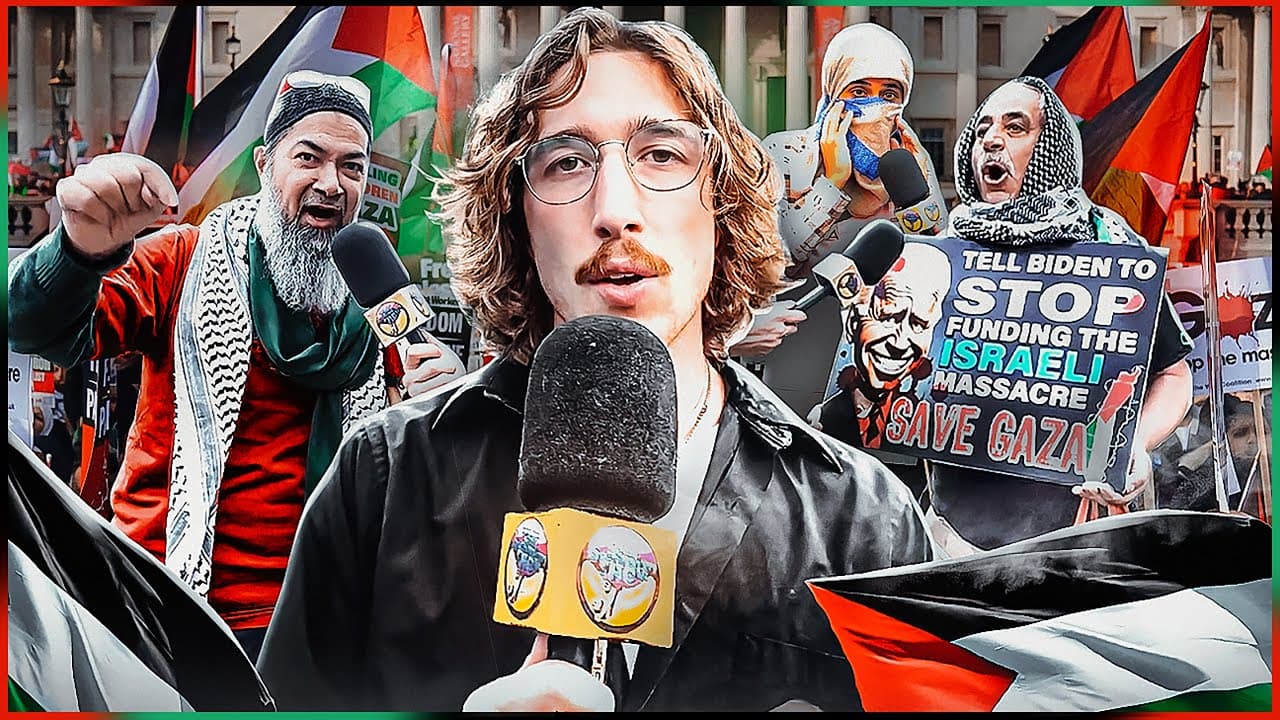
What Happened at the Largest Pro-Palestine Protest in America?
TL;DR
The largest pro-Palestine protest in American history highlights a humanitarian crisis in Gaza, with thousands of civilian casualties and lack of basic resources. Speakers emphasize that being anti-Zionist is not anti-Semitic, urging for awareness of historical injustices and the humanity of Palestinians. They call for immediate action to end violence and promote peace for all involved.
Transcript
this is what Holocaust is right now there's over 4,000 kids dead already in Gaza they died of thirst thirst and you got imagine two and a half million people you can't even give them water or feed them and the whole world is watching not just the United States the whole world is watching them die one by one I'm Jewish I understand cism and rhetoric... Read More
Key Insights
- 🌐 The speaker portrays the current situation in Gaza as a humanitarian crisis, describing it as a genocide that demands immediate global attention and action.
- 💁 They argue that the historical injustices, particularly the Nakba, inform the ongoing conflict and suffering of Palestinians today.
- 🇦🇬 The distinction between anti-Zionism and anti-Semitism is crucial; the speaker insists that legitimate critique of Israeli policy does not constitute hate against Jewish people.
- 🙈 The media is seen as complicit in shaping narratives that dehumanize Palestinians and obscure their plight, necessitating critical engagement from audiences.
- 😣 The realities faced by Gazans include severe restrictions on essential resources, painting a picture of daily struggle and helplessness.
- 🏍️ The speaker's critiques extend to U.S. foreign policy, suggesting that it perpetuates cycles of violence and neglect toward Palestinian humanity.
- 😄 A plea for empathy shines through the message, emphasizing the shared human experience and the universal desire for safety and peace.
Install to Summarize YouTube Videos and Get Transcripts
Explore YouTube Video Summarizer or Get YouTube Transcript Extractor
Questions & Answers
Q: What are the main arguments presented regarding the humanitarian crisis in Gaza?
The speaker emphasizes that the deaths of over 4,000 children due to a lack of basic resources highlight a humanitarian crisis akin to genocide. They argue that the international community, especially the U.S., plays a role through military support and funding of actions that exacerbate the suffering of the Palestinian people, prompting a need for urgent intervention and awareness.
Q: How does the speaker differentiate between anti-Zionism and anti-Semitism?
The speaker insists that their criticism of Zionism and Israel’s actions is not hostile towards Jewish people or Judaism. They explain that being anti-Zionist can be part of a broader critique of policies that harm Palestinians, and highlight that many Jews also oppose these actions. They advocate for a distinction between legitimate political critique and hate.
Q: What historical context is provided to understand the current conflict?
The speaker references the Nakba, which represents the mass displacement of Palestinians during the establishment of Israel in 1948. They argue this historical event has been largely erased from collective memory. By bringing up the past injustices, the speaker seeks to foster a better understanding of the ongoing struggles faced by Palestinians today.
Q: What is the role of the media according to the speaker?
The speaker criticizes the media for perpetuating narratives that dehumanize Palestinians, suggesting that coverage often frames them inaccurately in the context of the conflict. They encourage individuals to seek alternative sources of information, asserting that mainstream media can act as a tool of propaganda that skews public perception in favor of one side.
Q: How does the speaker describe the living conditions of Palestinians in Gaza?
The speaker portrays Gaza as a de facto concentration camp where basic human rights are violated daily. They describe conditions of extreme scarcity, especially concerning water and food supply, and highlight the suffering of children. The speaker's description evokes a sense of urgency for the global community to recognize and address this dire situation.
Q: Why does the speaker criticize the American government’s stance on this issue?
The speaker argues that the American government’s support for Israel is driven by financial and political influences from pro-Israel groups in Congress. They believe this has led to a disregard for Palestinian suffering and a failure to seek justice or protect human rights, calling for substantial change to U.S. foreign policy.
Q: What future outcomes does the speaker hope to achieve?
The speaker expresses a desire for peace and justice, envisioning a resolution that allows both Israelis and Palestinians to live side by side in harmony. They call for empathetic understanding from the global community to recognize the shared humanity of all people affected by the conflict.
Q: How does the speaker view the role of Jews regarding the Palestinian situation?
The speaker feels a personal responsibility as a Jew to condemn the actions of Israel towards Palestinians, equating it with a betrayal of lessons learned from historical genocides. They call for Jewish voices opposing Zionist policies to be amplified and for the community to unite in the advocacy for peace and acknowledgment of Palestinian rights.
Summary & Key Takeaways
-
The speaker condemns the deaths of thousands of children in Gaza due to a lack of resources, arguing that the world is complicit in these atrocities through silence and financial support.
-
They emphasize that being anti-Zionist does not equate to anti-Semitism, advocating for the rights of Palestinians while denouncing violence from both Hamas and the Israeli government.
-
The narrative of the Israeli-Palestinian conflict is challenged, calling attention to historical injustices, the Nakba, and the humanity of Palestinians, urging for global awareness and compassion.
Read in Other Languages (beta)
Share This Summary 📚
Summarize YouTube Videos and Get Video Transcripts with 1-Click
Try YouTube Summary with ChatGPT & Claude or YouTube Transcript Generator
Explore More Summaries from Brandon Buckingham 📚




Summarize YouTube Videos and Get Video Transcripts with 1-Click
Try YouTube Summary with ChatGPT & Claude or YouTube Transcript Generator