How to Make Basic Copper Carbonate as a Catalyst
TL;DR
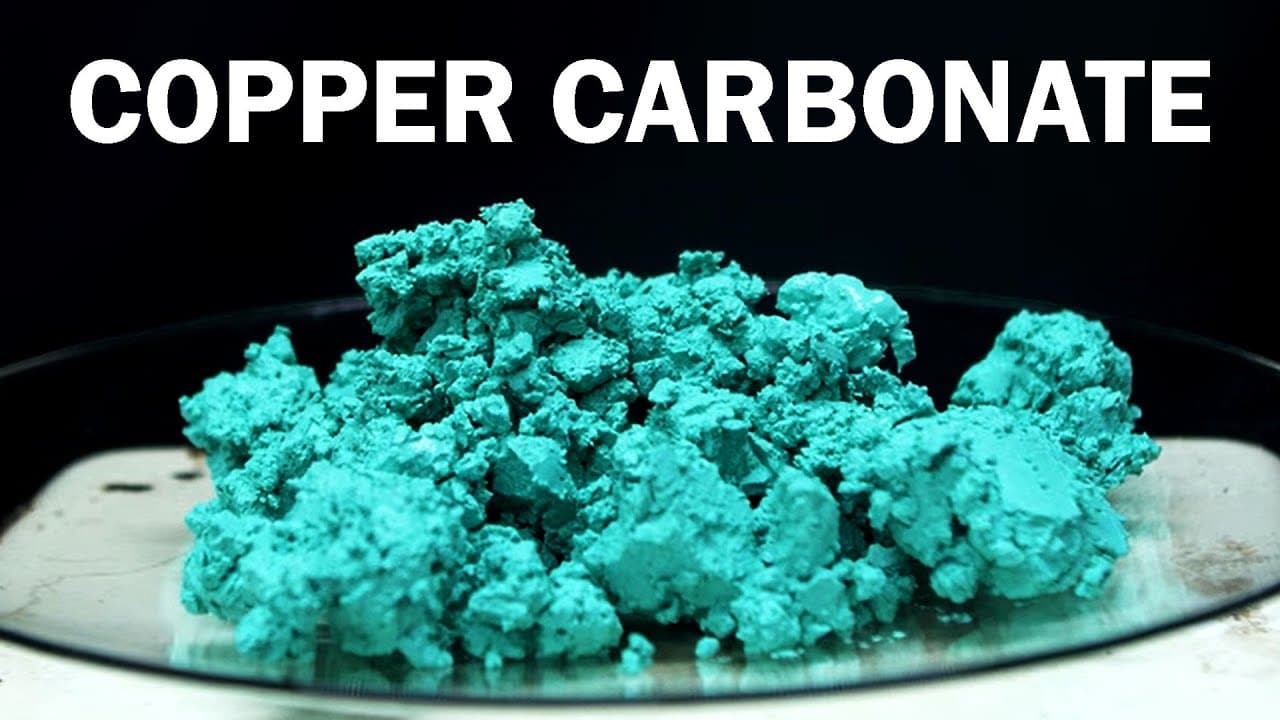
To make basic copper carbonate, combine copper sulfate pentahydrate with sodium carbonate in distilled water. The reaction produces a blue precipitate, which is filtered to separate it from impurities. After drying, the final product can be powdered and used as a catalyst in chemical reactions.
Transcript
Basic copper carbonate has a wide variety of uses. It can be used as a precursor to a lot of other copper salts, as a pigment or a dye, or even to control the growth and spread of aquatic weeds. For me though. I am not going to be using it for any of these and I'm actually going to be using it as a catalyst in a chemical reaction. For this preparat... Read More
Key Insights
- 🧑🏭 Basic copper carbonate has various applications, including acting as a catalyst and controlling aquatic weed growth.
- 💄 Copper sulfate pentahydrate and sodium carbonate are the main ingredients for making basic copper carbonate.
- 👻 Mixing the solutions and allowing the mixture to react forms the blue precipitate of basic copper carbonate.
- 💦 Vacuum filtration is used to separate the precipitate from the water and impurities.
- ❓ The final product may still contain some moisture and can be dried to obtain a fine powder.
- 💁 When cleaning the basic copper carbonate, hydrochloric acid is used to convert the copper back into a soluble form.
- 🎮 The video creator acknowledges Doug's Lab as a reference for the preparation method.
Install to Summarize YouTube Videos and Get Transcripts
Explore YouTube Video Summarizer or Get YouTube Transcript Extractor
Questions & Answers
Q: What are the uses of basic copper carbonate?
Basic copper carbonate has multiple uses, including serving as a precursor to other copper salts, a pigment or dye, and controlling the growth of aquatic weeds. Additionally, it can be used as a catalyst in chemical reactions, as shown in the video.
Q: Where can copper sulfate pentahydrate and sodium carbonate be purchased?
Copper sulfate pentahydrate can be purchased online, such as on eBay. Sodium carbonate can be made from sodium bicarbonate, as demonstrated in a previous video.
Q: What is the purpose of heating the solutions?
Heating the copper sulfate solution helps dissolve the copper sulfate pentahydrate, while heating the sodium carbonate solution aids in dissolving the sodium carbonate. This step ensures that all ingredients are fully mixed.
Q: Why is the copper carbonate separated using vacuum filtration?
Vacuum filtration is used to separate the basic copper carbonate from the remaining water and any impurities. The water is filtered off, leaving behind the solid copper carbonate.
Summary & Key Takeaways
-
The content focuses on the process of making basic copper carbonate as a catalyst.
-
Copper sulfate pentahydrate and sodium carbonate are used as the main ingredients.
-
The mixture undergoes a chemical reaction, resulting in the formation of basic copper carbonate.
Read in Other Languages (beta)
Share This Summary 📚
Summarize YouTube Videos and Get Video Transcripts with 1-Click
Try YouTube Summary with ChatGPT & Claude or YouTube Transcript Generator
Explore More Summaries from NileRed 📚

Summarize YouTube Videos and Get Video Transcripts with 1-Click
Try YouTube Summary with ChatGPT & Claude or YouTube Transcript Generator