How to Upgrade a DC Motor with an AS5600 Encoder
TL;DR
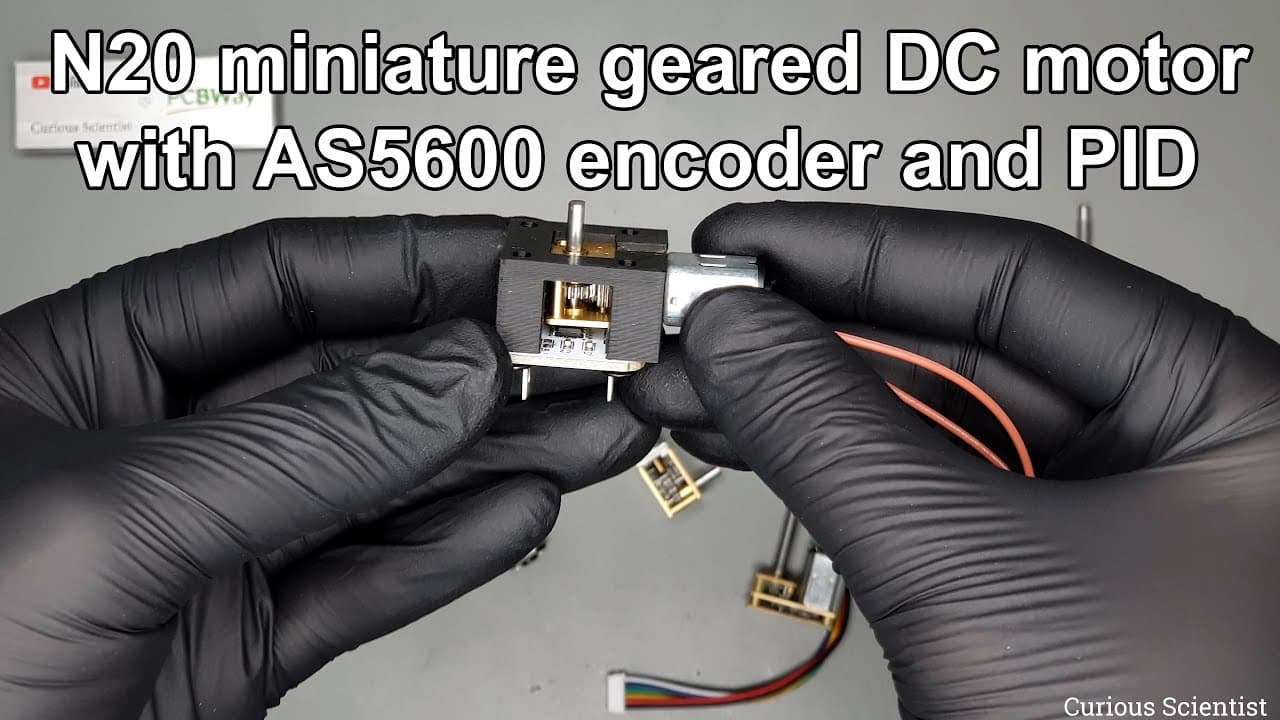
To upgrade a DC motor for improved positioning, attach an AS5600 magnetic encoder, which provides absolute angular position readings. This setup allows accurate tracking of motor movements, substantially enhancing performance when integrated with a PID control system using Arduino. It effectively addresses issues like backlash and mechanical slippage, resulting in better responsiveness and precision.
Transcript
welcome everyone in this video I'm going to show you a neat little upgrade for these miniature DC motors so these motors are typically equipped with some sort of gearbox for example this uh specific uh motor comes with a gearbox which has a right angle uh output shaft so you can see that uh the motor's gear uh or the first gear on the motor shaft i... Read More
Key Insights
- 🧑🦼 DC motors need encoders for precise positioning, as they cannot accurately determine their location without them.
- 🦾 The AS5600 magnetic encoder provides absolute angular position readings, enhancing feedback accuracy in mechanical systems.
- 👻 Integrating an encoder with an Arduino allows for dynamic real-time control through PID algorithms, improving motor accuracy.
- 😒 The video highlights the challenges associated with backlash in gearboxes and presents a solution through the use of absolute encoders.
- 🧘 The implementation of position feedback systems is crucial for applications requiring exact positioning and motion control.
- 🧘 The demonstration illustrated how small fluctuations in position readings can occur due to sensor resolution limitations.
- 🦾 Using a magnetic sensor helps mitigate the inaccuracies associated with mechanical flexibility in gears.
Install to Summarize YouTube Videos and Get Transcripts
Explore YouTube Video Summarizer or Get YouTube Transcript Extractor
Questions & Answers
Q: What is the primary limitation of the standard DC motors discussed in the video?
The main limitation of standard DC motors, particularly those without encoders, is their inability to accurately determine their position or movement. This limitation is due in part to mechanical backlash and slippage within the gearbox, which can lead to discrepancies between the motor's actual position and the commanded position.
Q: How does the AS5600 magnetic encoder enhance motor performance?
The AS5600 magnetic encoder enhances motor performance by providing absolute position feedback based on the magnetic field. It detects the position of a magnet aligned with the encoder, enabling precise measurements of rotational angle and allowing for accurate position control. This feedback significantly reduces the uncertainty associated with motor movement, improving overall system reliability for applications requiring precise positioning.
Q: What role does the Arduino play in the setup demonstrated in the video?
In the demonstrated setup, the Arduino serves as the central controller that processes the signals from the AS5600 encoder and drives the motor based on feedback. It implements a PID control algorithm to dynamically adjust the motor's position, ensuring that the motor accurately reaches and maintains the targeted angle. The Arduino also handles the display outputs of the target and actual positions, facilitating real-time monitoring.
Q: What common issue is associated with gearboxes in DC motors, and how is it addressed?
A common issue with gearboxes in DC motors is backlash, which can introduce inaccuracies in positioning. This is due to the mechanical play between gears, leading to slippage and misalignment. The video addresses this issue by integrating an absolute magnetic encoder that allows for real-time position tracking, thereby compensating for any inaccuracies introduced by the gearbox.
Q: What does the term "PPR" stand for, and what significance does it have in this context?
"PPR" stands for "Pulses Per Revolution," which refers to the number of distinct output pulses generated by an encoder for each full rotation of the motor shaft. In the context of this video, the PPR value directly influences the resolution and accuracy of position feedback provided by the encoder, with higher PPR resulting in finer positional control.
Q: Can you explain the significance of backlash and its impact on motor control?
Backlash refers to the slight movement or play in a mechanical system where the direction of motion is reversed, often leading to a lag in response or inaccuracies in positioning. In motor control, excessive backlash can undermine precision, making it difficult to accurately determine the motor's position. This can lead to overshooting or undershooting target positions, complicating applications that require tight control and reliability.
Summary & Key Takeaways
-
The video explains the limitations of standard DC motors, particularly in terms of positioning without encoders. It details how traditional setups are inadequate due to backlash and mechanical slippage.
-
The presenter introduces an upgrade using a magnetic encoder (AS5600), which allows tracking of motor position by detecting a magnet on the shaft, thereby increasing accuracy in control.
-
A demonstration showcases the integration of the encoder with a PID control system using an Arduino, highlighting how the setup improves motor responsiveness and positioning precision.
Read in Other Languages (beta)
Share This Summary 📚
Summarize YouTube Videos and Get Video Transcripts with 1-Click
Try YouTube Summary with ChatGPT & Claude or YouTube Transcript Generator
Explore More Summaries from Curious Scientist 📚
![Building a Peltier cooler-based cooling box - First iteration, improvements [Part 2/6] thumbnail](/_next/image?url=https%3A%2F%2Fi.ytimg.com%2Fvi%2F0YlNw0EGnzI%2Fhqdefault.jpg&w=750&q=75)
Summarize YouTube Videos and Get Video Transcripts with 1-Click
Try YouTube Summary with ChatGPT & Claude or YouTube Transcript Generator