Did AI Prove Our Proton Model WRONG?
TL;DR
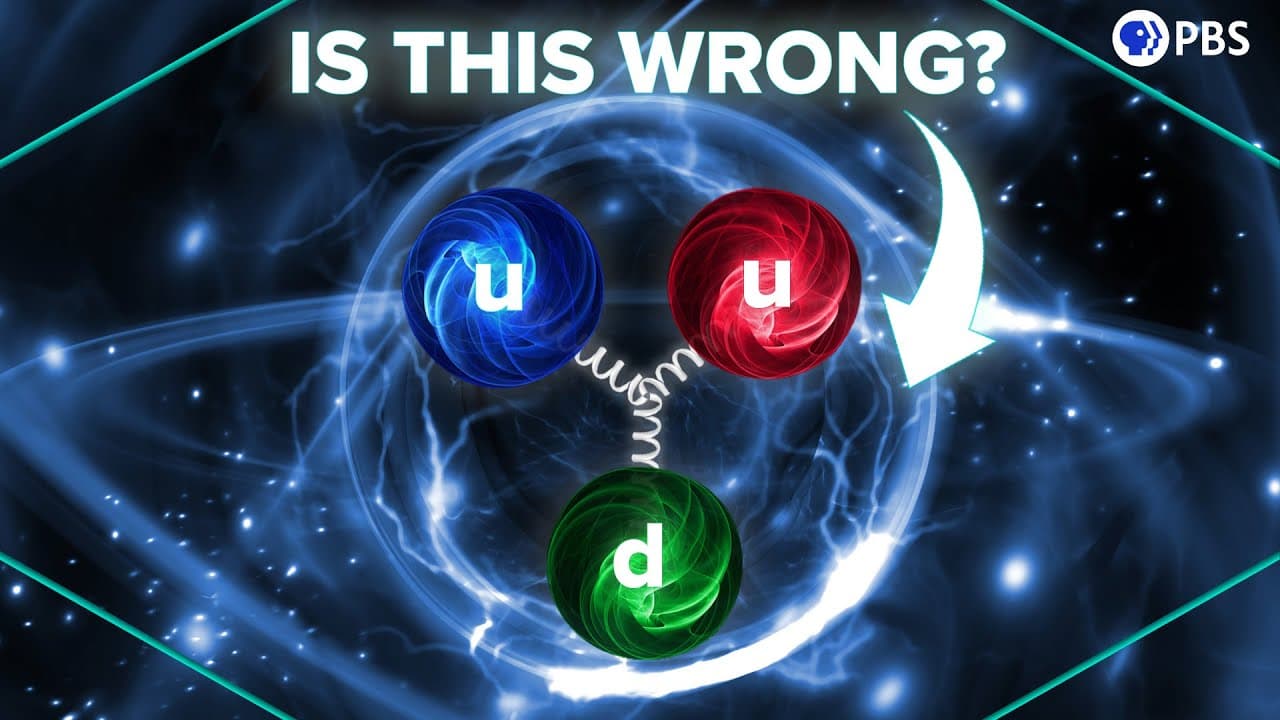
AI suggests protons may contain five quarks including charm quarks.
Transcript
People are made of cells, cells are made of molecules, molecules are made of atoms, atoms are made of electrons and proton and neutrons, and those last two are made up of three quarks. Simple stuff, right? All except for that last part. Protons and neutrons are actually made of many, many quarks that just happen to look like three quarks when you... Read More
Key Insights
- Protons, once thought to be made of three quarks, may contain five quarks, including charm quarks, under certain conditions.
- The understanding of protons has evolved significantly since the 1960s, with AI now providing new insights into their structure.
- Scattering experiments are crucial for probing the subatomic world, revealing the complex structure of protons beyond the simple three-quark model.
- The quark sea within protons is a dynamic environment where gluons transform into virtual quarks and antiquarks, contributing to the proton's complexity.
- Charm quarks, heavier than protons, are occasionally detected within them, suggesting they may be intrinsic to the proton's structure.
- Quantum chromodynamics (QCD) describes the strong nuclear force within protons, but modeling low-energy states remains challenging.
- AI has enabled the testing of numerous models simultaneously, revealing that models with intrinsic charm quarks better fit scattering data.
- The presence of intrinsic charm quarks in protons remains tentative, requiring further experiments to reach the gold standard of 5-sigma confidence.
Install to Summarize YouTube Videos and Get Transcripts
Explore YouTube Video Summarizer or Get YouTube Transcript Extractor
Questions & Answers
Q: What new insight has AI provided about protons?
AI has provided evidence suggesting that protons may contain five quarks, including charm quarks, rather than the traditionally accepted three. This insight challenges the long-held model of proton structure and opens new avenues for understanding subatomic particles.
Q: How do scattering experiments help in understanding protons?
Scattering experiments help in understanding protons by allowing scientists to probe their internal structure. By using high-energy particles to collide with protons, researchers can observe the resulting scattering patterns, revealing the complex interactions and components within protons, such as the quark sea and potential intrinsic charm quarks.
Q: What is the quark sea within protons?
The quark sea within protons is a dynamic environment where gluons continuously transform into virtual quark-antiquark pairs. These particles quickly annihilate each other, turning back into gluons. This constant flickering contributes to the complex internal structure of protons, beyond the simple three-quark model.
Q: Why is the presence of charm quarks in protons surprising?
The presence of charm quarks in protons is surprising because charm quarks are significantly heavier than protons. Their occasional detection within protons suggests they might be intrinsic to the proton's structure, challenging the traditional understanding and indicating a more complex internal environment than previously thought.
Q: How does quantum chromodynamics relate to the study of protons?
Quantum chromodynamics (QCD) is the theory describing the strong nuclear force within protons. It accounts for the interactions between quarks and gluons. However, modeling the low-energy states of protons using QCD is particularly challenging, making it difficult to fully understand the proton's internal structure without advanced computational tools like AI.
Q: What role does AI play in testing proton models?
AI plays a crucial role in testing proton models by enabling the simultaneous evaluation of hundreds or thousands of models. This approach allows for a comprehensive analysis of proton collision data, identifying models that best fit the evidence, including those suggesting the presence of intrinsic charm quarks, which were previously difficult to confirm.
Q: What is the significance of a 3-sigma result in scientific research?
A 3-sigma result in scientific research indicates a 1 in 1000 chance that the observed outcome is due to random chance. While significant, it is not definitive. The gold standard is a 5-sigma result, which corresponds to a 1 in a million chance of error, providing much stronger evidence for a scientific claim, such as the existence of intrinsic charm quarks in protons.
Q: How might future experiments confirm the presence of charm quarks in protons?
Future experiments might confirm the presence of charm quarks in protons by conducting more high-energy scattering experiments to gather additional data. Improved AI models and machine learning techniques could also enhance the analysis of collision data, potentially reaching the 5-sigma confidence level required for definitive confirmation of intrinsic charm quarks within protons.
Summary & Key Takeaways
-
Protons, once thought to contain only three quarks, may actually contain five, including the heavier charm quark, challenging traditional models.
-
Scattering experiments, crucial to understanding subatomic structures, have revealed the complex interior of protons, including the quark sea and potential intrinsic charm quarks.
-
AI has revolutionized the study of proton structures by testing numerous models simultaneously, suggesting intrinsic charm quarks may exist within protons, pending further validation.
Read in Other Languages (beta)
Share This Summary 📚
Summarize YouTube Videos and Get Video Transcripts with 1-Click
Try YouTube Summary with ChatGPT & Claude or YouTube Transcript Generator
Explore More Summaries from PBS Space Time 📚


Summarize YouTube Videos and Get Video Transcripts with 1-Click
Try YouTube Summary with ChatGPT & Claude or YouTube Transcript Generator