Why Are Latin Sayings So Memorable?
TL;DR
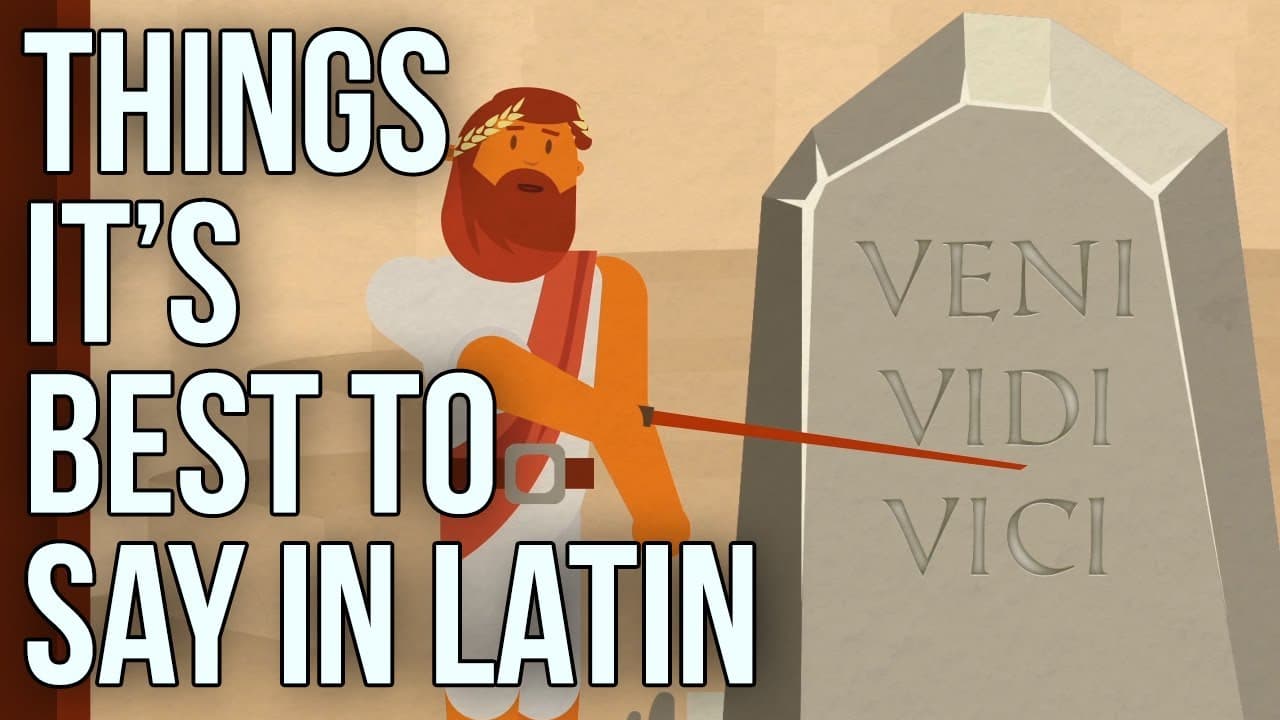
Latin sayings are celebrated for their conciseness and depth, often conveying complex ideas in fewer words than English. Phrases like 'Veni, vidi, vici' and 'Carpe diem' illustrate how Latin's grammatical structure enhances their impact, making them timeless expressions that resonate across cultures.
Transcript
Latin sentences and sayings seem to be designed to be carved out of stone this is a matter of their concision and weightiness because of its highly inflected grammatical structure Latin uses far fewer words to express something that a non-inflicted language such as English here are some of our favorite Latin sayings Veni VII vichi Julius Caesar's m... Read More
Key Insights
- 👻 Latin's inflected grammatical structure allows for greater expressiveness and succinctness in communication compared to non-inflected languages like English.
- 🔑 Phrases like "Veni, vidi, vici," attributed to Julius Caesar, exemplify how Latin can convey triumphant messages in remarkably few words.
- 🙊 Latin sayings often encapsulate complex philosophies, such as "Carpe diem," which speaks to the ethos of seizing opportunities in life.
- 🪈 The ability of Latin to manipulate word order adds a layer of poetic ambiguity and richness, enhancing the memorability of its sayings.
- 😑 Well-crafted Latin expressions often carry a weightiness that lends them a timeless quality, making them stand the test of history.
- 🙏 The use of subjunctive forms in Latin, like "requescat in pace," allows for expressions of wishes or hopes that resonate with emotional depth.
- 💄 The structural and aesthetic qualities of Latin contribute to its enduring appeal, making it a choice language for memorializing ideas and ideals.
Install to Summarize YouTube Videos and Get Transcripts
Explore YouTube Video Summarizer or Get YouTube Transcript Extractor
Questions & Answers
Q: What makes Latin sayings particularly memorable compared to English phrases?
Latin sayings often possess a unique blend of conciseness and weightiness due to their inflected grammatical structure. This allows them to convey complex meanings in fewer words, creating a resonance that is often lost in English translations, which tend to require more elaborate phrasing.
Q: Why is "Carpe diem" a significant Latin saying?
"Carpe diem," which translates to "seize the day," encapsulates Epicurean philosophical ideas about the importance of living in the moment. Its succinctness and rhythmic balance contribute to its memorability, and it has become widely adopted in various cultural contexts, enhancing its legacy.
Q: How do grammatical structures in Latin influence the meaning of sayings?
The inflectional nature of Latin means that verbs and nouns carry significant grammatical information. This allows for flexibility in word order and often results in a more impactful delivery of ideas, as seen in phrases where emotional or contextual contrasts are highlighted through placement.
Q: Can you provide an example of a Latin saying that demonstrates its playful nature?
The saying "parturient montes, nascetur ridiculus mus" from Horace's works plays on the expectation of grand outcomes from considerable effort, ultimately humorously illustrating the disparity between effort and results. The playful manipulation of language accentuates the humor while illustrating a clever point about expectation versus reality.
Summary & Key Takeaways
-
Latin sayings are known for their conciseness and weightiness, often requiring fewer words than their English counterparts to convey similar meanings, making them an art form in communication.
-
Notable phrases like "Veni, vidi, vici" and "Carpe diem" showcase Latin's unique grammatical structure that allows for significant depth and richness in meaning, often resulting in English translations lacking the same impact.
-
The grammatical inflections of Latin provide a unique ability to manipulate word order, enhancing the memorability and expressiveness of phrases, contributing to their enduring relevance and architectural grandeur over time.
Read in Other Languages (beta)
Share This Summary 📚
Summarize YouTube Videos and Get Video Transcripts with 1-Click
Try YouTube Summary with ChatGPT & Claude or YouTube Transcript Generator