Why Is Apple Using Google to Rebuild Siri?
TL;DR
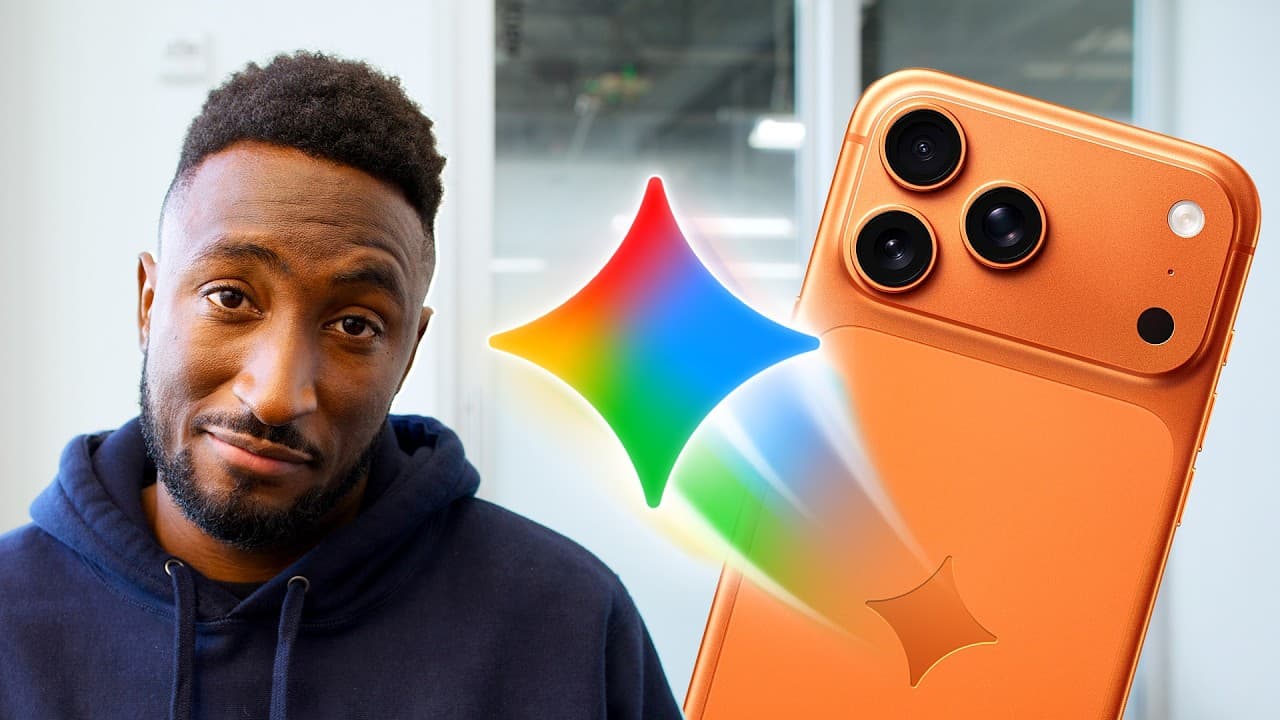
Apple plans to release a major Siri update during 2026 using Google’s technology as the foundation for Apple’s own models. The partnership could improve Siri’s understanding and capabilities while Apple adds its interface, features, and privacy protections, potentially reducing its reliance on ChatGPT and helping the iPhone compete more closely with AI experiences already available on Android phones.
Transcript
So, the headline is that the big Siri update we've all been waiting for is finally going to be coming in 2026, and it will be powered by Google. Now, we knew this was coming. This was a rumor for a while. We've talked about it in the past. Apple continued for the last couple of months to just spin their wheels and Siri continued to suck. Uh, I made... Read More
Key Insights
- Apple has confirmed that Google’s technology will provide the foundation for Apple’s models behind a major Siri update expected during 2026. The exact release timing and partnership terms remain unknown, with a formal announcement potentially coming at Apple’s WWDC event in June.
- The Google partnership is a practical response to Siri’s continuing limitations and Apple’s delays in delivering previously advertised AI capabilities. The presenter argues that using an established competitor’s models makes sense if Apple’s priority is providing users with the strongest available experience.
- Google was selected after what Apple described as a careful evaluation of available technology. The presenter considers Gemini a strong foundation because it already performs well on Android phones and now incorporates many capabilities previously associated with Google Assistant.
- Apple’s existing ChatGPT integration currently handles complex Siri requests involving world knowledge or multiple steps. A substantially improved Siri based on Google’s models could handle more of those requests itself, creating uncertainty about the future role of Apple’s partnership with OpenAI.
- Foundation models can improve Siri’s understanding and intelligence, but Apple must still create the features, integrations, and user experience built on top of them. The final product will therefore depend on how effectively Apple customizes Google’s underlying technology for its devices.
- Privacy is expected to remain a major part of Apple’s implementation. The presenter notes that using Google’s technology as a model foundation does not inherently mean user requests will be sent to Google, particularly if relevant models and processing operate on the device.
- Circle to Search is presented as an example of a useful Google-powered capability that could benefit iPhone users. Apple currently offers a more limited screenshot and highlighting workflow, while deeper integration could enable direct searches for text, images, locations, or signs shown onscreen.
- Control of the interface may matter more than ownership of the underlying AI model. The presenter argues that Apple can use external models while retaining customers through the iPhone experience, much as Raycast lets users select different models without surrendering control of its interface.
Install to Summarize YouTube Videos and Get Transcripts
Explore YouTube Video Summarizer or Get YouTube Transcript Extractor
Questions & Answers
Q: Why is Apple using Google technology to rebuild Siri?
Apple said that, after careful evaluation, Google’s technology offered the most capable foundation for Apple’s models. The presenter interprets the decision as a practical response to Siri’s poor performance and Apple’s delayed AI features. Rather than continuing to rely exclusively on internal progress, Apple can build its own Siri experience on technology that already performs strongly in Gemini on Android phones.
Q: When will the Google-powered Siri update be released?
Apple’s major Siri update is expected at some point during 2026, but the transcript provides no exact release date. The presenter assumes Apple may formally announce the revamped assistant at its WWDC event in June. That timing would place the announcement about two years after Apple originally introduced its planned major Siri update, according to the presenter.
Q: Will Google receive Siri users’ personal requests?
Using Google’s technology as the foundation for Apple’s models does not inherently mean Siri will send users’ requests to Google. The presenter suggests that models could operate on the device while Apple adds its own functions and protections. The precise architecture has not been announced, but Apple’s previous ChatGPT integration included substantial work intended to preserve user privacy when outside processing was required.
Q: What will happen to Siri’s ChatGPT integration?
The future of Siri’s ChatGPT integration is not yet known. Siri currently sends certain complex requests to ChatGPT when they require broader world knowledge or multiple steps. If Google’s models make the rebuilt Siri capable of completing those tasks independently, it may no longer need to transfer as many requests to ChatGPT, raising questions about the continuing purpose and scope of Apple’s OpenAI partnership.
Q: How much better could Google’s models make Siri?
The presenter expects Google’s models could make Siri substantially better because Gemini already performs well on Android phones and includes many older Google Assistant functions. The foundation could improve Siri’s understanding, intelligence, and ability to interpret requests. However, the final result also depends on Apple’s implementation, including the features, integrations, privacy measures, and device controls it builds above the underlying models.
Q: Could Circle to Search come to the iPhone through this deal?
The partnership creates the possibility of a richer search experience resembling Android’s Circle to Search, although no such iPhone feature has been confirmed. Apple currently offers a limited workflow that involves taking a screenshot, highlighting an item, and performing an image search. A deeper implementation could potentially search text, identify images, and retrieve information about locations, signs, or other onscreen content.
Q: Does Apple need to own the AI model behind Siri?
The presenter argues that owning the underlying model may be less important than controlling the interface through which people use it. Raycast illustrates this idea by letting subscribers choose among models such as ChatGPT, Gemini, or Grok while keeping users inside Raycast’s tools and experience. Similarly, Apple can rely on Google’s models while retaining control of Siri, the iPhone interface, and customer relationships.
Q: How could the Siri partnership help Apple retain iPhone users?
The partnership could remove AI capability as a reason for customers to leave the iPhone for a Pixel, Samsung phone, or another Android device. If Apple can offer features and experiences comparable to those available on Android, users may be less motivated to switch platforms. Apple would keep control of the iPhone experience while gaining the benefits of stronger underlying models and potentially improving Siri’s reputation.
Summary & Key Takeaways
-
Apple and Google have confirmed that Google’s technology will provide the foundation for Apple’s models behind a major Siri update planned for 2026. The presenter views the partnership as evidence that Apple’s internal AI efforts have struggled, but also as a practical decision to deliver a more capable assistant to iPhone users.
-
Google’s models could give Siri stronger understanding and reasoning, while Apple builds its own functionality, privacy protections, and device experiences on top. The presenter expects Gemini’s existing quality and its integration with older Google Assistant features to provide a promising base, although the final quality of Apple’s customization remains unknown.
-
The partnership raises questions about Apple’s existing ChatGPT integration and whether an improved Siri will still need to send complex requests elsewhere. More broadly, the deal suggests that controlling the interface and retaining users may matter more than owning the underlying model, especially if comparable AI features reduce reasons to switch from iPhone to Android.
Read in Other Languages (beta)
Share This Summary 📚
Summarize YouTube Videos and Get Video Transcripts with 1-Click
Try YouTube Summary with ChatGPT & Claude or YouTube Transcript Generator
Explore More Summaries from Marques Brownlee 📚


Summarize YouTube Videos and Get Video Transcripts with 1-Click
Try YouTube Summary with ChatGPT & Claude or YouTube Transcript Generator