How to Find Credible Sources for Research | Finding Reliable Sources
TL;DR
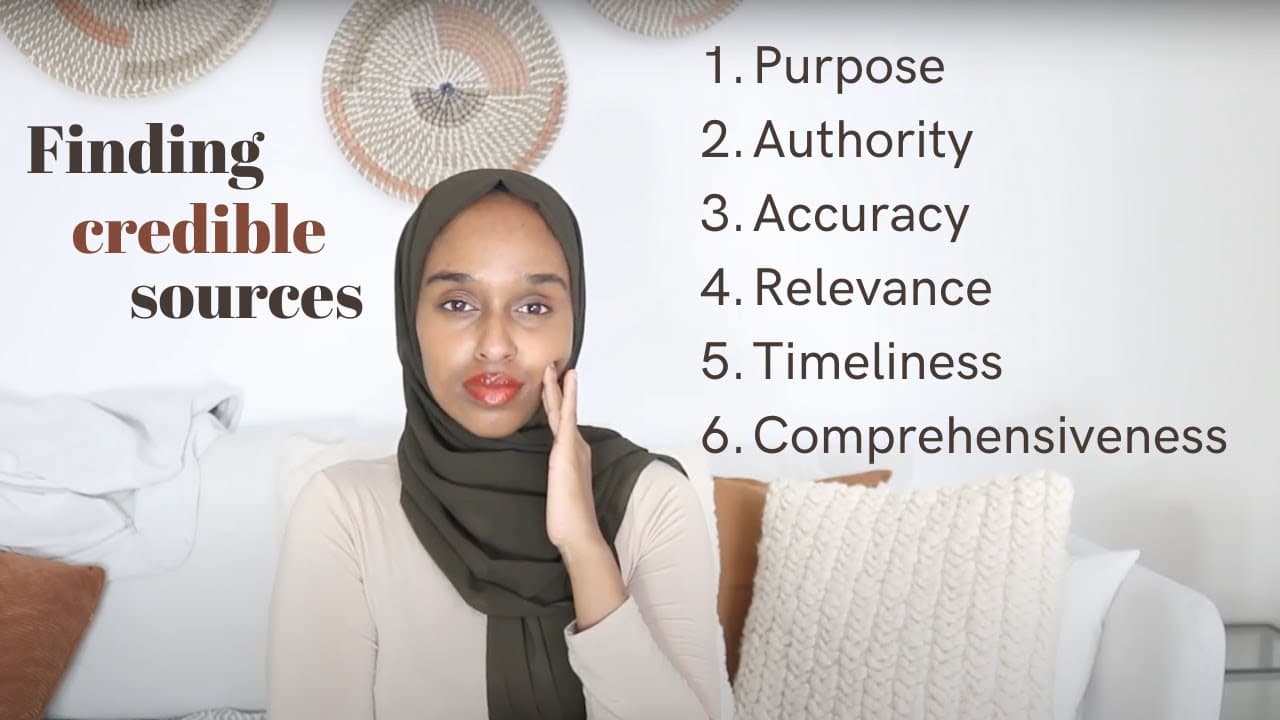
To find credible sources for research, evaluate their purpose, authority, accuracy, relevance, timeliness and comprehensiveness before using them in academic work. Check who created and published each source, whether its claims can be verified, and whether funding or sales motives may shape its message. Read on for practical questions that help assess papers, articles, books and online information.
Transcript
hey everyone and welcome back to my channel my name is amina and if you are new here welcome welcome i've used content all about academia juggling that with motherhood and productivity and absolutely love it if you would subscribe to see more from me today's video is all about credibility of sources now in research we talk a lot and i've done loads... Read More
Key Insights
- "the first thing is the purpose what is the reason that this source exists" (1:58)
- "the second thing is the authority authority is kind of split into two so you've got a which is the authority of the source and b the authority of the publisher itself" (3:24)
- "for the authority of the source you need to think about who is the source" (3:32)
- "the third is accuracy so accuracy is can this information be verified how reliable and how true is this content" (4:59)
Install to Summarize YouTube Videos and Get Transcripts
Explore YouTube Video Summarizer or Get YouTube Transcript Extractor
Questions & Answers
Q: How do you determine whether a source is credible for research?
Examine the source's purpose, the authority of its creator and publisher, and whether its information can be verified. Also consider whether it is relevant, timely and comprehensive enough for your research or assignment.
Q: Why does the purpose of a source matter?
A source intended to educate should present information in an educational, unbiased way and cover both sides. A source intended to sell may use pushy or emotive language, making it potentially less credible for the researcher's particular purpose.
Q: How can you identify a source that is trying to sell something?
Check whether it clearly identifies itself as an advertisement, states that it is selling a product, or links to a particular product. Pushy presentation and emotive language can also reveal a sales purpose.
Q: How can research funding affect source credibility?
Funding can indicate the intentions or perspective behind a research paper. The transcript gives the example of pro-vaccine research funded by a pharmaceutical company and advises deciding whether that source is appropriate to use.
Q: What does authority mean when evaluating a source?
Authority has two parts: the authority of the source and the authority of the publisher. Researchers should assess who created the content, what credentials that person has, where it was published and why the publisher shared it.
Q: How do you assess the authority of a content creator?
Identify who wrote, designed or created the content and whether their credentials support the subject they discuss. Check whether contact details are available so that further questions can be asked.
Q: How do you assess the authority of a publisher?
Look at where the information was published and what type of website or platform it is. Consider whether the publisher was paid, is informing readers, is addressing an issue, or may have its own agenda.
Q: What does accuracy mean when checking a research source?
Accuracy asks whether the information can be verified and how reliable and true the content is. A source that can be edited by anyone may require extra caution before it is included in a reference list.
Summary & Key Takeaways
-
Amina discusses the importance of determining source credibility for academic work, focusing on factors like the purpose, authority, accuracy, relevance, timeliness, and comprehensiveness of the source.
-
She emphasizes the need to analyze the purpose of the source, the authority of both the content creator and the publisher, the accuracy of the information, relevance to the topic, timeliness of publication, and comprehensiveness of the source.
-
By considering these factors, researchers and students can ensure that the sources they use are credible and reliable for their work.
Read in Other Languages (beta)
Share This Summary 📚
Summarize YouTube Videos and Get Video Transcripts with 1-Click
Try YouTube Summary with ChatGPT & Claude or YouTube Transcript Generator
Explore More Summaries from Dr Amina Yonis 📚


Summarize YouTube Videos and Get Video Transcripts with 1-Click
Try YouTube Summary with ChatGPT & Claude or YouTube Transcript Generator