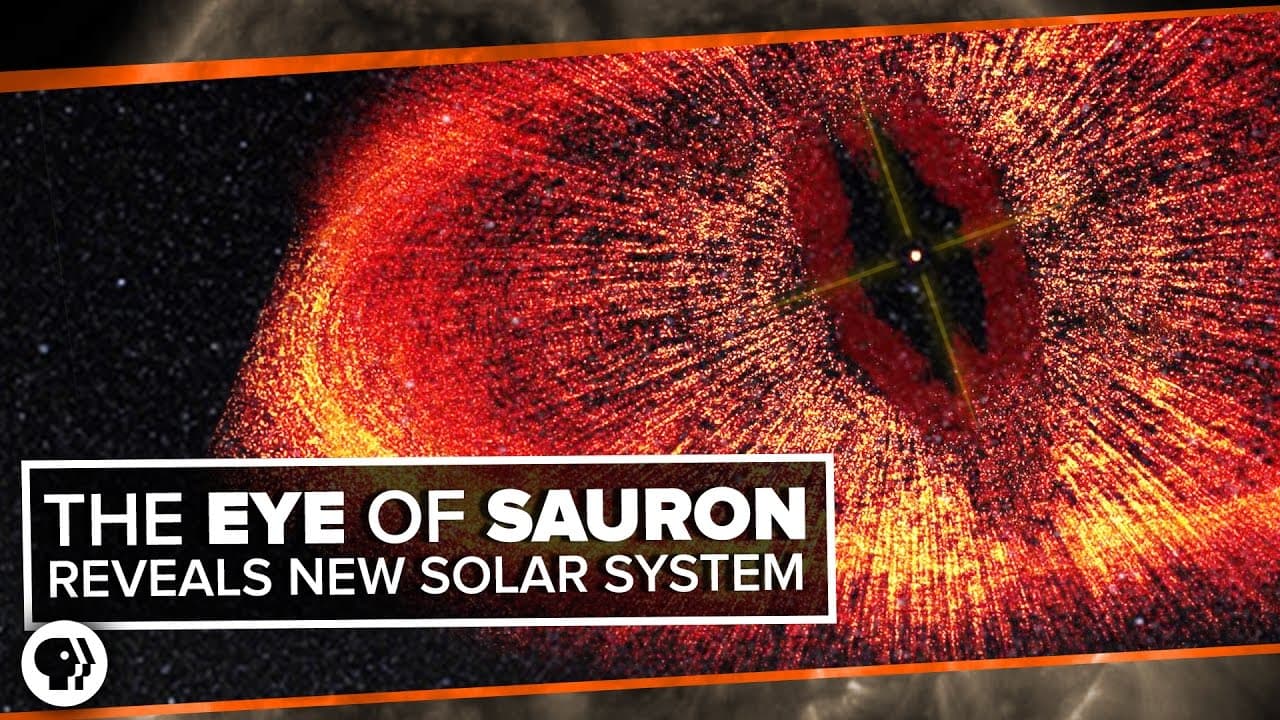
The Eye of Sauron Reveals a Forming Solar System!
TL;DR
Fomalhaut's dust ring offers insights into solar system formation.
Transcript
[MUSIC PLAYING] Today's episode is supported by CuriosityStream. It's well-known that after his defeat at the end of the third age, the Dark Lord Sauron fled Mordor into the sky and traveled about 25 light years towards the constellation Piscis Austrinus. We still see his terrible flaming eye gazing down at us, biding his time. The incredible Hubbl... Read More
Key Insights
- Fomalhaut is a young A-type star surrounded by a massive ring of ice and dust, which is a remnant of its protoplanetary disk. This ring provides a unique opportunity to study the processes that lead to the formation of planetary systems.
- The coronagraph technique is used to block Fomalhaut's bright light, allowing astronomers to study the surrounding structures. This reveals a giant ring of debris, indicating ongoing processes similar to early solar system formation.
- Fomalhaut's ring is thought to be shaped by newly formed planets, similar to how shepherd moons shape Saturn's rings. These planets may guide the dust into a well-defined path, creating sharp edges in the ring.
- The planet Fomalhaut B, also known as Dagon, has an eccentric orbit and may be surrounded by a reflective ring system. Its visibility in Hubble images but not in infrared suggests it might be a smaller planet still forming.
- Fomalhaut's retention of its protoplanetary disk for an unusually long time raises questions about its developmental stage compared to other stars. This could provide insights into the timeline and processes of planetary formation.
- The existence of two stellar companions in the Fomalhaut system makes it a rare trinary star system. These companions might also have protoplanetary disks, indicating a shared origin and formation time.
- The presence of a flare star as a companion adds complexity to the system, with its variable brightness due to magnetic storms potentially affecting the surrounding environment.
- Understanding Fomalhaut's unique characteristics and comparing them with other young stars will help determine if it is typical or an anomaly, thereby enhancing our knowledge of stellar and planetary formation.
Install to Summarize YouTube Videos and Get Transcripts
Explore YouTube Video Summarizer or Get YouTube Transcript Extractor
Questions & Answers
Q: What is the significance of Fomalhaut's dust ring?
Fomalhaut's dust ring is significant because it is a remnant of the star's protoplanetary disk, offering a glimpse into the processes that lead to planetary system formation. By studying this ring, astronomers can gain insights into how planets form and evolve, which is crucial for understanding the origins of our own solar system.
Q: How does the coronagraph technique help in studying Fomalhaut?
The coronagraph technique helps by blocking the bright light of Fomalhaut, allowing astronomers to observe the surrounding structures without interference. This technique reveals the giant ring of debris around the star, which is critical for studying the processes of planetary formation and the dynamics of the protoplanetary disk.
Q: What role do shepherd planets play in shaping Fomalhaut's dust ring?
Shepherd planets play a crucial role in shaping Fomalhaut's dust ring by guiding the dust into a well-defined path, creating sharp edges. These planets, similar to Saturn's shepherd moons, exert gravitational forces that influence the movement of dust particles, maintaining the structure and boundaries of the ring.
Q: What are the characteristics of the planet Fomalhaut B?
Fomalhaut B, also known as Dagon, has an eccentric orbit and is visible in Hubble images but not in infrared. This suggests it might be a smaller planet still forming or a collection of debris from a collision. Its characteristics, including a potential reflective ring system, make it an intriguing object for study.
Q: Why is Fomalhaut's retention of its protoplanetary disk unusual?
Fomalhaut's retention of its protoplanetary disk is unusual because, at 440 million years old, it is still holding onto part of its disk. This prolonged developmental stage raises questions about its timeline compared to other stars, offering a unique opportunity to study the processes and duration of planetary formation.
Q: How does Fomalhaut's trinary star system impact its study?
Fomalhaut's trinary star system, with two stellar companions, provides a rare opportunity to study early star formation. The presence of companions, possibly with their own protoplanetary disks, indicates a shared origin, adding complexity and depth to our understanding of stellar and planetary development in multi-star systems.
Q: What is the significance of the flare star in Fomalhaut's system?
The flare star in Fomalhaut's system is significant because its variable brightness, caused by magnetic storms, can affect the surrounding environment. Studying this star helps astronomers understand the interactions and dynamics within the system, contributing to our knowledge of how such stars influence their surroundings.
Q: What questions remain about Fomalhaut and its planetary system?
Several questions remain, such as whether Fomalhaut is typical of young stars or an anomaly, the true nature of Fomalhaut B, and the causes of its visible-infrared light mismatch. Further observations are needed to understand its planetary system's formation and evolution, which could provide insights into our solar system's early years.
Summary & Key Takeaways
-
Fomalhaut, a young A-type star, is surrounded by a massive ring of ice and dust, remnants of its protoplanetary disk. This provides an opportunity to study planetary system formation processes, similar to those that shaped our solar system billions of years ago.
-
The planet Fomalhaut B, or Dagon, has an eccentric orbit and may be surrounded by a reflective ring system. Its visibility in Hubble images but not in infrared suggests it might be a smaller planet still forming, or a collection of debris from a collision.
-
Fomalhaut's trinary star system, with two stellar companions, adds complexity and offers a rare chance to study early star formation. The system's unique characteristics could reveal whether Fomalhaut is typical or an anomaly among young stars.
Read in Other Languages (beta)
Share This Summary 📚
Summarize YouTube Videos and Get Video Transcripts with 1-Click
Try YouTube Summary with ChatGPT & Claude or YouTube Transcript Generator
Explore More Summaries from PBS Space Time 📚






Summarize YouTube Videos and Get Video Transcripts with 1-Click
Try YouTube Summary with ChatGPT & Claude or YouTube Transcript Generator