How to make Propanal (propionaldehyde)
TL;DR
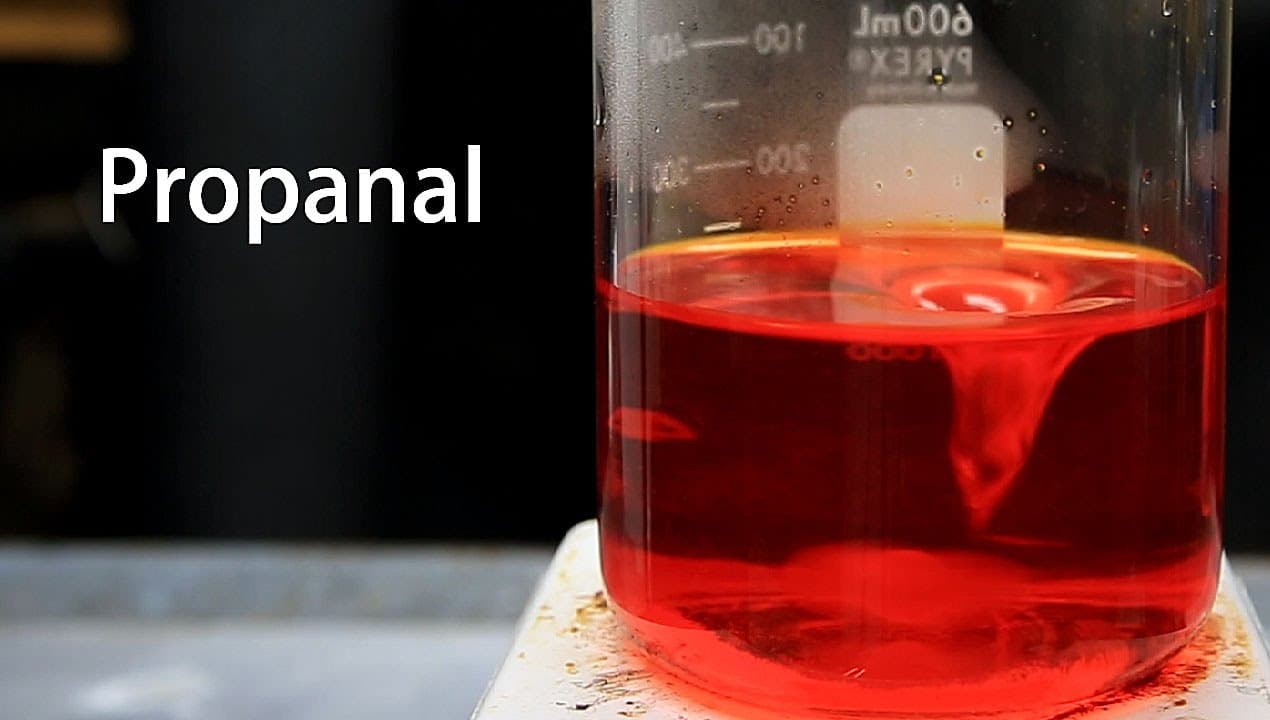
Propanal (propionaldehyde) is made by oxidizing n-propanol with a potassium dichromate and sulfuric acid solution, then distilling the aldehyde out of the mixture immediately before it over-oxidizes to the carboxylic acid. This run used 25 mL of n-propanol, 33 g of potassium dichromate, and 24 mL of concentrated sulfuric acid, giving about 11 mL of product at roughly 46% yield. A 60 C condenser is the key trick that lets the aldehyde pass while returning unreacted alcohol. Read on for the full setup and purification steps.
Transcript
propene aldehyde is very specialized uses and none of which I'm very interested in except for one I plan to use the propyne aldehyde in a Fisher indole synthesis to produce cattle scat ole is an interesting molecule which unsurprisingly has the strong smell of feces so naturally I would definitely want to make it so for this experiment I used 25 mi... Read More
Key Insights
- 👃 Propionaldehyde has a distinct smell of feces, which makes it an interesting molecule to synthesize.
- ❓ The Fisher indole synthesis method can be used to synthesize propionaldehyde.
- ❓ A specialized distillation setup is necessary to separate the propionaldehyde from the reaction mixture promptly.
- ❓ The yield of propionaldehyde obtained in this synthesis is approximately 46%, consistent with literature reports.
- 😒 Purification of the propionaldehyde involves the use of activated sieves and fractional distillation.
- ❓ Potassium dichromate is used in the synthesis as an oxidizing agent.
- 💦 Safety precautions, such as adding acid to water and not the other way around, should be followed during the synthesis.
Install to Summarize YouTube Videos and Get Transcripts
Explore YouTube Video Summarizer or Get YouTube Transcript Extractor
Questions & Answers
Q: What is the best method to prepare propanal (propionaldehyde)?
Propanal is prepared by oxidizing n-propanol with a chromic acid solution made from potassium dichromate and concentrated sulfuric acid. The chromic acid is added dropwise to boiling n-propanol, and the aldehyde is distilled off as it forms. This run gave about 11 mL of product at a roughly 46% yield, consistent with the 45 to 50% reported in the literature.
Q: Is propanal an aldehyde, and how is it formed here?
Yes. In this synthesis n-propanol, an alcohol, is oxidized by the sulfuric acid and potassium dichromate mixture to its corresponding aldehyde, propanal. You can watch the chromium change from an orange +6 oxidation state to a green +3 state as it accepts three electrons from the alcohol.
Q: What chemicals and amounts are needed to make propanal?
The reaction uses 25 mL of n-propanol, 33 g of potassium dichromate, 24 mL of concentrated sulfuric acid, and 200 mL of distilled water. The acid is always added to the water, not the other way around, to avoid a dangerous exotherm. The dichromate is not exothermic and can be added all at once.
Q: Why is a specialized distillation setup necessary for this synthesis?
The product must be pulled out of the reaction mixture as soon as it forms, because if it stays too long in the acidic oxidizing mixture it can be oxidized all the way to the carboxylic acid, which is undesirable. The setup is designed to remove propanal promptly while keeping the starting material in the flask.
Q: Why is the condenser run at 60 C instead of cold water?
n-Propanol boils at around 97 C while propanal boils at around 50 C. Running 60 C water through the first condenser lets the propanal vapor pass through but recondenses the unreacted n-propanol back into the flask. After that hot condenser, a normal cold condenser does a simple distillation to collect the product.
Q: What yield of propanal was achieved?
The synthesis produced about 11 mL of crystal-clear propanal, corresponding to a yield of roughly 46%. Although this is a low yield, it is consistent with the literature, which reports yields between 45 and 50%.
Q: How is the propanal purified after the reaction?
Activated molecular sieves are added and stirred for several minutes to remove any water. A fractional distillation is then carried out, collecting the fraction that boils between 48 and 53 C. The purified product is stored in a small amber glass vial with sieves at the bottom to keep it dry.
Q: What is propanal used for in this video?
The maker plans to use the propanal in a Fischer indole synthesis to produce scat (skatole), a molecule that has the strong smell of feces. The propanal itself is made first by the potassium dichromate oxidation shown here.
Summary & Key Takeaways
-
Propionaldehyde, known for its distinct smell of feces, can be synthesized using a Fisher indole synthesis method.
-
The reaction requires n-propanol, potassium dichromate, concentrated sulfuric acid, and distilled water.
-
A specialized distillation setup is necessary to ensure the propionaldehyde is separated from the reaction mixture promptly.
Read in Other Languages (beta)
Share This Summary 📚
Summarize YouTube Videos and Get Video Transcripts with 1-Click
Try YouTube Summary with ChatGPT & Claude or YouTube Transcript Generator
Explore More Summaries from NileRed 📚
Summarize YouTube Videos and Get Video Transcripts with 1-Click
Try YouTube Summary with ChatGPT & Claude or YouTube Transcript Generator