Why Is Anthropic Relaxing Its AI Safety Policy?
TL;DR
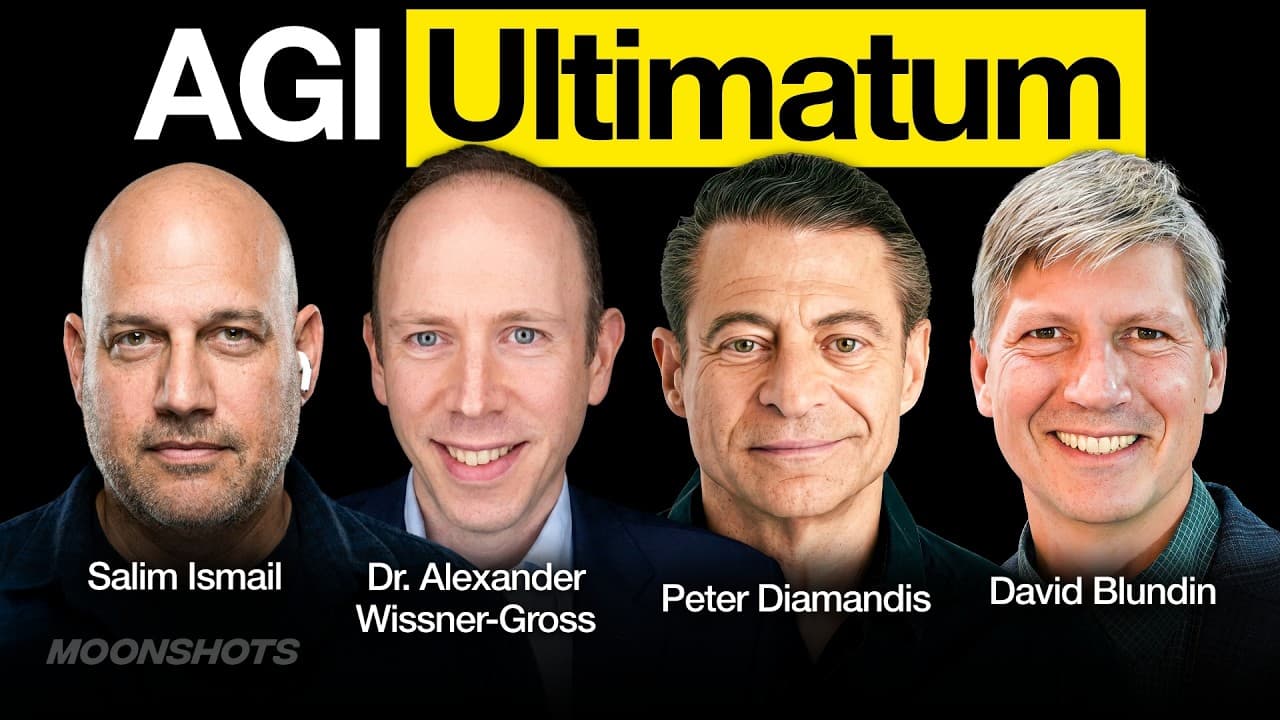
Anthropic relaxed its pledge not to train advanced AI without guaranteed safety because competitors continue advancing and no credible mechanism currently stops the race. The hosts disagree on the remedy: some warn that competitive pressure creates a dangerous slide, while another argues that safety must emerge from competition, shared oversight, and civilization-wide alignment rather than any single heroic laboratory.
Transcript
Amazon uh makes a contingent offer to put $35 billion into open AI based upon them first off going public and secondly achieving AGI. It's kind of incredible that we've financialized uh super intelligence which is amazing. The open AI to Microsoft definition of AGI was something like generating hundred billion in either earnings or revenue. I I for... Read More
Key Insights
- Anthropic is replacing an absolute safety condition with a competition-relative standard, shifting from refusing to train advanced AI without guaranteed safety to developing it as safely as rival laboratories develop their own systems.
- Competitive pressure is described as a force that gradually weakens original ethical commitments, because organizations must choose between preserving unilateral restrictions and remaining relevant while rivals continue advancing without equivalent limits.
- AI safety lacks a credible mechanism for slowing the current race, according to several hosts, because voluntary pauses and individual corporate pledges cannot reliably bind every frontier laboratory or nation participating in development.
- Civilization-wide alignment is presented as an alternative to unilateral control, based on the argument that humanity collectively supplied the online content used to pre-train advanced systems and may likewise need to co-align and co-scale them.
- Competition is proposed as a possible source of safety through balanced and separated power, although the participants disagree about whether this process could create an emergent safety property or instead produce a slide toward weaker standards.
- Truth-seeking AI is described as only one component of alignment, because avoiding censorship or a single imposed worldview does not resolve job losses, privacy risks, commercial persuasion, consumer protection, or inadequate regulation.
- Consumer AI incentives are identified as a near-term risk, since companies needing revenue may use accumulated private information to persuade people and sell products, repeating the gradual expansion of data collection described in the Google example.
- Amazon's proposed $35 billion OpenAI investment is described as contingent on an initial public offering and achieving AGI, illustrating how the discussion says intelligence milestones are increasingly defined through financial conditions and dollar-based measurements.
Install to Summarize YouTube Videos and Get Transcripts
Explore YouTube Video Summarizer or Get YouTube Transcript Extractor
Questions & Answers
Q: Why did Anthropic relax its responsible scaling policy?
Anthropic relaxed its policy because competitors continue training increasingly capable AI systems without matching restrictions. The discussion says maintaining a unilateral promise not to train advanced AI unless safety is guaranteed could make Anthropic irrelevant without stopping anyone else. The revised approach is described as building systems as safely as competitors build theirs, a more competitive but potentially weaker standard.
Q: What was Anthropic's original advanced AI safety pledge?
Anthropic's 2023 pledge was described as a commitment not to train advanced AI unless safety could be guaranteed. The hosts say the company is moving away from that absolute condition amid increased competition. Its new position is characterized as developing AI as safely as competing laboratories, rather than waiting for an independently guaranteed level of safety before proceeding.
Q: Can one AI laboratory guarantee superintelligence safety?
One participant argues that no single laboratory or heroic individual was ever capable of guaranteeing safety for superintelligence. In this view, alignment requires participation from an entire civilization because advanced systems were pre-trained using humanity's collective online content. Safety would therefore need to arise through broad co-alignment, co-scaling, competition, balanced power, and separated authority.
Q: How could competition improve AI safety?
Competition could improve safety, according to one argument in the discussion, by preventing a single organization from controlling the future and by creating a balance and separation of powers among frontier laboratories or even nation states. The proposal assumes that competing groups will try to advance humanity while checking one another, although other hosts question what mechanism would make safety emerge.
Q: Why might competition weaken AI safety standards?
Competition can weaken standards when an organization believes that keeping strict voluntary limits will only surrender influence to less constrained rivals. The hosts compare this pressure to a slippery slope in which original ethical promises are gradually diluted. Anthropic's change from requiring guaranteed safety to matching competitors' safety practices is presented as a clear example of this dynamic.
Q: Is truth-seeking AI sufficient for alignment and safety?
Truth-seeking AI is described as useful but insufficient. It could reduce the risk of imposing one religion, one worldview, or excessive censorship, yet it does not address job losses, commercial manipulation, privacy, consumerism, or unregulated sales behavior. The discussion argues that systems holding highly private information may eventually use that knowledge to persuade users to take actions or purchase products.
Q: What near-term AI risks do the hosts emphasize?
The hosts emphasize job losses, consumer confusion, privacy loss, and aggressive AI-driven selling over an approximately three-year horizon discussed in the episode. They warn that people are giving AI systems highly private information without fully understanding how it may be used. Profit-seeking companies could turn those systems into persuasive sales channels if protective rules remain absent.
Q: What conditions were attached to Amazon's OpenAI offer?
Amazon's proposed $35 billion investment in OpenAI was described as contingent on two conditions: OpenAI first going public and then achieving AGI. The hosts use the offer to illustrate the financialization of advanced intelligence, noting that compute is discussed in gigawatts while AGI can be defined using revenue or earnings targets rather than only technical capability.
Summary & Key Takeaways
-
Anthropic changed its responsible scaling stance from refusing to build advanced AI without guaranteed safety to building as safely as competitors do. The hosts frame this shift as a response to intense competition, weak global coordination, and the practical risk that a laboratory maintaining stricter unilateral limits could become irrelevant.
-
The discussion presents two competing safety theories. One view holds that commercial races steadily weaken ethical commitments and require enforceable rules. Another argues that no individual or frontier laboratory could ever guarantee safety alone, so alignment must develop through competition, balanced power, separation of powers, and participation across civilization.
-
The hosts connect safety policy to economic incentives, privacy, employment, and investment. They discuss Amazon's contingent $35 billion OpenAI offer, forecasts of rapid Anthropic revenue growth, agents gaining greater capacity, and the risk that consumer AI systems could exploit private information to persuade users and sell products without adequate rules.
Read in Other Languages (beta)
Share This Summary 📚
Summarize YouTube Videos and Get Video Transcripts with 1-Click
Try YouTube Summary with ChatGPT & Claude or YouTube Transcript Generator
Explore More Summaries from Peter H. Diamandis 📚

Summarize YouTube Videos and Get Video Transcripts with 1-Click
Try YouTube Summary with ChatGPT & Claude or YouTube Transcript Generator