How to Improve Sleep and Fall Back Asleep
TL;DR
Improve sleep by keeping bedtime and wake time consistent, reducing household light before bed, and using a deliberate wind-down routine. If you wake during the night, redirect attention away from anxious thoughts through meditation, breath work, a body scan, or a highly detailed mental walk, because actively forcing sleep can make it harder to return.
Transcript
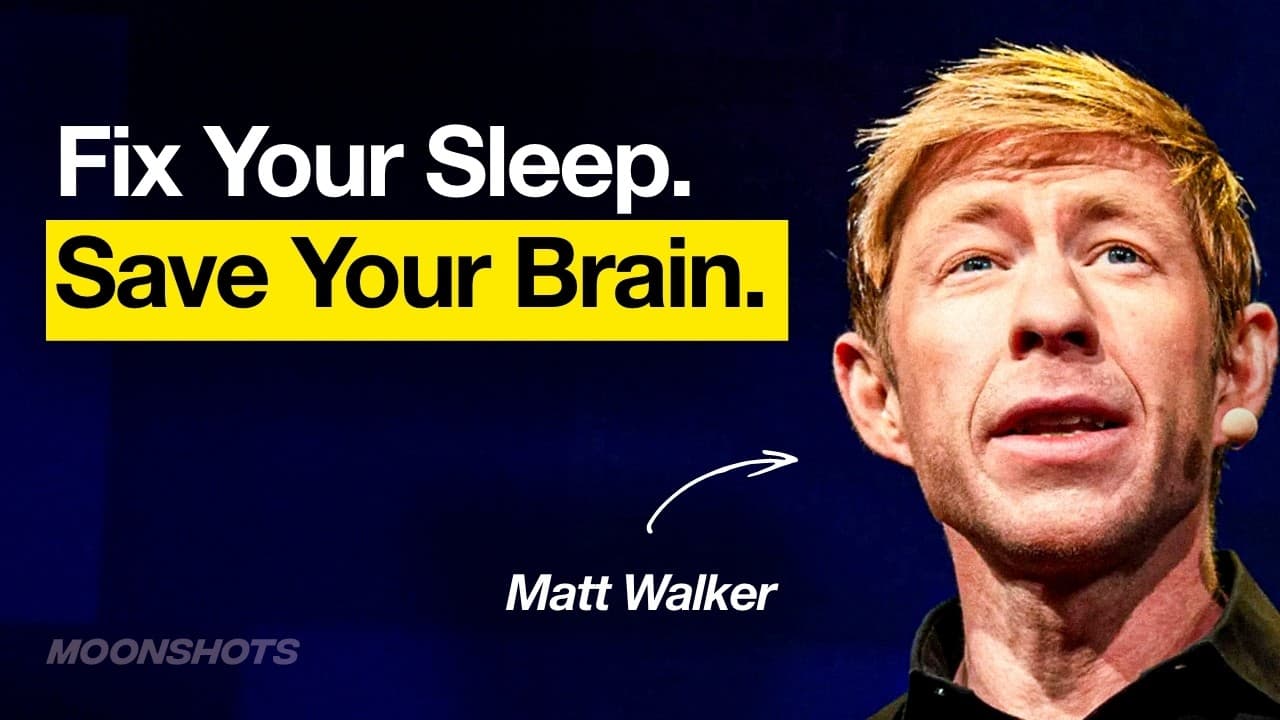
Sleep aids, ambient, Lunesta, good, bad. Tell me about what your thoughts are on those. Sedation is not sleep. Rhythm, routine, and the right wind down. Matt Walker. Matt Walker. Matt Walker breaks down the science of truly restorative rest. You spend a third of your life sleeping. You should care about that. As you say, it's the foundation upon wh... Read More
Key Insights
- Sedation is not the same as natural sleep. Benzodiazepines and medications such as Ambien and Lunesta act on the brain's inhibitory GABA system, producing unconsciousness with an electrical signature that differs from naturalistic sleep.
- DORA medications work by reducing wakefulness rather than broadly suppressing the cortex. They act nearer the brain stem, lowering the neural drive for wakefulness so that naturalistic sleep can emerge in its place.
- The sleep supported by newer DORA medications may be functional rather than merely longer. The research discussed found improvements in sleep duration and the overnight clearance of amyloid and tau proteins associated with Alzheimer's.
- Ambien may interfere with an important function of sleep. A recently released study cited in the conversation found that it reduced the sleep-related clearance process by forty percent, contrasting with the beneficial clearance findings described for a DORA medication.
- Middle-of-the-night anxiety can prolong wakefulness through rumination and catastrophizing. The practical objective after waking is to distract the mind from its own anxious cycle instead of concentrating harder on the need to fall asleep.
- Meditation, breath work, body scanning, and detailed mental walks can help redirect attention after a nighttime awakening. Their shared mechanism is taking the mind away from self-focused effort, tension, and worry.
- Counting sheep can make returning to sleep harder because it keeps attention on whether the technique is working. A detailed imagined activity, such as preparing to walk a dog step by step, gives the mind a more absorbing and neutral focus.
- Regular sleep timing is the strongest behavioral recommendation in the discussion. Going to bed and waking at the same times across weekdays and weekends anchors the circadian rhythm and can improve both sleep quantity and sleep quality.
- Related book: Why We Sleep
- Export your Kindle highlights to Glasp: How to Download Highlights and Notes from Kindle
Install to Summarize YouTube Videos and Get Transcripts
Explore YouTube Video Summarizer or Get YouTube Transcript Extractor
Questions & Answers
Q: How can I fall back asleep after waking during the night?
Redirect attention away from the pressure to sleep. Try meditation, box breathing with numbers that feel comfortable, or a body scan that identifies and releases tension from the head downward. Another option is to imagine a familiar walk in precise detail, including each small choice and movement. The goal is to interrupt rumination and stop forcing sleep, which can push it further away.
Q: Why does trying harder to sleep make falling asleep more difficult?
Trying hard to sleep keeps the mind focused on the problem and encourages monitoring, worry, and frustration. After a nighttime awakening, this can start a cycle of rumination and catastrophizing that sustains wakefulness. Sleep is compared with remembering a person's name: intense effort can make the desired result more elusive, while shifting attention elsewhere often allows it to happen naturally.
Q: Are Ambien and Lunesta equivalent to natural sleep?
Ambien and Lunesta are described as sedative-hypnotic medications that act through the inhibitory GABA system in the cortex. They clearly make a person no longer awake, but the resulting electrical brain signature is not presented as equivalent to naturalistic sleep. The central distinction is that unconsciousness caused by sedation should not automatically be interpreted as biologically normal or fully restorative sleep.
Q: What are DORA sleep medications, and how do they work?
DORA medications are a newer class of sleep drugs that work differently from traditional sedative-hypnotics. Rather than broadly suppressing the cortex, they reduce the brain's wakefulness signal nearer the brain stem. This lowered wake drive allows naturalistic sleep to arise. The discussion also reports that these medications can increase total sleep and REM sleep without disrupting deep sleep.
Q: Can sleep medication support the brain's overnight cleaning process?
The research described suggests that a DORA medication can support functional sleep and overnight brain clearance. In older adults, investigators compared nights with the medication and a placebo, then measured Alzheimer's-related amyloid and tau proteins. Participants slept longer with the medication, and more of these proteins had been cleared from the brain, according to the study summarized in the conversation.
Q: What is the most important habit for improving sleep quality?
Maintain a regular schedule by going to bed and waking at the same times on weekdays and weekends. Regularity anchors the circadian rhythm, which is presented as beneficial for both the quantity and quality of sleep. If only one behavioral change is practical, consistent timing is the recommended priority because it gives the body's sleep and wake systems a dependable daily pattern.
Q: How should light exposure change before bedtime?
Reduce household light as bedtime approaches. The suggested routine is to set a bedtime reminder and dim about half of the lights when the wind-down period begins. Blackout curtains, removal of electronics, and a comfortable sleep mask can also support darkness. The broader principle is to seek stronger light during the day and clearer darkness at night instead of remaining in muted light around the clock.
Q: Why can counting sheep fail as a sleep technique?
Counting sheep can keep attention fixed on the expectation that sleep should already be happening. That creates an ongoing evaluation of whether the method is working, which may increase effort and frustration. A more useful distraction is a richly detailed mental walk, such as selecting a leash, opening a door, and imagining each movement, because it absorbs attention without directly testing sleep.
Summary & Key Takeaways
-
Natural sleep differs from drug-induced sedation. Older sedative-hypnotic medications act through an inhibitory cortical system and can produce unconsciousness without reproducing natural sleep. Newer DORA medications instead reduce wakefulness, allowing sleep to emerge, and the research discussed suggests they may support sleep duration, REM sleep, and overnight brain clearance.
-
Consistent timing is presented as the most important behavioral foundation for better sleep because it anchors the circadian rhythm and supports both sleep quantity and quality. Darkness also matters. Dimming household lights before bedtime, limiting nighttime electronics, and using blackout curtains or a comfortable sleep mask can signal that wakefulness is ending.
-
Middle-of-the-night awakenings become difficult when anxiety turns into rumination and catastrophizing. Helpful responses include meditation, breath work, a body scan, and an imagined walk described in precise detail. These techniques redirect attention away from the effort to sleep, while counting sheep may intensify frustration by keeping attention fixed on sleep failure.
Read in Other Languages (beta)
Share This Summary 📚
Summarize YouTube Videos and Get Video Transcripts with 1-Click
Try YouTube Summary with ChatGPT & Claude or YouTube Transcript Generator
Explore More Summaries from Peter H. Diamandis 📚





Summarize YouTube Videos and Get Video Transcripts with 1-Click
Try YouTube Summary with ChatGPT & Claude or YouTube Transcript Generator