How Does the World's Largest Water Gun Work?

52.9M views
•
July 11, 2017
by
Mark Rober
YouTube video player
How Does the World's Largest Water Gun Work?

TL;DR

High-pressure nitrogen pushes two gallons of water through a submerged tube and out of a seven-foot water gun at 272 miles per hour. The system operates at 2,400 PSI, uses an electrically controlled pneumatic trigger, and accepts interchangeable nozzles for either a fast, narrow cutting stream or maximum water output for drenching and breaking targets.

Transcript

(water spraying) (birds chirping) (drills buzzing) (bell ding) (glass breaks) (water spraying) (glass breaks) (Mark Laughing) - Yeah. When the Super Soaker was first invented it was an absolute game changer in my neighborhood. So now that I'm a dad and I know how to engineer I decided to once again level up my water fighting capabilities with this.... Read More

Key Insights

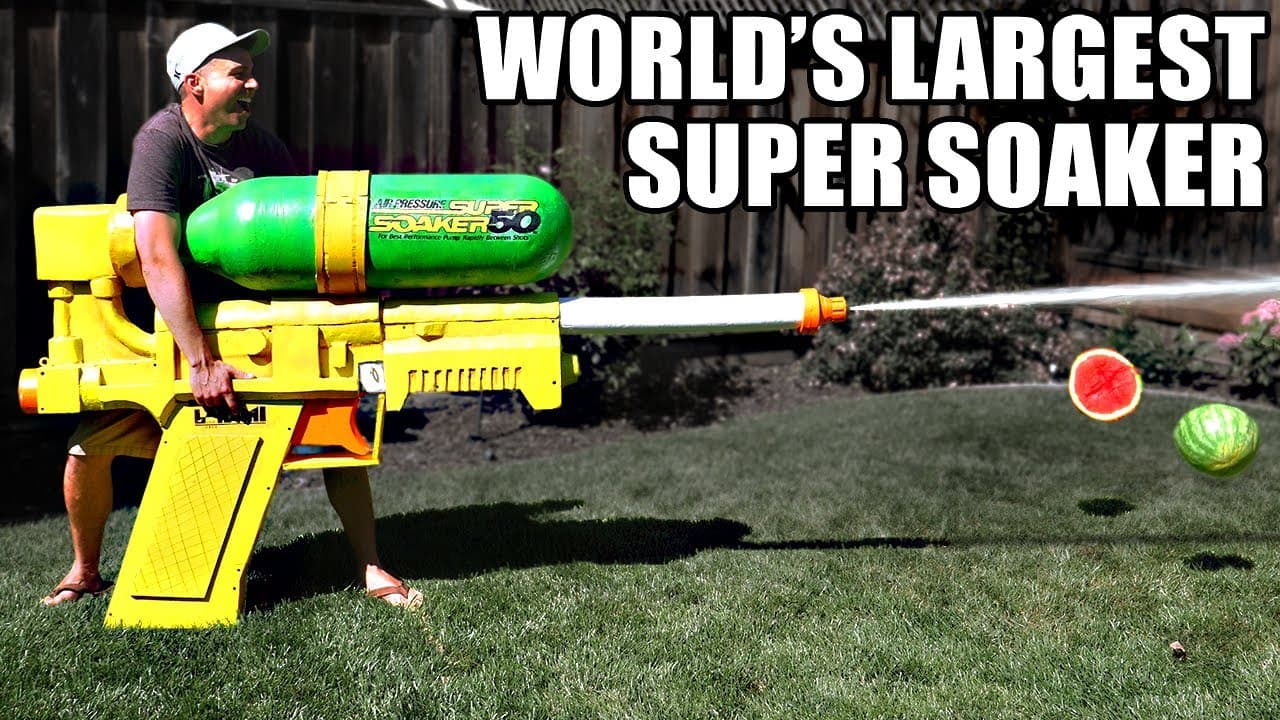
  • The giant water gun is seven feet long and holds the Guinness World Record for the largest water gun. Its structure uses a fabricated skeleton, EVA foam, and paint to reproduce the recognizable appearance of a Super Soaker at a much larger scale.
  • The gun's low center of mass is created by placing most of its mass in the handle. This arrangement improves stability and maneuverability, which are especially important because the water gun is unusually large and must still be aimed and carried by a person.
  • The original Super Soaker works by compressing air inside a tank that also holds water. Each pump adds more air molecules, increasing pressure until pulling the trigger allows that compressed air to push the water through a tube and out of the gun.
  • The intake tube is intentionally bent downward so its opening remains beneath the waterline when the gun is tilted. This design helps ensure that pressure drives water, rather than air, through the tube and out of the nozzle during operation.
  • The giant version uses high-pressure nitrogen instead of manual pumping. Nitrogen fills one tank, while another tank contains about two gallons of water, and the pressurized gas pushes on the water's surface to force it through the submerged tube.
  • The trigger system uses a ball valve operated by a nitrogen-powered pneumatic piston. A solenoid connected to double A batteries responds to a button, opening the valve while the button is pressed and stopping the flow when the button is released.
  • The operating pressure is 2,400 PSI, compared with 40 PSI for the original Super Soaker, a little over 50 PSI for a household hose, and 300 PSI for a fire truck hose. The description warns that 2,400 PSI requires serious precautions.
  • The interchangeable nozzles serve different purposes. A small opening produces higher stream velocity with lower water output for cutting or puncturing, while the quarter-inch opening produces lower velocity but maximum output for rapidly drenching targets or breaking them with force.

Install to Summarize YouTube Videos and Get Transcripts

Explore YouTube Video Summarizer or Get YouTube Transcript Extractor

Questions & Answers

Q: How does the world's largest water gun work?

The water gun uses high-pressure nitrogen to push down on roughly two gallons of water stored in a separate tank. Because a tube extends to the bottom of the water tank, the pressurized water travels up that tube and exits through the nozzle. Opening the flow produces a stream reported to travel at 272 miles per hour.

Q: How is the giant water gun similar to an original Super Soaker?

Both devices rely on pressurized gas pushing water through a tube and out of a nozzle. In the original Super Soaker, repeated pumping forces more air into the water tank, raising its pressure. The giant version follows the same principle but replaces manual pumping with a tank of high-pressure nitrogen and uses a separate tank holding about two gallons of water.

Q: Why does the water tube bend toward the bottom of the tank?

The tube bends downward so its open end stays below the waterline even when the gun is tilted. When compressed gas pushes on the surface of the water, the submerged opening receives water rather than air. This arrangement allows water to move up the tube and out of the gun across different firing positions.

Q: How does the trigger open and close the water flow?

The trigger is based on a ball valve, but the operator does not turn the valve manually. A pneumatic piston, also powered by the nitrogen supply, moves the valve. Pressing a button activates a solenoid connected to double A batteries, which opens the flow. Releasing the button closes it and stops the stream.

Q: Why are most of the components placed inside the handle?

Most of the mass is positioned in the handle to give the seven-foot gun a low center of mass. Keeping the weight lower improves stability and maneuverability, making the oversized device easier to carry, aim, and control. Placing substantial mass higher in the body would make such a large water gun more awkward to handle.

Q: What pressure does the giant water gun use?

The giant water gun operates at 2,400 PSI. For comparison, the transcript gives 40 PSI for the original Super Soaker, a little over 50 PSI for a household hose, and 300 PSI for a fire truck hose. The giant gun therefore uses eight times the stated fire truck pressure, which its creator describes as probably excessive.

Q: How do the interchangeable nozzles change performance?

The small-diameter nozzle creates a faster stream while reducing the total amount of water released, making it suitable for puncturing or cutting targets. The quarter-inch nozzle is essentially wide open, so it produces somewhat lower velocity but the maximum water output. That configuration is intended for rapid drenching or breaking objects through greater water force.

Q: What are the main limitations and safety concerns of the giant water gun?

The gun's main practical limitation is its finite water supply. It performed effectively during a water fight but stopped being useful after its stored water ran out. Its larger concern is pressure: the system operates at 2,400 PSI, and the description explicitly warns that this is extremely dangerous and requires precautions not shown during the build.

Summary & Key Takeaways

  • The seven-foot water gun was created as a larger counterpart to the original Super Soaker and earned a Guinness World Record. Its internal components were placed mainly in the handle to produce a low center of mass, improving the stability and maneuverability of a device that would otherwise be difficult to handle.

  • The operating principle mirrors the original Super Soaker. Pressurized gas above the water pushes it into a tube whose opening remains below the waterline. The giant version replaces manual pumping with nitrogen at 2,400 PSI, forcing roughly two gallons of water from the tank at a reported 272 miles per hour.

  • A pneumatic piston opens the ball valve when a battery-powered solenoid is activated by a button. Interchangeable nozzles change the balance between velocity and water output. Testing showed that the gun could puncture, drench, and break targets, although its limited water supply eventually became a disadvantage during a water fight.


Read in Other Languages (beta)

Share This Summary 📚

Explore More Summaries from Mark Rober 📚