How Does the Von Neumann Computing Model Work?
TL;DR
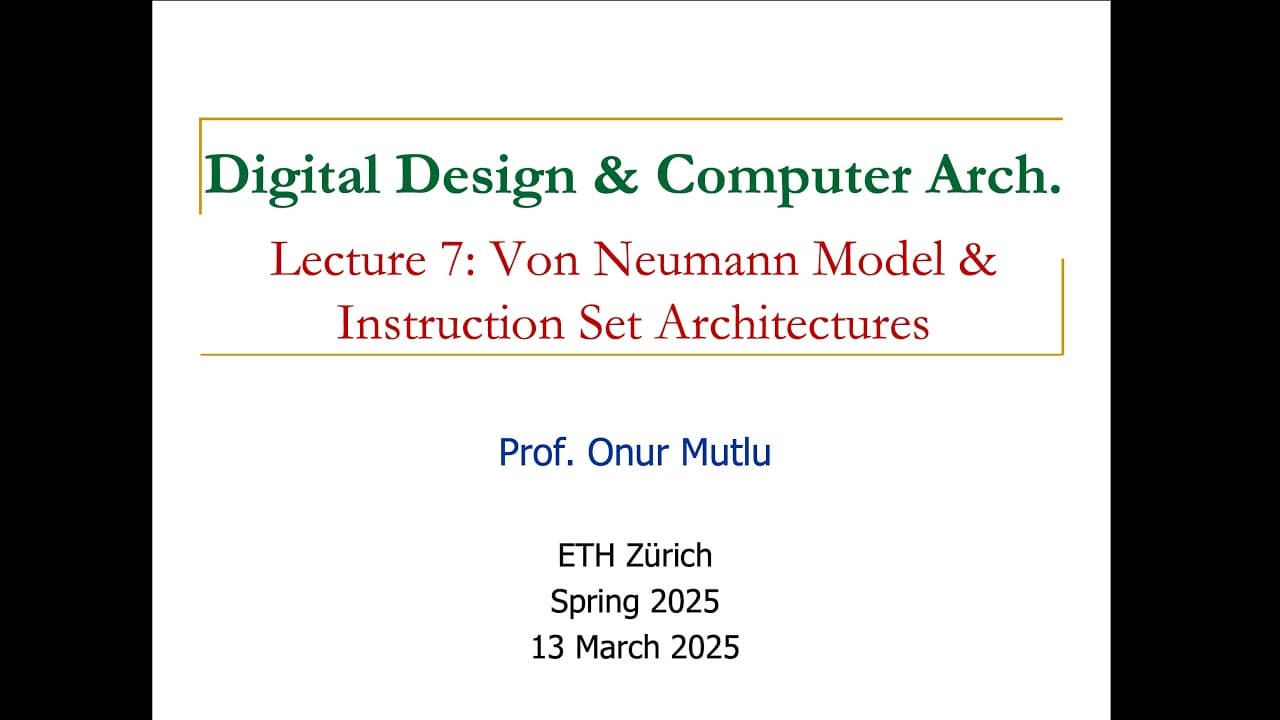
A Von Neumann computer stores programs and data in memory, processes them with a processing unit, interacts through input and output units, and coordinates operations through a control unit. Its instruction set defines the operations the hardware can execute, creating a programming interface that connects software to implementations built from digital logic.
Transcript
no do you know why the camera is like this e e for for is live stream working okay good I we can use the camera here this this makes little sense just use the camera over there and then let's see yeah that's better okay I think there's some background issue though as you can see it's it's related to this computer yeah okay let's get started everybo... Read More
Key Insights
- The lecture marks a transition from digital design to computer architecture, moving above transistors, logic circuits, finite-state machines, hardware description languages, timing, and verification toward the programming interface that allows software to direct hardware.
- A computer program is a set of instructions that specifies what a computer must do, and each instruction represents a well-defined piece of work that the machine is expected to carry out as part of the requested task.
- An instruction is the smallest piece of specified work in a program, while an instruction set is the complete collection of possible instructions that a particular computer is designed to understand and execute.
- The Von Neumann model is an execution model for processing programs, providing a structured way to build a computer that can retrieve and carry out instructions rather than merely combine isolated logic and storage structures.
- Memory is responsible for storing both the program and its data in the Von Neumann model, ensuring that the instructions to execute and the information those instructions manipulate are available within the computing system.
- The processing, input, and output units have distinct roles: processing performs work on stored information, input receives information from users, and output enables the computer to communicate results to the outside world.
- The control unit coordinates everything the computer does, including the order in which instructions are carried out, making it the component that organizes the activity of memory, processing, input, and output.
- LC-3 and MIPS are the lecture's two main instruction set architecture examples. LC-3 serves as an educational architecture, while MIPS is presented as a real architecture used in the field, with additional architectures mentioned only for context.
Install to Summarize YouTube Videos and Get Transcripts
Explore YouTube Video Summarizer or Get YouTube Transcript Extractor
Questions & Answers
Q: What is the Von Neumann model of computing?
The Von Neumann model is an execution model for building a computing system that processes programs. It consists of five components: memory, a processing unit, an input unit, an output unit, and a control unit. Memory stores programs and data, processing performs work, input and output connect with the outside world, and control coordinates instruction execution.
Q: What are the five components of a Von Neumann computer?
The five components are memory, a processing unit, an input unit, an output unit, and a control unit. Memory contains the program and data. The processing unit operates on them. The input unit accepts information from the user, the output unit communicates outward, and the control unit coordinates computer activity and instruction order.
Q: What is an instruction in computer architecture?
An instruction is the smallest piece of specified work in a program. It describes a well-defined operation that the computer can carry out. A complete program contains a set of such instructions that collectively specify the intended task. Hardware must be designed to interpret and execute these machine-level operations correctly.
Q: What is an instruction set architecture?
An instruction set is the collection of all possible instructions that a computer is designed to carry out. It forms the programming interface to hardware because software operations must be expressed in instructions the machine understands. A microarchitecture then implements that interface using logic structures while obeying the software-hardware contract defined by the architecture.
Q: How do high-level programs connect to computer hardware?
High-level programs can contain operations that the hardware does not directly understand, such as operations on a hashmap or key-value store. Those operations must be mapped to lower-level instructions supported by the machine. Assembly language and the instruction set help bridge this gap by expressing software tasks in operations that hardware can interpret and execute.
Q: What role does memory play in the Von Neumann model?
Memory stores both the program and the data used by that program. The program must reside somewhere so that its instructions are available for execution, while the data must be accessible for processing. This shared storage role makes memory one of the five fundamental components identified in the Von Neumann computing model discussed in the lecture.
Q: Why are LC-3 and MIPS used as architecture examples?
LC-3 and MIPS provide two examples for examining Von Neumann machines and instruction set architectures. LC-3, meaning Little Computer 3, is presented as an educational ISA whose fundamentals are covered well by the course material. MIPS is presented as a real ISA used in the field, allowing comparison with a practical architecture.
Q: How does digital logic lead to a complete computer?
Digital logic provides the structures needed to construct a computer, including combinational logic, sequential logic, arithmetic logic units, decision units, memory or storage units, and communication units. Computer architecture raises the abstraction level by organizing these structures around an execution model and software-hardware interface, while microarchitecture determines how the instruction set is implemented.
Summary & Key Takeaways
-
The lecture moves from digital design into computer architecture. Earlier material covered transistors as switches, combinational and sequential logic, finite-state machines, hardware description languages, timing, and verification. The new focus is the software-hardware interface, beginning with the Von Neumann execution model and instruction set architectures before progressing to microarchitecture.
-
A computer program specifies a task as a set of instructions, with each instruction describing a well-defined piece of work. The instruction set contains every instruction a computer is designed to execute. High-level programming operations must ultimately map onto instructions that hardware can interpret, making the instruction set a contract between software and hardware.
-
The Von Neumann model contains memory, a processing unit, input, output, and a control unit. Memory holds programs and data, processing performs operations, input and output connect the computer with users or the outside world, and control coordinates instruction order. LC-3 and MIPS provide the lecture's principal architectural examples.
Read in Other Languages (beta)
Share This Summary 📚
Summarize YouTube Videos and Get Video Transcripts with 1-Click
Try YouTube Summary with ChatGPT & Claude or YouTube Transcript Generator
Explore More Summaries from Onur Mutlu Lectures 📚
Summarize YouTube Videos and Get Video Transcripts with 1-Click
Try YouTube Summary with ChatGPT & Claude or YouTube Transcript Generator