How Does CycleGAN Transform Images Between Domains?
TL;DR
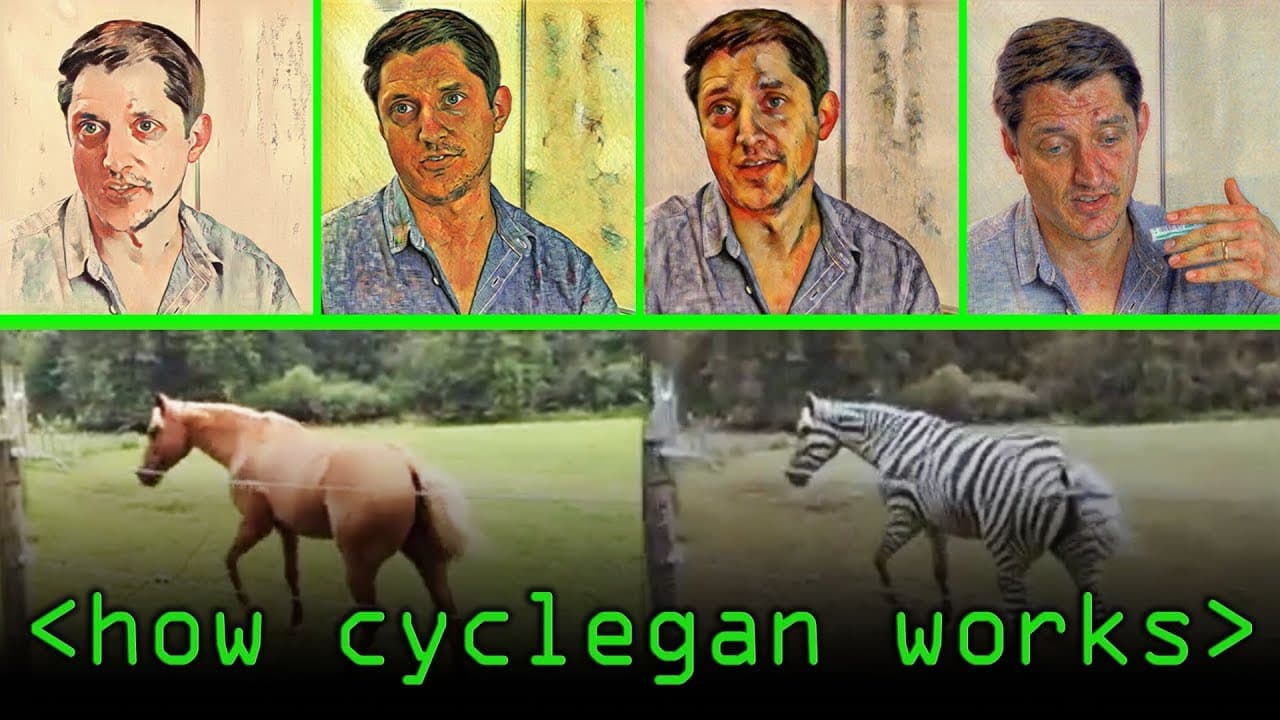
CycleGAN is a generative adversarial network that efficiently converts images from one domain to another without needing paired data. By utilising two networks, it ensures that the output images remain both realistic and reversible, tackling challenges like mode collapse. This approach has broad applications, including transforming photographs into artistic styles and various medical imaging tasks.
Transcript
What I've been wondering is you know If you've got a lot of pictures of horses and you really want to turn them into a lot of pictures of zebras How are you gonna do that, right? Marker pen. Yeah, marker pen, just draw some lines there. Yeah, that is quicker Today we're going to talk about cycle-GAN, which is a really interesting innovation in gene... Read More
Key Insights
- 🪡 Traditional style transfer methods require paired data, while Cycle-GAN eliminates the need for paired data by using two discriminators.
- 🏍️ Cycle-GAN addresses the issue of mode collapse by encouraging the generator to produce more diverse and interesting images.
- 😷 Cycle-GAN can be applied to various domains, such as converting photos into paintings or medical imaging tasks.
Install to Summarize YouTube Videos and Get Transcripts
Explore YouTube Video Summarizer or Get YouTube Transcript Extractor
Questions & Answers
Q: How does Cycle-GAN differ from traditional style transfer methods?
Traditional style transfer methods require paired data, while Cycle-GAN eliminates the need for paired data by using two discriminators and ensuring both realism and reversibility.
Q: How does a GAN address the issue of mode collapse?
Mode collapse occurs when a generator produces the same image repeatedly. In Cycle-GAN, the use of two discriminators encourages the generator to produce more diverse and interesting images, reducing the risk of mode collapse.
Q: What are some applications of Cycle-GAN?
Cycle-GAN can be used for style transfer, such as converting photos into paintings or black-and-white images into colored ones. It can also be applied to medical imaging, encryption, and super-resolution tasks.
Q: What is the loss function used in Cycle-GAN training?
The loss function calculates the difference between the generated and real images and is used to train the networks to improve their performance. It measures how wrong or right the network's predictions are and guides the learning process.
Summary & Key Takeaways
-
Cycle-GAN is a type of generative adversarial network (GAN) that focuses on converting images from one domain to another, such as turning photos into paintings or black-and-white images into colored ones.
-
GANs consist of two networks: a generator that learns to generate images and a discriminator that learns to differentiate between generated and real images.
-
Traditional methods of style transfer require paired data, but Cycle-GAN eliminates the need for paired data by using two discriminators and ensuring that the generated images are both realistic and reversible.
Read in Other Languages (beta)
Share This Summary 📚
Summarize YouTube Videos and Get Video Transcripts with 1-Click
Try YouTube Summary with ChatGPT & Claude or YouTube Transcript Generator
Explore More Summaries from Computerphile 📚


Summarize YouTube Videos and Get Video Transcripts with 1-Click
Try YouTube Summary with ChatGPT & Claude or YouTube Transcript Generator