Map of Computer Science
TL;DR
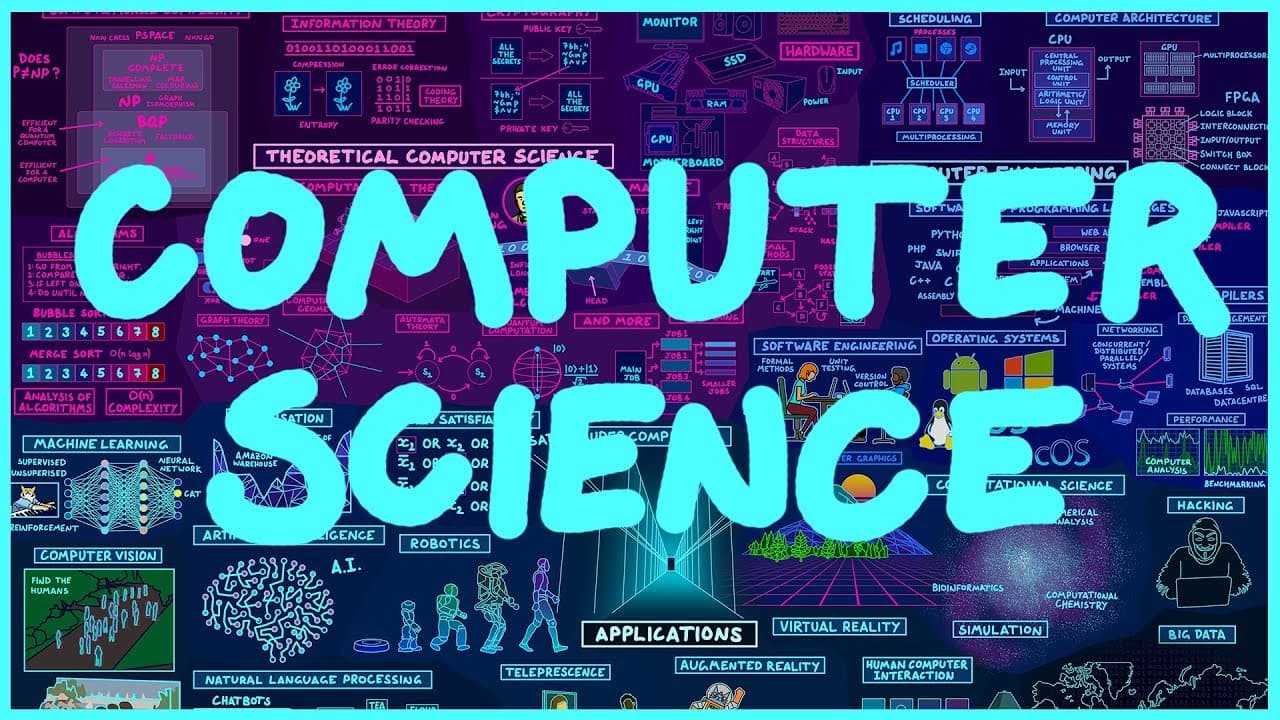
Computer science covers theoretical concepts like Turing machines, algorithmic complexity, and information theory, as well as computer engineering, software engineering, and real-world problem solving using technologies like artificial intelligence and machine learning.
Transcript
we built computers to expand our brains originally scientists built computers to solve arithmetic but they turn out to be incredibly useful for many other things as well running the entire internet life like graphics artificial brains or simulating the universe but amazingly all of it boils down to just flipping zeros and ones computers have become... Read More
Key Insights
- 🫚 Theoretical computer science is rooted in the concept of Turing machines, which serve as the foundation of computing.
- 💻 Computer engineering involves designing and building computer hardware and software systems, including CPUs, GPUs, FPGAs, programming languages, compilers, and operating systems.
- 💻 Real-world problem solving in computer science encompasses optimization problems, boolean satisfiability, artificial intelligence, machine learning, computer vision, natural language processing, big data analysis, computational science, human-computer interaction, virtual reality, augmented reality, telepresence, and robotics.
- 🆘 Algorithmic complexity helps determine the efficiency and effectiveness of algorithms in solving problems.
- 💁 Information theory plays a crucial role in measuring, storing, and communicating information, with applications in data compression and cryptography.
- 🥶 Software engineering focuses on developing efficient, error-free software by applying best practices and design philosophies.
- 🏃 The operating system is a critical component that controls how all other programs run on computer hardware.
Install to Summarize YouTube Videos and Get Transcripts
Explore YouTube Video Summarizer or Get YouTube Transcript Extractor
Questions & Answers
Q: What is the foundation of theoretical computer science?
The concept of a Turing machine, developed by Alan Turing, serves as the foundation of theoretical computer science. It is a simple model that allows for general-purpose computation and serves as the basis for understanding the capabilities of computers.
Q: What is computability theory?
Computability theory examines the types of problems that can be solved by a computer. It attempts to classify what is and is not computable, with famous examples like the halting problem, where it is impossible to determine if a program will stop running or carry on forever.
Q: What is algorithmic complexity?
Algorithmic complexity focuses on the efficiency of algorithms in solving specific problems. It studies the best way to solve problems by comparing different algorithms and their efficiency in terms of time and memory usage.
Q: What is the role of machine learning in computer science?
Machine learning is a branch of artificial intelligence that aims to develop algorithms and techniques for computers to learn from large amounts of data. It enables computers to make decisions, classify objects, and perform tasks based on what they have learned.
Q: How does computer engineering contribute to the field?
Computer engineering involves designing and building computer hardware and software systems. It encompasses tasks such as developing processors (CPUs) optimized for different purposes, creating programming languages, compilers, and operating systems, and implementing software engineering practices to build efficient, error-free software.
Q: What are some real-world applications of computer science?
Real-world applications include optimization problems (finding the best solution to a problem), boolean satisfiability (determining if a logic formula can be satisfied), artificial intelligence (developing computer systems that can think for themselves), machine learning (using data to train computers to make decisions or classify objects), computer vision (teaching computers to see objects in images), and natural language processing (enabling computers to understand and communicate using human language).
Q: How does big data play a role in computer science?
Big data focuses on managing and analyzing large amounts of data to derive insights and value from it. With the increasing amount of data collected from various sources, understanding how to handle and process this data efficiently becomes crucial in many areas, including business, research, and decision-making.
Q: What does computational science involve?
Computational science uses computers to help answer scientific questions by simulating complex systems and performing calculations. It combines computer science with other scientific disciplines, such as physics, chemistry, biology, and neuroscience, to model and analyze various phenomena and make scientific advancements.
Key Insights:
- Theoretical computer science is rooted in the concept of Turing machines, which serve as the foundation of computing.
- Computer engineering involves designing and building computer hardware and software systems, including CPUs, GPUs, FPGAs, programming languages, compilers, and operating systems.
- Real-world problem solving in computer science encompasses optimization problems, boolean satisfiability, artificial intelligence, machine learning, computer vision, natural language processing, big data analysis, computational science, human-computer interaction, virtual reality, augmented reality, telepresence, and robotics.
- Algorithmic complexity helps determine the efficiency and effectiveness of algorithms in solving problems.
- Information theory plays a crucial role in measuring, storing, and communicating information, with applications in data compression and cryptography.
- Software engineering focuses on developing efficient, error-free software by applying best practices and design philosophies.
- The operating system is a critical component that controls how all other programs run on computer hardware.
- Computer science has had a significant impact on society, and ongoing advancements will continue to shape the future of technology.
Summary & Key Takeaways
-
Computer science encompasses three main areas: theoretical computer science, which studies the fundamental theory, computability, and complexity; computer engineering, which focuses on designing and building computer hardware and software systems; and real-world problem solving using computer technologies like artificial intelligence and machine learning.
-
Theoretical computer science explores the concept of Turing machines as the foundation of computing, and delves into computability theory and computational complexity, which classify what can and cannot be computed.
-
Computer engineering involves designing computer systems, including CPUs, GPUs, and FPGAs, as well as developing programming languages, compilers, operating systems, and software engineering practices.
-
Real-world problem solving in computer science includes optimization problems, boolean satisfiability, artificial intelligence, machine learning, computer vision, natural language processing, big data analysis, computational science, human-computer interaction, virtual reality, augmented reality, telepresence, and robotics.
Read in Other Languages (beta)
Share This Summary 📚
Summarize YouTube Videos and Get Video Transcripts with 1-Click
Try YouTube Summary with ChatGPT & Claude or YouTube Transcript Generator
Explore More Summaries from Domain of Science 📚


Summarize YouTube Videos and Get Video Transcripts with 1-Click
Try YouTube Summary with ChatGPT & Claude or YouTube Transcript Generator