Gravitational Waves Are Awesome
TL;DR
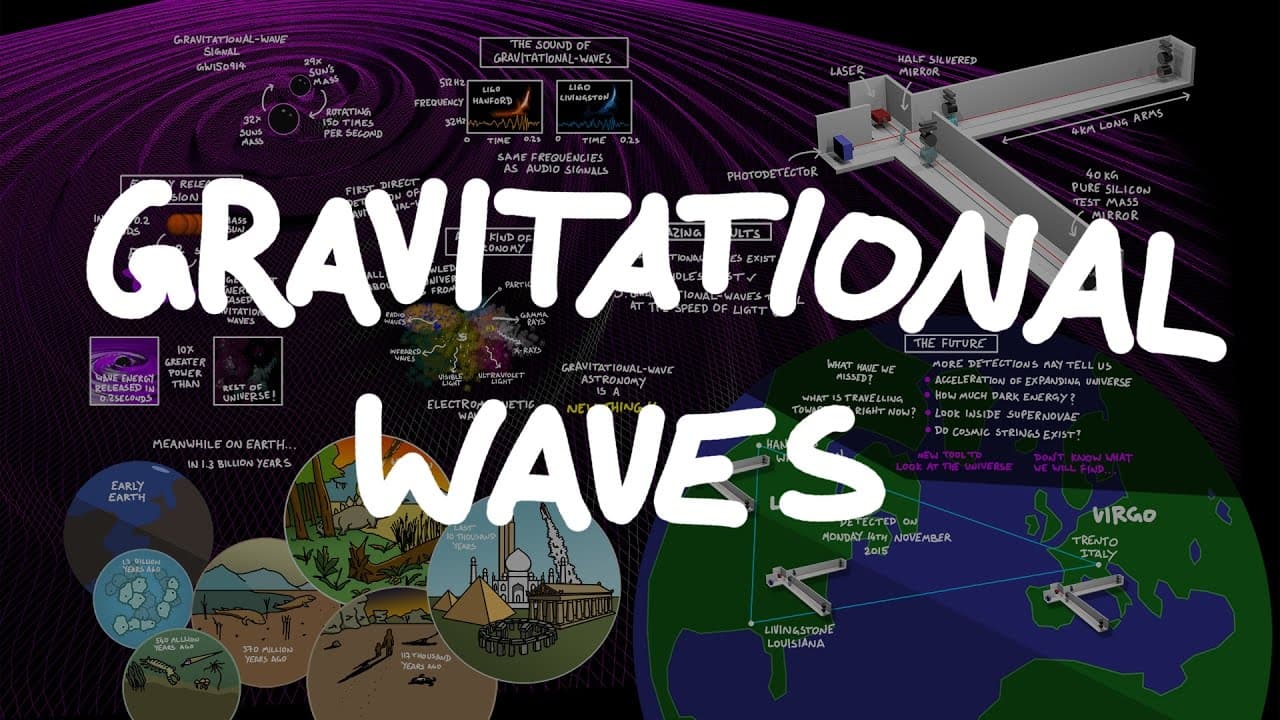
Scientists at the Advanced Laser Interferometer Gravitational-wave Observatory (aLIGO) detected gravitational waves for the first time, confirming the existence of black holes and opening up a new era of gravitational wave astronomy.
Transcript
Gravitational waves are ripples in the fabric of spacetime, predicted by Einstein’s laws of general relativity, but they are incredibly difficult to detect. To see them you need a detector that can accurately measure distances 10,000 times smaller than a proton. Thats crazy! That’s like trying to measure the distance from our Sun to the nearest sta... Read More
Key Insights
- 👋 Gravitational waves are predicted by Einstein's general relativity but are incredibly challenging to detect.
- 🖤 The first direct observation of gravitational waves occurred in 2015 with the collision of two black holes.
- 👻 Gravitational waves allow scientists to study phenomena, such as black holes, that are inaccessible through traditional telescopes.
- 🥳 LIGO detectors, located in different parts of the world, enable scientists to verify signals and determine the direction of gravitational waves.
- 👋 Gravitational wave astronomy has already confirmed the existence of black holes and the nature of gravitational wave travel.
- 🤗 The detection of gravitational waves has opened up a new field of study and has the potential to answer fundamental questions about the universe.
- 👋 Gravitational wave detectors operate by measuring the minute changes in distance caused by gravitational waves passing through.
Install to Summarize YouTube Videos and Get Transcripts
Explore YouTube Video Summarizer or Get YouTube Transcript Extractor
Questions & Answers
Q: What are gravitational waves, and why are they difficult to detect?
Gravitational waves are ripples in the fabric of spacetime. They are hard to detect because their effects are incredibly small, requiring highly sensitive instruments capable of measuring distances 10,000 times smaller than a proton.
Q: How do scientists measure the properties of gravitational waves?
Scientists measure gravitational waves using detectors like aLIGO and VIRGO, which utilize laser interferometry. By bouncing lasers off mirrors and detecting changes in the arm lengths caused by passing gravitational waves, scientists can determine the properties of the waves.
Q: What did the detection of gravitational waves confirm?
The detection of gravitational waves confirmed the existence of black holes and provided the first direct evidence of their existence. It also confirmed that gravitational waves travel at the speed of light.
Q: What can gravitational wave astronomy reveal about the universe?
Gravitational wave astronomy opens up a new way to observe the universe and may help scientists answer questions about the expansion of the universe, the nature of spacetime, and the processes behind supernovae.
Summary & Key Takeaways
-
Gravitational waves are ripples in spacetime predicted by Einstein's laws of general relativity.
-
The first direct observation of gravitational waves occurred when two black holes, 1.3 billion light-years away, collided, releasing an enormous amount of energy.
-
LIGO detectors, using laser interferometry, were able to detect the slight changes in arm length caused by the passing gravitational waves.
Read in Other Languages (beta)
Share This Summary 📚
Summarize YouTube Videos and Get Video Transcripts with 1-Click
Try YouTube Summary with ChatGPT & Claude or YouTube Transcript Generator
Explore More Summaries from Domain of Science 📚



Summarize YouTube Videos and Get Video Transcripts with 1-Click
Try YouTube Summary with ChatGPT & Claude or YouTube Transcript Generator