You Use Quantum Physics to Smell
TL;DR
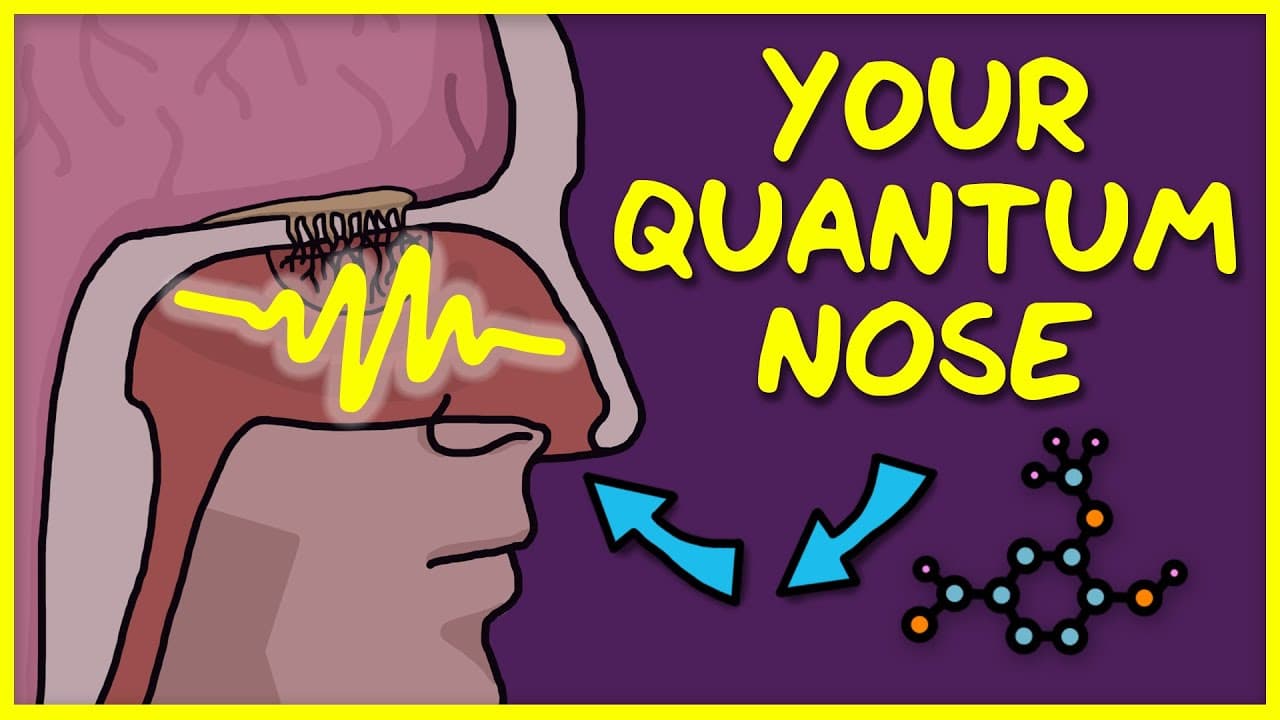
Our noses use quantum physics to smell, utilizing shape and vibration theories of smell receptors to detect different molecules based on their resonant frequencies.
Transcript
Our nose uses quantum physics to smell at least according to our best theory of how smell works. Now how our noses work was always a bit of a mystery to be but I recently learned how they worked and so I thought I would make a video about it. When you sniff, odour molecules get sucked into your nose and then get captured by a layer of mucus, and ar... Read More
Key Insights
- 🧠 Odour molecules are captured by receptors in the olfactory epithelium, which send signals to the brain.
- 💠 The shape theory suggests that smell receptors have specific shapes that fit odour molecules, while the vibration theory suggests that receptors detect molecules based on their resonant frequencies.
- 🕵️ Inelastic electron tunnelling spectroscopy can be used to probe molecules and detect their resonant frequencies.
- 👃 The vibration theory can explain some aspects of smell, but it cannot explain the difference in smell between chiral molecules.
- 👃 Both the shape and vibration theories may work together to explain how our noses detect different smells.
- 👻 Quantum physics plays a role in our sense of smell through quantum tunnelling, which allows electrons to pass through receptors and trigger the nerves.
- 👃 Our sense of smell is a complex process that involves both classical and quantum physics.
Install to Summarize YouTube Videos and Get Transcripts
Explore YouTube Video Summarizer or Get YouTube Transcript Extractor
Questions & Answers
Q: How do odour molecules reach the olfactory epithelium in our nasal cavity?
Odour molecules are sucked into the nose and captured by mucus, which then transports them to the olfactory epithelium in the nasal cavity.
Q: What are the two main theories of smell receptors?
The two main theories are the shape theory and the vibration theory. The shape theory suggests that smell receptors have specific shapes that fit odour molecules, while the vibration theory suggests that smell receptors detect different molecules based on their resonant frequencies.
Q: How do scientists study the vibrations of molecules?
Scientists use techniques like Raman spectroscopy and inelastic electron tunnelling spectroscopy to study the vibrations of molecules. Raman spectroscopy uses laser light to detect the vibrational frequencies, while inelastic electron tunnelling spectroscopy uses electron tunnelling to probe molecules.
Q: Can the vibration theory explain the difference in smell between chiral molecules?
The vibration theory alone cannot explain the difference in smell between chiral molecules. Chiral molecules have the same vibrations, yet they have different smells. This suggests that both the shape and vibration theories are needed to explain the sense of smell.
Summary & Key Takeaways
-
Odour molecules are sucked into the nose and captured by mucus, which then take them to the olfactory epithelium in the nasal cavity.
-
The olfactory epithelium contains neurons with special receptor sites that detect the molecules and send signals to the brain.
-
There are two main theories of smell receptors: shape and vibration, with evidence suggesting that both theories play a role in our sense of smell.
Read in Other Languages (beta)
Share This Summary 📚
Summarize YouTube Videos and Get Video Transcripts with 1-Click
Try YouTube Summary with ChatGPT & Claude or YouTube Transcript Generator
Explore More Summaries from Domain of Science 📚






Summarize YouTube Videos and Get Video Transcripts with 1-Click
Try YouTube Summary with ChatGPT & Claude or YouTube Transcript Generator