VIRUSES Explained in 9 Slides
TL;DR
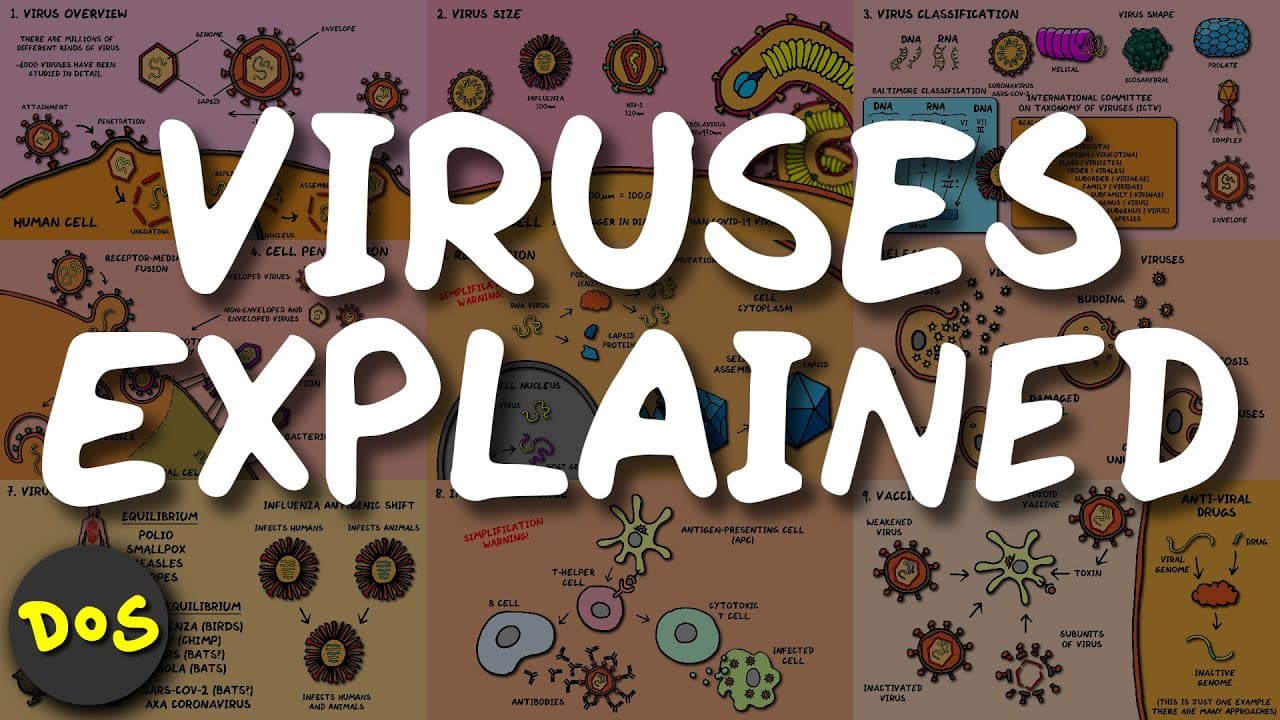
Viruses are abundant but not considered life. They invade cells to reproduce, vary widely in type, and can be classified based on genome, shape, and replication process.
Transcript
At the beginning of this pandemic like everyone I was hearing lots about viruses, but realised I didn’t know that much about what they are. So I did a load of research and have summarised what I learned in these nine images. Okay let’s get into it. Viruses are the most abundant form of life on Earth. But, are they life? Not really. They can’t repro... Read More
Key Insights
- 👻 Viruses are not considered life because they lack the ability to reproduce independently and must invade host cells.
- 🛩️ Viruses vary in size, with some being up to a thousand times smaller than human cells.
- ⚾ Classification of viruses can be based on their genome type (DNA or RNA) and single or double-stranded nature.
- 💌 Viruses exhibit a wide range of shapes, including helical, icosahedral, prolate, complex, and enveloped structures.
- ⚾ The Baltimore classification system categorizes viruses based on their genome's pathway to encoding messenger RNA.
- 💌 Soap can destroy enveloped viruses, including the coronavirus, which explains the importance of frequent handwashing.
- 😒 Viruses use different methods to enter host cells, such as fusion, endocytosis, or genetic injection.
- 👻 Viral replication involves the host cell transcribing the viral genetic material and creating copies of the viral genome through an enzyme called polymerase.
- 👻 Viruses can exit host cells through bursting, budding, or exocytosis processes.
- 🖤 Equilibrium viruses have coexisted with humans for a long time and tend to be less lethal, while non-equilibrium viruses pose a higher risk due to lacking adaptation to human biology.
- 🕵️ Our immune system has mechanisms to detect and destroy viral infections, including producing specific antibodies and activating cytotoxic T cells.
- 🧑🚒 Vaccines are highly effective in preventing viral infections by stimulating our immune system to recognize and fight specific viruses.
Install to Summarize YouTube Videos and Get Transcripts
Explore YouTube Video Summarizer or Get YouTube Transcript Extractor
Questions & Answers
Q: Are viruses considered living organisms?
No, viruses are not considered life because they cannot reproduce independently and rely on invading host cells.
Q: What are the different ways viruses can enter a cell?
Viruses can enter cells through enveloped viruses fusing with the cell membrane, viruses without envelopes tricking the cell into engulfing them, or genetic injection where the virus injects its genetic material directly into the cell.
Q: How do viruses replicate inside host cells?
RNA viruses replicate in the cell cytoplasm, while DNA viruses replicate in the cell nucleus. However, there are exceptions to this general rule.
Q: How do viruses exit host cells?
Viruses can exit cells through apoptosis, where the cell dies and releases the viruses, budding where the virus takes the cell's membrane as an envelope, or exocytosis where the virus exits through the cell wall, leaving the membrane behind.
Summary & Key Takeaways
-
Viruses are not considered life because they cannot reproduce on their own and rely on invading cells and hijacking their molecular machinery.
-
There are millions of different kinds of viruses, but only a small fraction has been studied in detail.
-
Viruses vary in shape, size, and classification criteria, such as genome type, shape of the capsid, and viral replication process.
Read in Other Languages (beta)
Share This Summary 📚
Summarize YouTube Videos and Get Video Transcripts with 1-Click
Try YouTube Summary with ChatGPT & Claude or YouTube Transcript Generator
Explore More Summaries from Domain of Science 📚

Summarize YouTube Videos and Get Video Transcripts with 1-Click
Try YouTube Summary with ChatGPT & Claude or YouTube Transcript Generator