How to Build a SaaS in a Weekend Using AI Tools
TL;DR
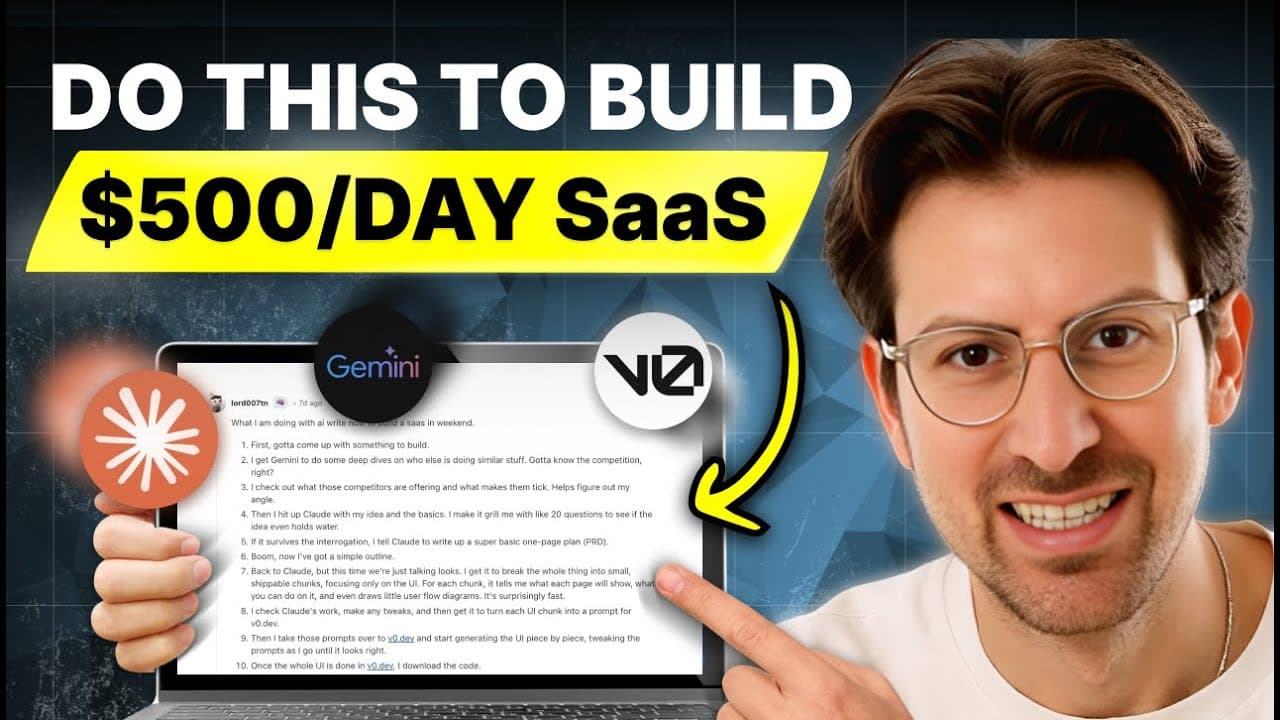
Identify your niche before building and validate ideas with AI aided research. Start by selecting an audience, then study competitors, gather honest feedback, draft a simple PRD, break the UI into small chunks, and finally generate the UI with AI while planning the backend integration. This approach aims to maximize launch prospects.
Transcript
Today we're going to talk about how to use AI to build a SAS in a weekend. I came across this Reddit post by this guy or girl, Lord 007 TN. It had 27 upvotes and I was reading it and I was like, "This is absolutely gold." He outlines exactly how to build SAS in a weekend. Now, there's some things I would do differently, some things um that I really... Read More
Key Insights
- Audience first is essential; the missing step zero is to define a niche and audience before choosing what to build.
- Competitive research is accelerated by AI tools to map landscape and identify differentiators for a Goodreads like product.
- Honest feedback is used to validate ideas and improve the product plan before heavy development begins.
- A one page PRD helps crystallize goals, core features, and success metrics in a concise document.
- Break the UI into small, shippable chunks to enable rapid iteration and faster delivery.
- AI tools can generate design and UX options, speeding up UI creation and visual polish.
- Back end planning should align with the PRD and frontend milestones to ensure cohesive integration.
- Focusing on real user pain points rather than aesthetics improves differentiation and market fit.
- More videos from this channel:
- More from this channel: Greg Isenberg
Install to Summarize YouTube Videos and Get Transcripts
Explore YouTube Video Summarizer or Get YouTube Transcript Extractor
Questions & Answers
Q: How to start a SaaS project with AI in a weekend, step zero and audience
The initial step is to identify a niche and audience before building anything. The speaker suggests starting a social presence to gauge interest and let the audience tell you what to build. This audience driven approach helps reveal the actual pain points, priorities, and potential features that will matter most when you begin a weekend development sprint. Establishing this baseline makes subsequent research and design more focused.
Q: What role does competitive research play in this plan
Competitive research is used to map the landscape around a Goodreads like idea. The approach employs AI tools to gather data about competitors, understand their strengths, and spot gaps or opportunities. By analyzing other platforms and their features, you can craft a differentiating value proposition and decide which features are essential versus optional, reducing wasted effort during the sprint.
Q: How is honest feedback incorporated into the process
Honest feedback is gathered to test assumptions and refine the product concept. The process involves asking direct questions about user needs and potential limitations, and using that feedback to adjust the idea, target audience, and feature set. This validation helps ensure the project stays aligned with real user pain points rather than just preferences.
Q: What does a 1-page PRD include and why is it useful
The PRD is a concise document that outlines the executive summary, market opportunity, target audience, core features, and success criteria. It serves as a single source of truth to guide development, preventing scope creep and aligning the team. A clear PRD makes it easier to communicate the plan to stakeholders and coordinate the weekend sprint.
Q: How should the UI be structured to ship quickly
The UI should be broken into small, shippable chunks that can be developed and tested quickly. This modular approach allows the team to deliver incremental value, validate assumptions early, and adjust course without waiting for a full product build. It also makes it easier to assign tasks and track progress during a rapid development cycle.
Q: What is the role of AI in UI generation
AI is used to generate UI concepts and visual options, speeding up the design phase and providing a polished look with less manual effort. This enables the team to focus on core functionality and backend integration while still delivering an appealing user experience. The AI driven approach aligns with the weekend sprint by cutting design time.
Q: How does the plan ensure backend readiness
Backend planning is guided by the PRD and frontend milestones, ensuring that data models, APIs, and integrations are defined early. This alignment helps prevent disconnects between UI and server logic, reduces rework, and supports a smoother transition from prototype to production during the weekend sprint.
Q: What makes this approach stand out compared to traditional startup methods
The approach combines audience driven idea selection, AI assisted research and planning, and rapid, modular UI generation to accelerate time to first workable product. It emphasizes validating the core concept with real users, breaking work into shippable parts, and maintaining focus on solving concrete pain points rather than aesthetics, which improves probability of market fit.
Summary & Key Takeaways
-
The video emphasizes a step zero that focuses on identifying an audience and niche before building a product, arguing that audience insight drives the idea and reduces risk.
-
A structured playbook is shown: audience first, competition research, feedback, PRD, modular UI, and AI powered UI generation to speed up delivery.
-
The discussion highlights using AI tools for research and planning, and stresses breaking work into shippable UI chunks plus clear product requirements to improve odds of success.
Read in Other Languages (beta)
Share This Summary 📚
Summarize YouTube Videos and Get Video Transcripts with 1-Click
Try YouTube Summary with ChatGPT & Claude or YouTube Transcript Generator
Explore More Summaries from Greg Isenberg 📚


Summarize YouTube Videos and Get Video Transcripts with 1-Click
Try YouTube Summary with ChatGPT & Claude or YouTube Transcript Generator