What explains AI growth amid bubble fears?
TL;DR
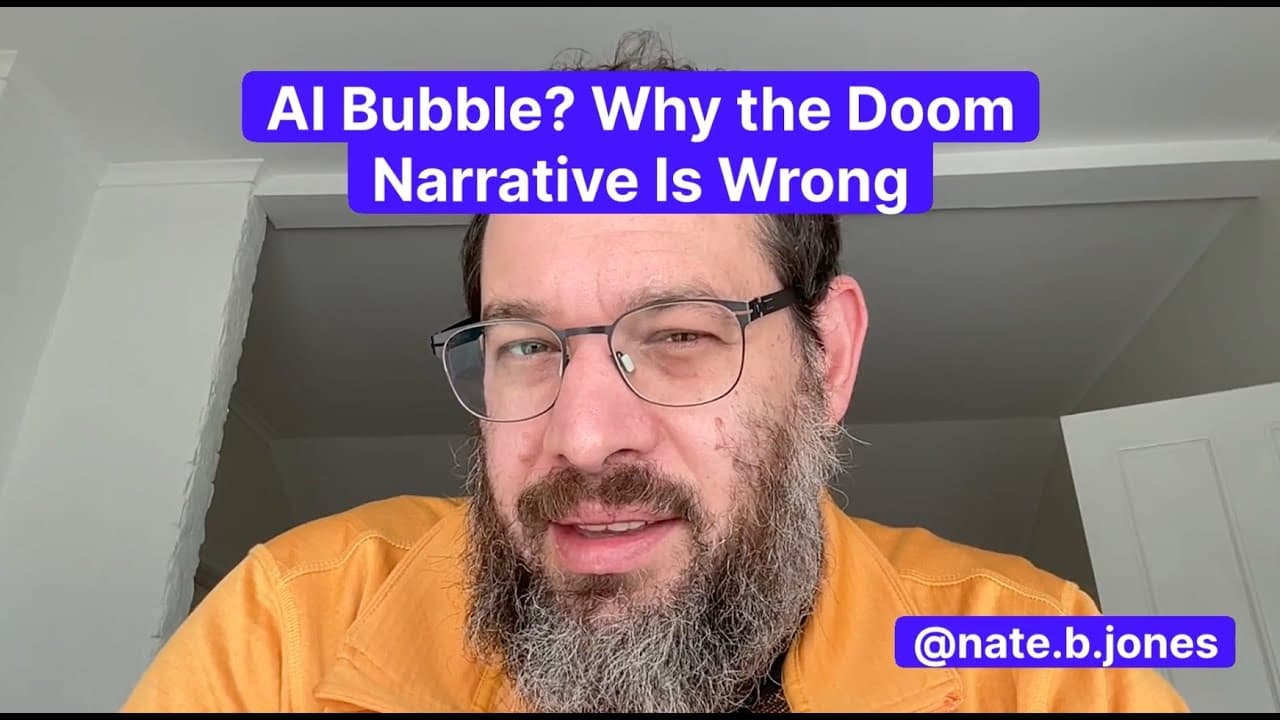
AI is not collapsing; progress continues in agentic use cases, chip demand remains high, and leadership warnings aside, the narrative is more nuanced. The video pins four hype drivers and five counterpoints, arguing sustained value, exponential progress, and power law dynamics justify continued investment and cautious optimism.
Transcript
A number of things are coming together to drive a narrative that we're in an AI bubble today. I saw a conversation just on X last night basically saying the death of AI is near, right? Like we have the profits of doom out. I want to lay out for you why I think that's happening. And then I want to lay out for you the pieces we're not looking at as a... Read More
Key Insights
- AI doom talk is amplified by a need for dramatic narratives and high profile comments, creating a temporary swing in sentiment.
- The chatbot use case is nearing saturation, limiting perceived gains from further model improvements.
- Progress is moving toward agentic and complex use cases that are harder to grasp but drive meaningful breakthroughs.
- Exponential gains persist on benchmarks that are not saturated, signaling continued acceleration in AI capabilities.
- Chip shortages reflect strong underlying demand and the willingness of organizations to invest heavily in AI.
- Corporate restructurings, like Meta, often signal refocusing toward next stage gains rather than retreat.
- Power law dynamics explain why large, early bets in AI are rational and potentially highly rewarding.
- Despite froth and hype, real enterprise value from AI exists when use cases are properly defined and leadership drives culture change and value realization.
- More videos from this channel:
- More from this channel: AI News & Strategy Daily | Nate B Jones
Install to Summarize YouTube Videos and Get Transcripts
Explore YouTube Video Summarizer or Get YouTube Transcript Extractor
Questions & Answers
Q: What is driving the AI bubble narrative according to the speaker?
The bubble narrative is driven by a need for a strong storyline after GPT-5 hype, reports of layoffs in AI divisions, Sam Altman’s admission of elements of a bubble, and a MIT study noting high failure rates for enterprise AI projects. Taken together, these create a negative mood and a belief that AI progress is overstated or unsustainable, prompting a cautious or skeptical public discourse.
Q: Why does the speaker say chatbot use cases are saturating?
The speaker notes that the chatbot use case is reaching a plateau because even with better models, the perceived progress is not as dramatic for end users. In other words, improvements in chat interfaces do not translate into substantial perceived gains, so additional gains feel diminishing compared to earlier breakthroughs, leading to sentiment that chat-based AI has limited upside.
Q: What are agentic use cases and why are they important?
Agentic use cases refer to AI applications that handle complex, planned tasks and proofs within defined problem spaces, beyond simple chat interaction. These use cases can drive significant value but are harder to understand and measure. They demonstrate progress in areas where models can brute force steps toward new proofs or solutions, signaling deeper forms of AI advancement.
Q: What does the speaker say about benchmarks like METR?
METR and similar benchmarks show exponential gains and continued improvement in AI performance on tasks without saturation. Although 50 percent is a low bar, these benchmarks demonstrate that AI progress is still accelerating in non saturated areas, suggesting ongoing capability growth rather than stagnation or decay.
Q: Why is chip allocation a sign of demand, according to the talk?
Both OpenAI and Anthropic acknowledge chip under allocation, indicating strong demand for AI infrastructure. This scarcity shows enterprises are racing to deploy AI, and despite concerns about the pace of progress, the demand for hardware to run larger models proves that interest and investment in AI remain high.
Q: How does restructuring at Meta fit into the AI narrative?
The talk frames Meta’s restructuring as refocusing around inference and next stage gains rather than retreat. This signals that large tech companies are adjusting teams to pursue higher value AI capabilities, implying a strategic shift rather than a retreat from AI altogether.
Q: What role do power laws play in AI investment according to the video?
Power law dynamics mean returns grow disproportionately with the scale of investment. This makes large bets in AI rational because the potential upside is immense. The speaker argues this drives ongoing, heavy investment in model development, chips, and specialized capabilities as firms seek outsized gains.
Q: What is the overall takeaway about the future of AI from the talk?
The speaker argues that while there is hype and froth, real value from AI exists when leadership aligns with culture change and high value use cases. Progress is ongoing, especially in agentic tasks and complex workflows, with hardware demand and strategic focus reinforcing continued growth rather than an imminent collapse of AI.
Summary & Key Takeaways
-
The video argues that the AI doom narrative is driven by a need for story, notable layoffs, Sam Altman’s bubble remark, and a misleading MIT study, which together created a swing away from progress. It then reframes the discussion around ongoing gains in higher value AI use cases and demand for hardware.
-
A key point is that chatbot gains are saturating, while progress shifts toward agentic, complex use cases where models excel at proofs and brute force problem solving, indicating different kinds of value than simple chat improvements.
-
The speaker concludes that despite hype, AI shows exponential progress on non saturated benchmarks, chip demand remains strong, corporate restructures reflect strategic refocusing, and power law dynamics encourage large bets and specialization across players.
Read in Other Languages (beta)
Share This Summary 📚
Summarize YouTube Videos and Get Video Transcripts with 1-Click
Try YouTube Summary with ChatGPT & Claude or YouTube Transcript Generator
Explore More Summaries from AI News & Strategy Daily | Nate B Jones 📚






Summarize YouTube Videos and Get Video Transcripts with 1-Click
Try YouTube Summary with ChatGPT & Claude or YouTube Transcript Generator