How Does Nano Banana Pro Create Work Visuals?
TL;DR
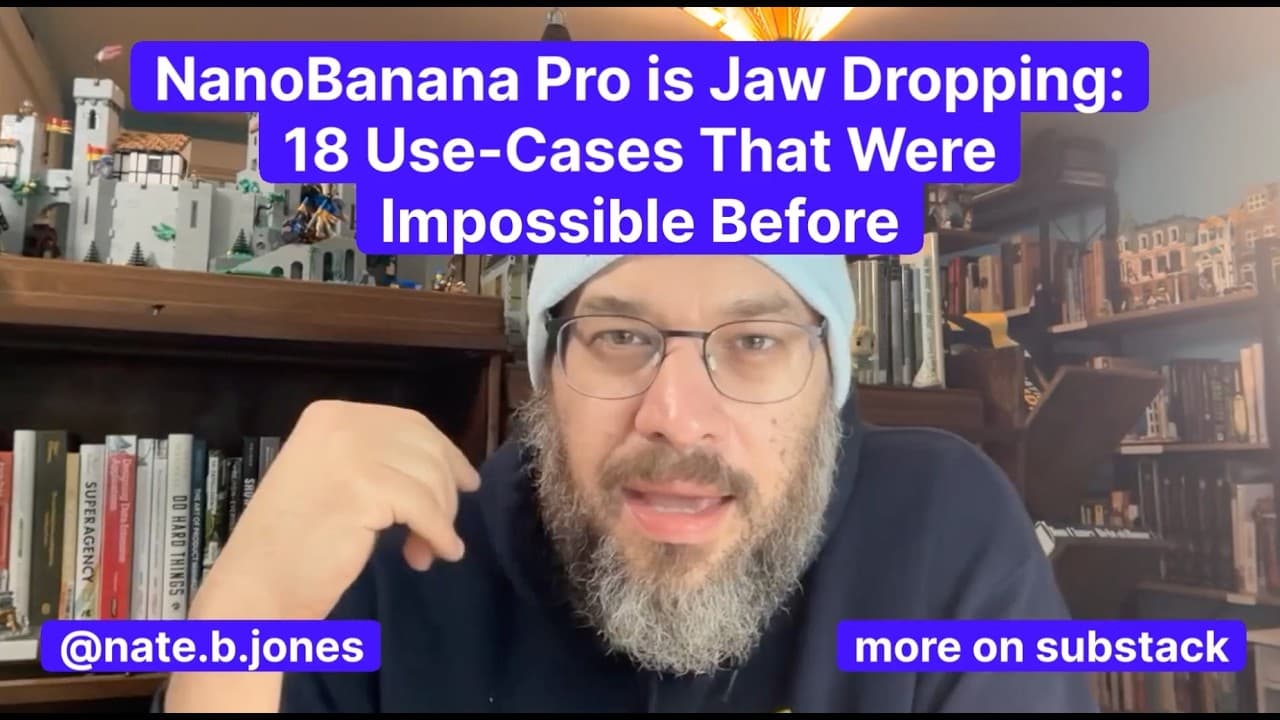
Nano Banana Pro can turn structured prompts, documents, text, charts, and images into polished visual artifacts such as diagrams, dashboards, blueprints, and editorial spreads. Its strengths include layout control, readable typography, data visualization, consistent styling, and 4K output, creating opportunities to automate routine visual communication while reserving senior designers for more meaningful work.
Transcript
Nano Banana Pro just dropped and it's going to change how visual thinking is done across the business. All of the old assumptions that you had that I had about what AI visuals can do, we have to throw them out the window now. And I'm going to show you later in the video what I mean. So if you thought, wow, you know, these image generators can't gen... Read More
Key Insights
- Nano Banana Pro is described as a visual reasoning model rather than an older diffusion-style image generator, with an ability to understand layout, structure, diagrams, typography, data, brand grammar, and stylistic systems within a single composition.
- The layout capability is designed to handle grids, gutters, margins, columns, alignment, spacing, and type hierarchy. These controls allow the model to produce organized one-page documents and other structured materials from dense prompts containing several simultaneous requirements.
- The diagram capability can convert structured text into a clean visual representation. One cited example transformed an academic paper about adversarial prompting with and without poetry into an explanatory graphic in a single generation.
- The typography capability can generate sharp small text, multi-line paragraphs, chart labels, handwriting, and unusually oriented writing. This addresses a major limitation attributed to earlier image generators, which often struggled to make text usable inside professional visual artifacts.
- The data visualization capability can translate numbers from documents into charts. The demonstrated workflow involved pasting Google's earnings PDF into the model and receiving a usable infographic that summarized the quarterly earnings statement in one generation.
- The style capability can maintain a consistent visual language across multi-element compositions and repeated generations. Demonstrated examples included Lego, blueprint, retro science-fiction, corkboard, and handwritten-note treatments, along with the application of brand palettes and logos.
- The representation transformation capability can express the same underlying concept as a blueprint, infographic, magazine spread, storyboard, or Lego scene while preserving its meaning. The desired surface or format therefore becomes something users can specify as part of a prompt.
- The API creates opportunities for software agents to generate diagrams, dashboards, visual PDF summaries, and updated onboarding assets. This makes visual communication more machine-native and can automate routine production tasks that previously depended on manual design capacity.
Install to Summarize YouTube Videos and Get Transcripts
Explore YouTube Video Summarizer or Get YouTube Transcript Extractor
Questions & Answers
Q: What is Nano Banana Pro?
Nano Banana Pro is described as a visual reasoning model that understands layout, structure, diagrams, typography, data, brand grammar, and stylistic systems. It treats text, images, and charts as equally composable elements rather than focusing only on picture generation. The model can separate dense, multi-constraint prompts into an orderly composition and produce finished visual artifacts such as dashboards, diagrams, blueprints, and editorial spreads.
Q: How does Nano Banana Pro create structured layouts?
Nano Banana Pro creates structured layouts by understanding grids, gutters, margins, columns, alignment, spacing, and type hierarchy. These capabilities allow it to arrange information into organized one-page documents and other professional compositions. The model can process prompts containing several requirements without the layout collapsing, which helps it combine paragraphs, diagrams, charts, labels, and visual elements into a coherent finished artifact.
Q: Can Nano Banana Pro generate readable text in images?
Nano Banana Pro can generate sharp text at small sizes, multi-line paragraphs, chart text, and handwriting according to the transcript. It can also handle unusual text presentations, including writing shown backward, upside down, and in perspective. This typography capability makes the model more useful for work materials because labels, explanations, annotations, and longer passages can function as meaningful parts of the composition.
Q: How can Nano Banana Pro turn documents into visuals?
Nano Banana Pro can accept document content and translate its structure, claims, or numbers into a visual format. The examples include converting an academic paper into a diagram and turning Google's earnings PDF into a usable infographic about the quarterly results. Because the model combines diagramming, typography, layout, and data visualization, it can produce the visual summary in one generation rather than requiring separate manual design steps.
Q: What visual styles can Nano Banana Pro maintain?
Nano Banana Pro can maintain a consistent style across compositions containing multiple elements and across repeated generations. The transcript cites Lego, blueprint, retro science-fiction, and corkboard styles, including handwritten notes layered on top of a corkboard treatment. It can also understand and apply brand palettes and logos, making consistent branded materials a significant potential use case for marketing teams.
Q: How do you access Nano Banana Pro?
Nano Banana Pro can be accessed through Google AI Studio using a Google API key, according to the transcript. The speaker characterizes setting up the key as a fast and manageable process, although less straightforward than accessing ChatGPT. The suggested reason for requiring a key is that the model consumes substantial tokens and Google wants frequent users to pay for their usage.
Q: How could software agents use Nano Banana Pro?
Software agents could use Nano Banana Pro through its API to generate diagrams, create dashboards, summarize PDFs visually, and update onboarding assets. These capabilities make visual communication available as an automated software output rather than only a manual design task. The model could therefore support workflows involving dashboard creation, concept art, editorial layouts, one-page documents, brand collateral, and other recurring visual materials.
Q: Will Nano Banana Pro replace professional designers?
The transcript does not claim that Nano Banana Pro will outperform excellent senior designers. It explicitly says that a strong senior designer can run circles around AI-generated work. Its more immediate value is reducing routine office production, such as quick charts, engineering concept sketches, client-meeting visuals, and internal materials, so limited design capacity can be directed toward more useful and meaningful work.
Summary & Key Takeaways
-
Nano Banana Pro is presented as a visual reasoning model that combines capabilities resembling layout, diagramming, typography, data visualization, and styling engines. It can organize dense prompts with multiple constraints, compose text and graphics together, and produce structured artifacts such as one-page documents, dashboards, diagrams, blueprints, storyboards, and editorial spreads.
-
The model can translate academic papers and earnings reports into visual summaries, maintain consistent aesthetics across iterations, apply brand palettes and logos, and transform one concept into several visual formats. Its support for 4K images improves output quality when users zoom in, making generated materials more suitable for executives, clients, onboarding, and teaching.
-
The broader opportunity is workflow compression and more accessible visual thinking. People and software agents can potentially generate diagrams, dashboards, onboarding assets, PDF summaries, concept art, and presentation materials through prompts or APIs. The model does not replace excellent senior designers, but it can reduce routine production work and dependence on limited design bandwidth.
Read in Other Languages (beta)
Share This Summary 📚
Summarize YouTube Videos and Get Video Transcripts with 1-Click
Try YouTube Summary with ChatGPT & Claude or YouTube Transcript Generator
Explore More Summaries from AI News & Strategy Daily | Nate B Jones 📚




Summarize YouTube Videos and Get Video Transcripts with 1-Click
Try YouTube Summary with ChatGPT & Claude or YouTube Transcript Generator