How Does China View the US-China AI Race?
TL;DR
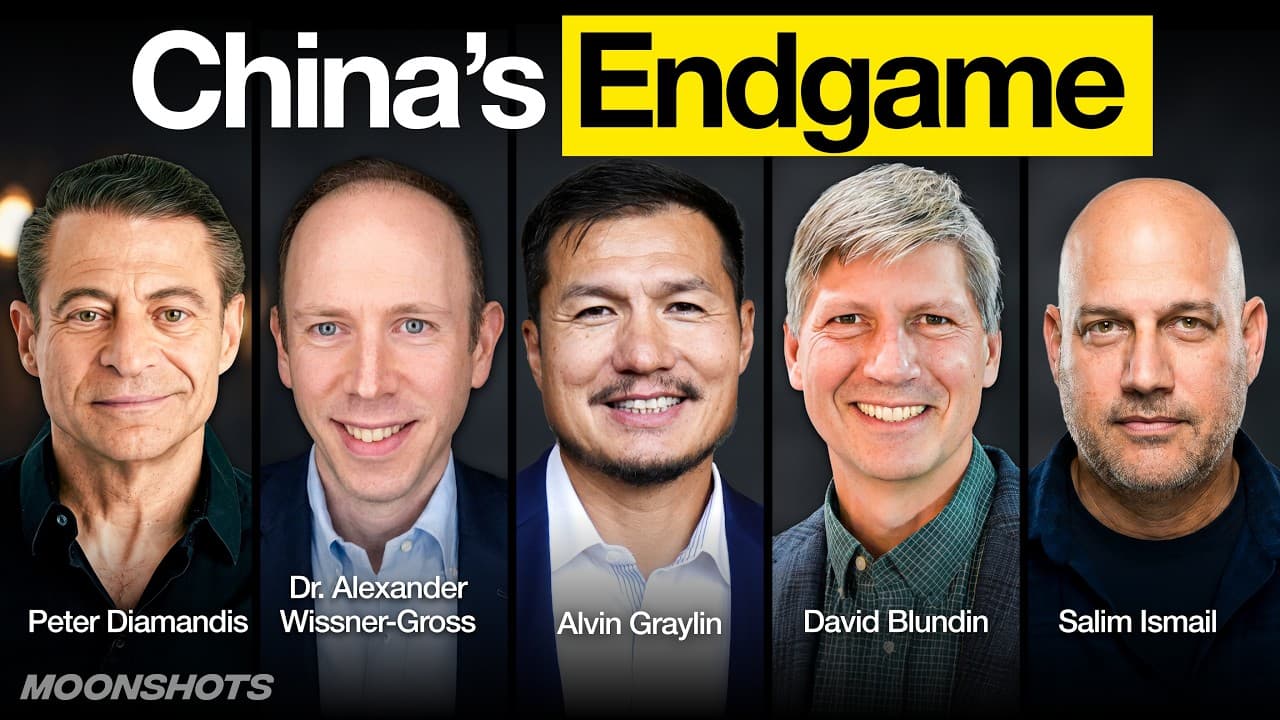
China’s behavior does not indicate that its leaders expect artificial superintelligence within the next 5 to 20 years. Alvin Graylin argues that framing US-China AI development as a race encourages irrational decisions, while cooperation and trust are essential for managing transformative AI, smaller-model security risks, economic fragility, and future safety dialogues.
Transcript
There seems to be a prevailing uh view around the campuses that ASI is, you know, 5 to 10 years out, maybe even 20 years. And so I'm really curious what the prevailing view is in China. >> They are not behaving like they believe ASI is around the corner. >> Why do you believe getting clarity and some resolution on the USChina AI race is so importan... Read More
Key Insights
- China’s behavior does not suggest that its leaders expect artificial superintelligence to arrive within the frequently discussed 5 to 20-year horizon. Graylin contrasts this observed behavior with the prevailing expectations he encounters around US campuses.
- The US-China AI relationship is described as a stag hunt, a strategic situation requiring coordination and trust. Graylin rejects a simple prisoner’s-dilemma framing because cooperation may offer both countries a safer path through the development of transformative artificial intelligence.
- An AI race condition can encourage irrational decisions by governments, laboratories, and companies. Graylin argues that greater clarity and some resolution between the United States and China are important because competitive pressure can weaken judgment when the consequences of advanced AI may be global.
- Artificial superintelligence could reduce the practical importance of nations if it eventually emerges. Graylin presents this as a future scenario rather than a confirmed timeline, emphasizing that systems beyond current intelligence levels could transform the political structures now organizing international competition.
- The AI sector’s stated value exceeding the GDP of America is presented as evidence of a fragile economic environment. Graylin interprets that comparison as a warning that an economic correction is due, connecting AI enthusiasm with broader financial vulnerability.
- A war-game scenario links US data-center expansion to a private-credit bubble that could burst within two years. The hypothetical outcome has the United States seeking Chinese financial help and negotiating a related concession involving Taiwan, but the exchange is explicitly presented as speculative.
- Smaller AI models may create more significant security threats than the biggest systems. Graylin’s recent paper challenges governance approaches that concentrate primarily on frontier scale and supports international cooperation as the only path toward adequate safety.
- Graylin’s Chinese institutional relationships arose from his technology-industry work and were not compensated. He says his VR alliance role involved more than 300 members, including international companies, while his part-time Beihang University teaching reflected the institution’s long-standing virtual and augmented reality program.
Install to Summarize YouTube Videos and Get Transcripts
Explore YouTube Video Summarizer or Get YouTube Transcript Extractor
Questions & Answers
Q: How soon does China expect artificial superintelligence?
China’s behavior does not indicate that its leaders believe artificial superintelligence is immediately around the corner, according to Alvin Graylin. The conversation contrasts that behavior with a prevailing view around US campuses that ASI could be 5 to 10 years away, or perhaps 20 years away. No specific official Chinese ASI forecast is provided in the supplied discussion.
Q: Why can the US-China AI race create dangerous decisions?
A race condition can force participants to make irrational decisions because each side feels pressure to move faster than its competitor. Graylin argues that the United States and China need greater clarity and some resolution in their AI relationship. Competitive urgency may otherwise discourage the coordination and trust required to address safety risks from increasingly capable artificial intelligence.
Q: Why is the US-China AI relationship called a stag hunt?
Graylin describes the relationship as a stag hunt because its central challenge is coordination and trust, not merely betrayal or unilateral advantage. The framing suggests that both countries can benefit from pursuing a shared, safer outcome. His argument challenges the prisoner’s-dilemma model and treats cooperation as particularly important as artificial intelligence moves toward potentially transformative capabilities.
Q: Could superintelligence make nations less important?
Graylin says that the concept of nations would probably become much less important if society eventually reached a superintelligence scenario. He presents this as a conditional possibility, not a confirmed prediction about timing or political outcomes. The point is that intelligence beyond current systems could reshape the national structures through which governments presently understand competition, security, and power.
Q: Why does Graylin think the AI economy is fragile?
Graylin points to the claim that the AI sector alone is worth more than the GDP of America and interprets that comparison as a sign of extreme financial fragility. He says an economic correction is due. The discussion also introduces concerns about the financing of US data-center construction, although the proposed collapse remains part of a speculative war-game scenario.
Q: What is the private-credit AI bubble scenario?
The hosts summarize a war game in which the United States uses private credit to finance its data-center buildout, the bubble bursts sometime within the next two years, and the United States subsequently asks China for financial assistance. They then raise a possible quid pro quo involving Taiwan. The exchange presents a hypothetical scenario, not a reported event or established forecast.
Q: Why might smaller AI models pose serious security risks?
Graylin’s paper argues that the biggest AI models are not necessarily the biggest threats and directs attention toward smaller systems. The supplied material does not detail the complete technical reasoning, so it supports only the broader conclusion: AI security policy should not focus exclusively on the largest models, and cooperation is presented as the only path toward safety.
Q: What experience informs Alvin Graylin’s views on China and AI?
Graylin has lived and operated in the Chinese and US technology ecosystems and has more than 30 years of experience in AI, extended reality, cybersecurity, and semiconductors. His roles have included HTC, Intel, IBM, Trend Micro, WatchGuard Tech, four startups, Stanford’s Human-Centered AI institute, the Asia Society Policy Institute, and AI policy teaching at the University of Washington.
Summary & Key Takeaways
-
Alvin Graylin brings experience from more than 30 years across AI, extended reality, cybersecurity, semiconductors, startups, and major technology companies. His work in China included industry and academic relationships that he describes as unpaid, while his current roles involve AI policy, human-centered AI, and support for US-China AI safety dialogues.
-
The discussion challenges the assumption that China is operating as if artificial superintelligence were imminent. Graylin characterizes the strategic relationship as a stag hunt centered on coordination and trust, rather than a prisoner’s dilemma. He argues that race conditions can push governments and companies toward irrational choices that undermine collective AI safety.
-
The conversation connects AI geopolitics with financial risk, open-weight models, regulation, robotics, diplomacy, and Taiwan. One war-game scenario considers a private-credit collapse tied to US data-center construction and possible Chinese financial assistance. Graylin also argues that smaller AI models may present greater security concerns than the largest systems alone.
Read in Other Languages (beta)
Share This Summary 📚
Summarize YouTube Videos and Get Video Transcripts with 1-Click
Try YouTube Summary with ChatGPT & Claude or YouTube Transcript Generator
Explore More Summaries from Peter H. Diamandis 📚



Summarize YouTube Videos and Get Video Transcripts with 1-Click
Try YouTube Summary with ChatGPT & Claude or YouTube Transcript Generator