How Did COVID Affect U.S. Healthcare Systems?
TL;DR
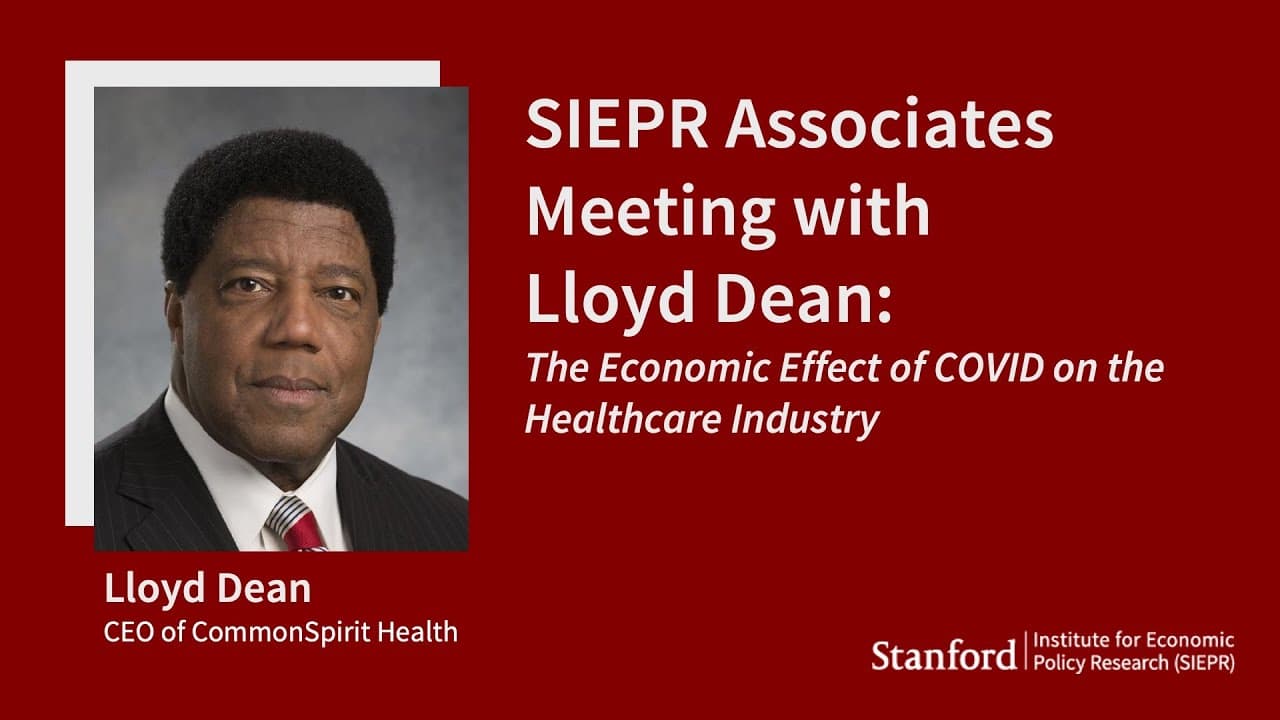
COVID placed continuous operational pressure on a large nonprofit health system while exposing longstanding gaps in access, resources, and racial representation. Lloyd Dean argues that healthcare organizations can respond more effectively through greater scale, investments in technology and people, stronger community advocacy, and sustained attention to vulnerable populations and minority physician training.
Transcript
hello everyone welcome to the first associates meeting of 2021 at the stanford institute for economic policy research i'm mark duggan the director of seeper and i hope you all enjoyed the holidays and are looking forward to the year ahead with optimism thank you all for starting off the year with us we have a really exciting lineup of virtu... Read More
Key Insights
- COVID was a continuous operational concern for CommonSpirit Health because its broad geographic footprint placed the organization close to pandemic conditions across many communities. Dean describes the virus as a constant leadership responsibility rather than an isolated clinical or financial event.
- Healthcare access is shaped by community resources and economic opportunity. Dean links his childhood experience of poverty, absent insurance, limited public resources, and early deaths in his family and neighborhood to his decision to pursue a career focused on healthcare.
- Representation is a healthcare and education issue. Dean recalls having no teachers of color and limited early exposure to health professionals, experiences that influenced his work in teaching and his commitment to training Black and other minority physicians.
- CommonSpirit Health is a large nonprofit system with hospitals, clinics, physicians, nurses, value-based agreements, charity care, and community-benefit programs across multiple states. Its scale gives the organization both substantial responsibilities and a platform for serving diverse and vulnerable populations.
- The CommonSpirit merger was driven by shared mission and complementary geography. Dignity Health and Catholic Health Initiatives identified common values, similar community priorities, and no geographic overlap, creating an opportunity to combine their capabilities without duplicating regional operations.
- Organizational scale can support investment in technology, employees, and communities. Dean says both legacy systems faced substantial investment needs, leading their leaders to consider whether joining forces could reduce duplication and make their shared work more efficient.
- Nonprofit healthcare leadership includes public advocacy as well as clinical operations. Dean describes using organizational influence to support broader healthcare access and engage government leaders, reflecting a view that health systems must address policy and community conditions.
- Partnerships can address racial disparities in the medical profession. CommonSpirit Health joined with Morehouse School of Medicine to develop undergraduate and graduate medical education intended to prepare more Black and other minority physicians for future healthcare roles.
Install to Summarize YouTube Videos and Get Transcripts
Explore YouTube Video Summarizer or Get YouTube Transcript Extractor
Questions & Answers
Q: How did COVID affect the leadership of a large healthcare system?
COVID became a constant leadership responsibility for Lloyd Dean because CommonSpirit Health operated across a broad geographic footprint and served many different communities. The crisis required attention to healthcare delivery while also highlighting gaps in access, resources, and racial equity. Dean presented the pandemic as both an immediate operational challenge and part of a wider need to strengthen healthcare systems and communities.
Q: Why was CommonSpirit Health created?
CommonSpirit Health was created after the leaders of Dignity Health and Catholic Health Initiatives recognized that their organizations faced similar challenges and shared important values. Both needed to invest in technology, employees, and communities while improving efficiency. They also served complementary geographic areas without overlap, supported vulnerable populations, and believed a combined organization could exercise a stronger national voice on healthcare access and policy.
Q: What organizations joined to form CommonSpirit Health?
CommonSpirit Health resulted from the combination of Dignity Health and Catholic Health Initiatives, often called CHI. Dignity Health had developed from Catholic Healthcare West, while Catholic Health Initiatives had a long history as a Catholic ministry. Dean says the organizations shared religious founders, nonprofit missions, community priorities, technology needs, and previous collaborative work, including a joint venture involving precision medicine.
Q: How did Lloyd Dean's childhood shape his healthcare leadership?
Lloyd Dean grew up in a large family in a community with few public resources and no routine access to insurance. He saw relatives and neighbors die early, although he did not fully understand those experiences as a child. His first encounter with a health professional occurred through an athletic physical. These circumstances helped form his interest in healthcare and his focus on vulnerable communities.
Q: Why does racial representation matter in healthcare education?
Racial representation matters because Dean's experiences showed how institutions can lack professionals who reflect the communities they serve. He attended a school with no diversity among teachers or administrators and later connected that absence to his work in education and healthcare. His leadership supports creating pathways that prepare Black and other minority physicians, with the goal of addressing disparities in the medical profession.
Q: How can healthcare mergers improve efficiency?
A healthcare merger can improve efficiency when organizations share goals, face similar investment needs, and avoid geographic duplication. Dean explains that Dignity Health and Catholic Health Initiatives were each making substantial investments in technology, people, and communities. Combining their capabilities offered a way to reduce duplicated work, respond to consumer demands for efficiency, and strengthen services while preserving their common mission and values.
Q: What role does community benefit play in nonprofit healthcare?
Community benefit is central to the nonprofit healthcare model Dean describes. CommonSpirit Health supports vulnerable populations through charity care, community programs, clinical services, and value-based agreements. The organization also works with community members, lawmakers, and health experts to improve outcomes. This approach treats healthcare as more than hospital treatment by connecting clinical operations with social responsibility, advocacy, and local investment.
Q: How is CommonSpirit Health addressing racial disparities?
CommonSpirit Health is addressing racial disparities by combining community advocacy with efforts to increase representation in medicine. The organization partnered with Morehouse School of Medicine, a historically Black medical school, to create undergraduate and graduate medical education programs. The partnership is intended to train the next generation of Black and other minority physicians while supporting broader work on equitable access and health outcomes.
Summary & Key Takeaways
-
Lloyd Dean connects his leadership priorities to childhood experiences with poverty, limited public resources, scarce healthcare access, and little racial diversity among educators. Those experiences led him first toward teaching and later toward healthcare, where he has focused on vulnerable communities, broader access, institutional representation, and improved health outcomes.
-
CommonSpirit Health emerged from discussions between Dignity Health and Catholic Health Initiatives about shared challenges and goals. The organizations saw opportunities to reduce duplicated investments, improve efficiency, strengthen their national advocacy, and combine complementary geographic footprints while preserving a mission rooted in nonprofit and Catholic healthcare traditions.
-
The pandemic became a continuous leadership responsibility across CommonSpirit Health's extensive network. Dean frames the crisis within broader weaknesses involving healthcare access, community resources, and racial disparities. His response emphasizes organizational scale, technology, workforce investment, community partnerships, public-policy engagement, and medical education pathways for Black and other minority physicians.
Read in Other Languages (beta)
Share This Summary 📚
Summarize YouTube Videos and Get Video Transcripts with 1-Click
Try YouTube Summary with ChatGPT & Claude or YouTube Transcript Generator
Explore More Summaries from Stanford Institute for Economic Policy Research (SIEPR) 📚




Summarize YouTube Videos and Get Video Transcripts with 1-Click
Try YouTube Summary with ChatGPT & Claude or YouTube Transcript Generator