How Do Optical Instruments Work?
TL;DR
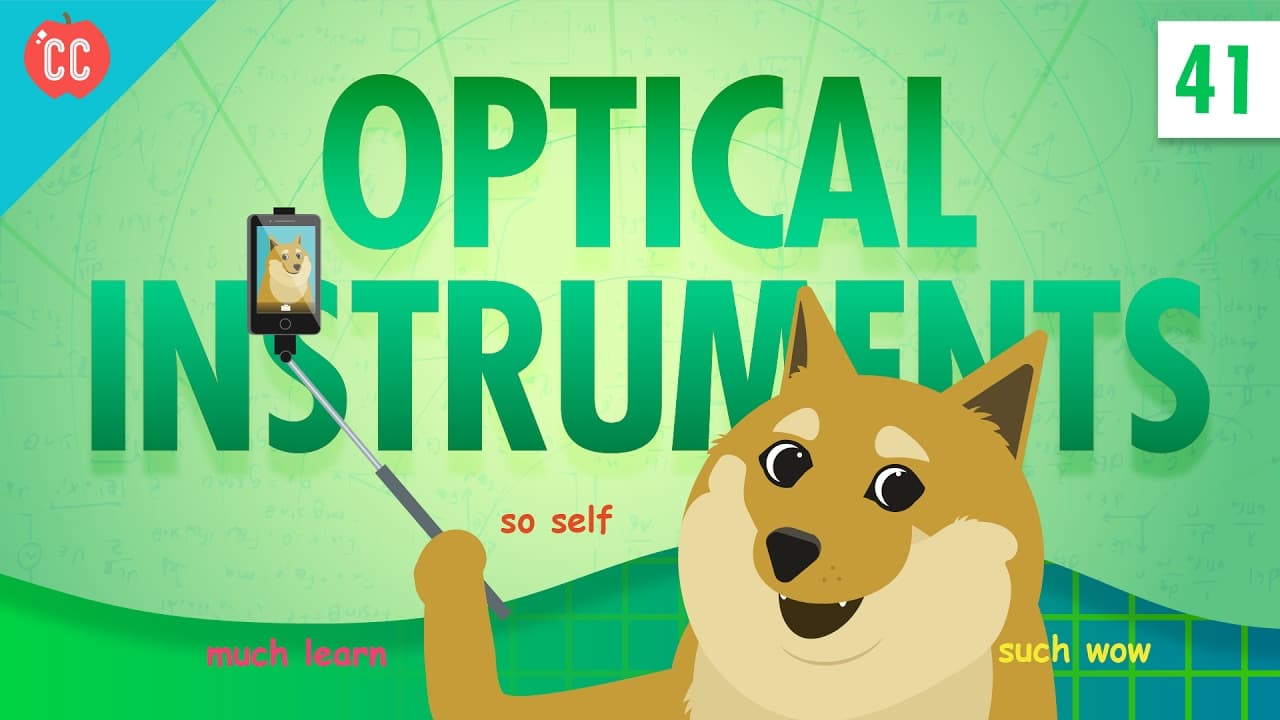
Optical instruments like cameras, telescopes, and microscopes function by utilizing lenses to manipulate light and form images. The human eye operates similarly to a camera, adjusting to focus on objects at different distances. Various lenses, such as converging and diverging lenses, correct vision issues and magnify objects, while the wave nature of light limits the resolution of optical tools.
Transcript
This episode is supported by Prudential. Cameras! They’re the reason you can see me right now, and they’re also why so many precious moments are stashed away safely inside your smart phone. And, just like everything else, these visual marvels are possible because of the laws of physics! To capture an image, a basic camera has a lens that light pass... Read More
Key Insights
- Cameras capture images by using a lens to focus light onto a film or sensor.
- The human eye functions similarly to a camera, with the iris controlling light entry and the lens adjusting focus.
- Hyperopia, or farsightedness, is corrected with converging lenses that focus light on the retina.
- Myopia, or nearsightedness, is corrected with diverging lenses that spread light rays to focus correctly on the retina.
- Magnifying glasses use a single converging lens to create a larger virtual image of an object.
- Refracting telescopes use objective and eyepiece lenses to magnify distant objects, producing flipped images.
- Compound microscopes magnify small objects using objective lenses and eyepieces, similar to telescopes.
- The wave nature of light limits the resolution of optical instruments, as diffraction causes image blurring.
Install to Summarize YouTube Videos and Get Transcripts
Explore YouTube Video Summarizer or Get YouTube Transcript Extractor
Questions & Answers
Q: How do cameras capture images?
Cameras capture images by using a lens to focus incoming light onto a film or digital sensor. The lens opening, or aperture, controls the amount of light entering the camera. When a picture is taken, the light that passes through the lens strikes the film or sensor, recording the image. This process is similar to how the human eye functions, with the retina acting as the sensor.
Q: What is the function of the human eye's lens?
The lens of the human eye focuses light onto the retina, allowing us to see images clearly. Muscles adjust the lens to change its focal length, enabling the eye to focus on objects at varying distances. This process is similar to how a camera lens focuses light, with the iris controlling the amount of light entering the eye.
Q: How is farsightedness corrected with lenses?
Farsightedness, or hyperopia, occurs when the eye cannot focus light rays onto the retina, causing images to form beyond it. This condition is corrected with converging lenses, which bring light rays closer together so that they focus correctly on the retina. This adjustment allows individuals with hyperopia to see nearby objects clearly.
Q: How do magnifying glasses work?
Magnifying glasses use a single converging lens to create a larger virtual image of an object. When an object is placed inside the focal point of the lens, the light rays diverge, and the lens forms a virtual image that appears larger than the actual object. This image is ideally positioned just beyond the viewer's near point for clear focus.
Q: What are refracting telescopes and how do they function?
Refracting telescopes use lenses to magnify distant objects. They consist of an objective lens that converges light rays from a distant source to form a real, flipped image inside the telescope. An eyepiece lens then magnifies this image, creating a larger virtual image for the observer. The telescope's magnification is determined by the focal lengths of the objective lens and the eyepiece.
Q: How do compound microscopes magnify small objects?
Compound microscopes magnify small objects by using objective lenses and eyepieces similar to telescopes. The object is placed just beyond the focal point of the objective lens, creating a flipped real image. This image is then magnified by the eyepiece, generating a large virtual image for the observer. This setup allows for detailed examination of cellular structures.
Q: How does the wave nature of light affect optical instruments?
The wave nature of light affects optical instruments by causing diffraction, which is the reshaping of light as it passes through lenses' edges. This diffraction results in slightly blurred images, limiting the resolution of optical tools. Higher magnification can exacerbate this issue, as diffraction patterns are also magnified, affecting the clarity of closely spaced points in an image.
Q: What is the resolution of an optical instrument?
The resolution of an optical instrument refers to its ability to produce clear images of points that are very close together. High resolution allows for the distinction of two points that are near each other in an image. However, the resolution is limited by the wave nature of light, as diffraction causes blurring and affects the clarity of images captured by cameras, telescopes, and microscopes.
Summary & Key Takeaways
-
Optical instruments like cameras and eyes use lenses to focus light and form images. Cameras capture images on film or sensors, while the eye uses the retina. Hyperopia and myopia are corrected with converging and diverging lenses, respectively. (50 words)
-
Magnifying glasses enlarge objects using converging lenses, while refracting telescopes and compound microscopes use objective and eyepiece lenses to magnify distant or tiny objects. The wave nature of light, causing diffraction, limits the resolution of these instruments. (50 words)
-
Refracting telescopes and compound microscopes both rely on the principles of optics to magnify images, using lenses to manipulate light paths. Despite advancements, the fundamental wave nature of light imposes limits on the resolution and magnification capabilities of optical devices. (50 words)
Read in Other Languages (beta)
Share This Summary 📚
Summarize YouTube Videos and Get Video Transcripts with 1-Click
Try YouTube Summary with ChatGPT & Claude or YouTube Transcript Generator
Explore More Summaries from CrashCourse 📚





Summarize YouTube Videos and Get Video Transcripts with 1-Click
Try YouTube Summary with ChatGPT & Claude or YouTube Transcript Generator