How to Learn From Business Failures and Get Rich
TL;DR
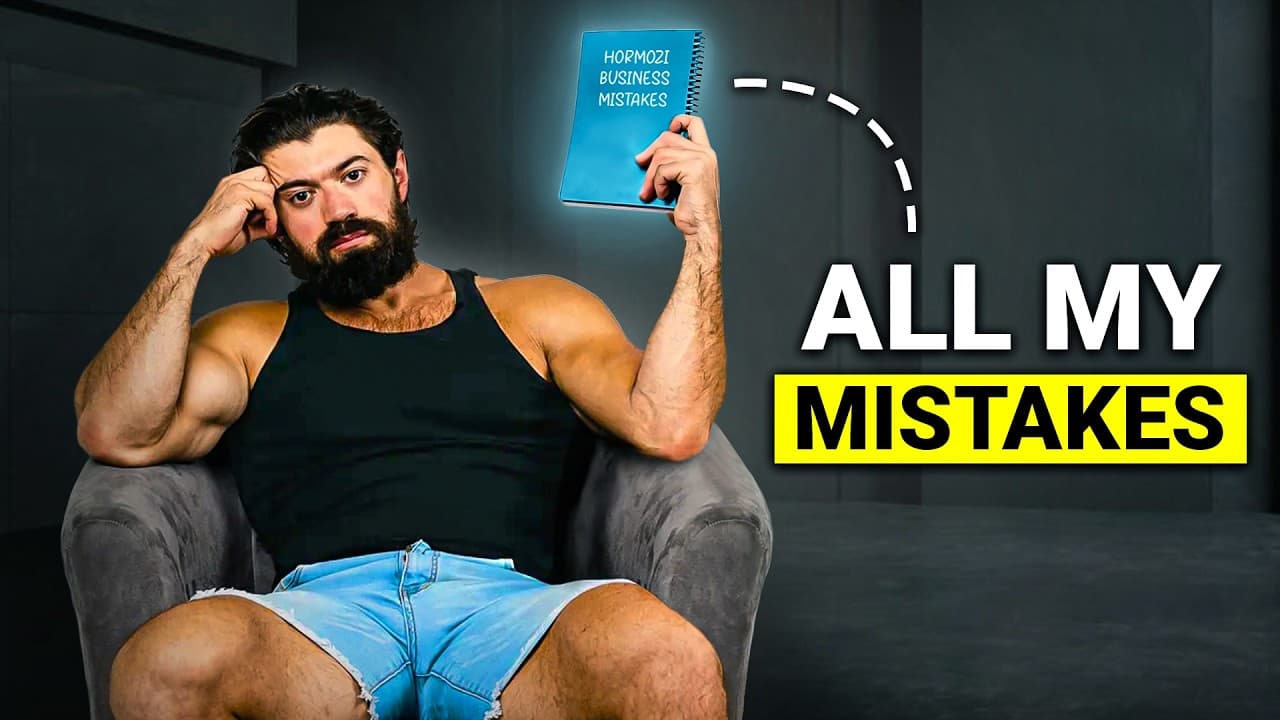
Writing down business failures helps you make more money by turning painful mistakes into lessons you can recognize and apply later. After losing everything twice, Alex Hormozi began documenting his decisions through yearly “lessons and failures” email threads and a podcast; over the next seven or so years, he did not lose everything again and built a $100 million-plus net worth. Read on for his documentation method and how it improves decision-making.
Transcript
documenting your business mistakes may be the most important thing you do in your entire business career to make more money after I lost everything for the second time in my career that experience was so painful that I was like I can't keep doing this I can't keep repeating these same mistakes so I was like I have to find a way that I can learn fro... Read More
Key Insights
- Documenting business mistakes may be the single most important thing you do in your career to make more money, because it lets you learn the right lessons instead of repeating the same painful failures.
- The wrong lesson is more dangerous than the mistake itself, because misattributing why something failed or succeeded means you are bound to repeat it rather than correct it.
- A source of truth beats memory, because current memory gets jaded by your current situation, while documented records let you go back to what actually happened and why.
- Entrepreneurship works like a video game with levels: you move fast through parts you have already 'died' on and learned, then slow down and repeatedly fail on new challenges like running Facebook ads or YouTube ads.
- Success is often misattributed to skill when it was outside circumstances: gym launch's early wins came partly from cheap Facebook ads making customer acquisition super cheap, not just being a good marketer.
- When the arbitrage of cheap ads disappeared, the business had to evolve from an arbitrage model to one based on execution, which made the founder a better entrepreneur even as net income went down.
- High predictive power is what separates better operators: they see business more clearly, recognize mistakes easily, and can predict what it takes to make a desired outcome happen again.
- Outcomes usually require two or three things happening at the same time, not one, so learning the full combination (like both the arrow and the sweet spot) is what makes results repeatable.
Install to Summarize YouTube Videos and Get Transcripts
Explore YouTube Video Summarizer or Get YouTube Transcript Extractor
Questions & Answers
Q: Why should you document your business mistakes?
Documenting mistakes helps you identify the right lesson, recognize similar situations, and avoid repeating the same failures. Hormozi considers this one of the largest factors behind his ability to move forward faster after losing everything twice.
Q: How did Alex Hormozi start documenting his failures?
Within three months of losing everything for the second time, Hormozi started a podcast about what he was doing, thinking, and struggling with. Its ideas came from yearly email threads to himself titled “lessons and failures” followed by the year.
Q: What should a business failure record include?
Hormozi recorded brief notes about events, what he thought would happen, and what actually happened later. These continuous, open-loop stories helped him see when an initially positive sign eventually produced a negative result.
Q: Does the format used to document business lessons matter?
Hormozi says the medium does not matter: video, podcasts, and writing can all work. He began with written email threads and a podcast, then later documented publicly through shorts, longs, and tweets.
Q: How does documenting failures improve business decisions?
A written or recorded history crystallizes knowledge that memory may lose over time. When a similar situation appears, Hormozi can recognize that he has seen it before, recall how it developed, and make a more informed decision.
Q: Why is entrepreneurship compared to a video game?
Entrepreneurs can move quickly through familiar challenges because they remember the obstacles and solutions. Progress slows at a new level, such as running Facebook ads or YouTube ads, where repeated failures continue until the required lesson is learned.
Q: What is the danger of learning the wrong lesson from a business mistake?
A business owner may experience a failure but misidentify what caused it, leaving the real problem uncorrected. Hormozi describes this as a major problem because the owner remains likely to repeat the same mistake.
Q: How can documenting business successes help during a losing streak?
Past records let you revisit a period when you were succeeding and compare how you viewed the world then with how you see it now. Hormozi calls this almost like a time machine because it provides a documented source of truth instead of a memory distorted by the current situation.
Q: Why was Gym Launch so profitable in its first year?
Gym Launch benefited from Facebook ads being extremely cheap at the time. That made customer acquisition inexpensive and profitable both for the gyms using the system and for acquiring gym owners as customers, so the success was not solely the result of great marketing.
Q: What happened to Gym Launch when the Facebook ads arbitrage disappeared?
Gym Launch had to evolve from an arbitrage business into one driven by execution. Its net income went down as the context changed, but recognizing why it was no longer “printing” helped Hormozi become a better entrepreneur.
Q: Why can business success make you learn the wrong lesson?
Business owners may credit success entirely to their own ability while overlooking favorable outside circumstances. Hormozi initially attributed Gym Launch’s results to his marketing, but later realized that unusually cheap Facebook ads were also a major factor.
Summary & Key Takeaways
-
After losing everything twice in his career, Alex Hormozi started a podcast within three months to document what he was doing, thinking, and struggling with. Since then he has not lost everything again and built a $100 million plus net worth over roughly the next seven years.
-
The documentation began as yearly email threads to himself titled 'lessons and failures,' hundreds of emails long, capturing short open-loop stories of what he predicted versus what actually happened. Reviewing these crystallized his decision-making because he could recognize situations he had seen before.
-
The core danger is learning the wrong lesson from a mistake, which guarantees repeating it. He illustrates this with the video-game idea that success can be misattributed to the wrong cause, and stresses learning the right lesson from each scar to move through business faster and more efficiently.
Read in Other Languages (beta)
Share This Summary 📚
Summarize YouTube Videos and Get Video Transcripts with 1-Click
Try YouTube Summary with ChatGPT & Claude or YouTube Transcript Generator
Explore More Summaries from Alex Hormozi 📚

Summarize YouTube Videos and Get Video Transcripts with 1-Click
Try YouTube Summary with ChatGPT & Claude or YouTube Transcript Generator