Does Dark Energy Really Exist?
TL;DR
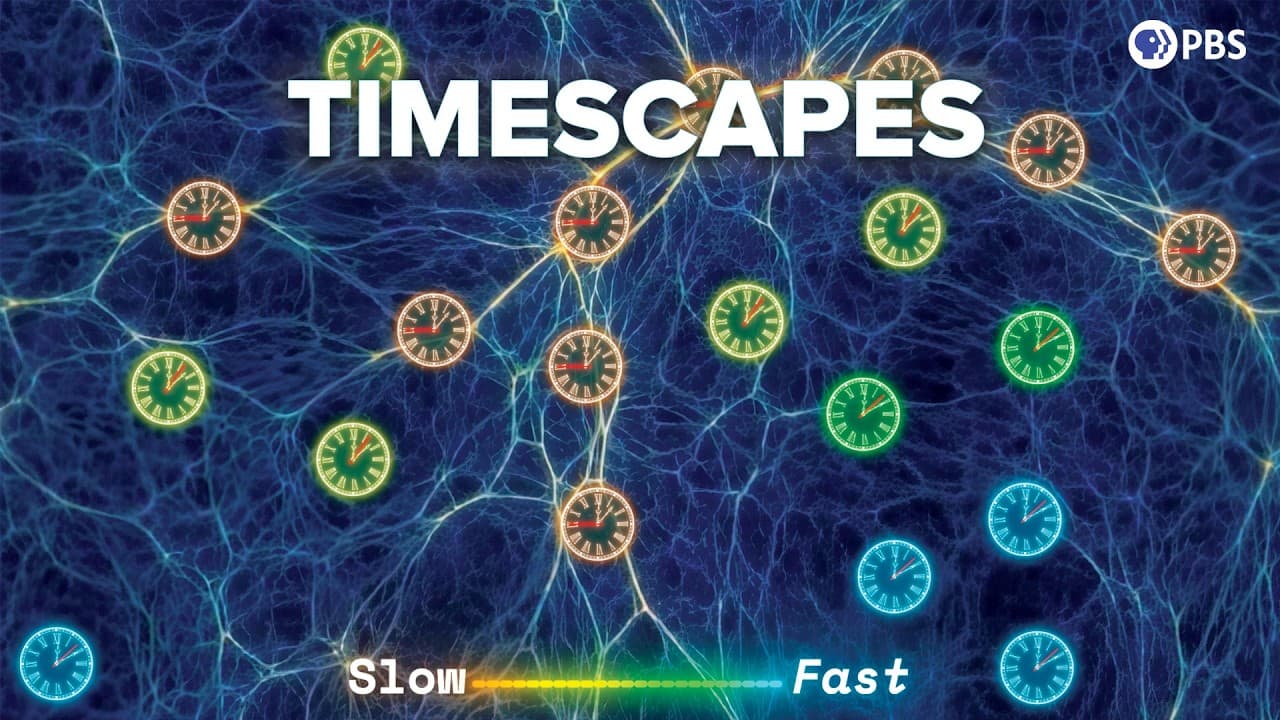
The timescape model challenges the existence of dark energy by proposing that time flows differently in various regions of the universe, potentially explaining the observed cosmic expansion without acceleration. While intriguing, this model lacks comprehensive evidence and faces challenges from existing observations supporting the Lambda-CDM model, which includes dark energy.
Transcript
Thank You To Radiacode for supporting PBS. The universe is expanding and that expansion is accelerating under the power of dark energy and eventually all matter and energy will be dispersed over such unthinkable distances that nothing can stop space from blowing up infinitely. Unless of course cosmologists blundered and dark energy doesn't even ... Read More
Key Insights
- Dark energy is believed to cause the universe's accelerating expansion.
- The timescape model suggests time flows differently across cosmic regions.
- This model could mimic cosmic expansion without dark energy.
- Type 1-a supernovae help measure the universe's expansion history.
- Lambda-CDM model includes dark energy as a cosmological constant.
- Timescape model challenges Lambda-CDM by fitting supernova data better.
- Lambda-CDM is supported by baryon acoustic oscillations and cosmic structure.
- Timescape requires large timeflow differences, which are not widely accepted.
Install to Summarize YouTube Videos and Get Transcripts
Explore YouTube Video Summarizer or Get YouTube Transcript Extractor
Questions & Answers
Q: How does the timescape model explain cosmic expansion?
The timescape model explains cosmic expansion by suggesting that time flows at different rates in various regions of the universe. In this model, regions with lower gravitational fields, such as cosmic voids, experience faster time flow and thus expand more. This differential expansion could mimic the observed acceleration of the universe without requiring dark energy.
Q: What evidence supports the existence of dark energy?
Evidence supporting dark energy includes the observed acceleration of the universe's expansion, primarily measured through Type 1-a supernovae. The Lambda-CDM model, which incorporates dark energy as a cosmological constant, is supported by baryon acoustic oscillations and the evolution of large-scale cosmic structures. These observations consistently indicate an accelerating universe that aligns with the presence of dark energy.
Q: What are baryon acoustic oscillations?
Baryon acoustic oscillations are sound waves from the early universe, now imprinted as faint rings in the distribution of galaxies. These oscillations provide an independent method to measure the universe's expansion rate. Observations of baryon acoustic oscillations strongly support the Lambda-CDM model and indicate an accelerating universe, reinforcing the hypothesis of dark energy's existence.
Q: What challenges does the timescape model face?
The timescape model faces challenges due to its requirement for large differences in timeflow between cosmic voids and dense regions, which are not widely accepted. Additionally, it lacks comprehensive evidence from other observations, such as baryon acoustic oscillations and large-scale cosmic structures, which support the Lambda-CDM model and indicate accelerating expansion.
Q: How does the Lambda-CDM model explain the universe's expansion?
The Lambda-CDM model explains the universe's expansion by incorporating dark energy as a cosmological constant, which causes the observed acceleration. This model is supported by various observations, including Type 1-a supernovae, baryon acoustic oscillations, and the evolution of large-scale cosmic structures, all of which indicate an accelerating universe consistent with the presence of dark energy.
Q: What is the role of Type 1-a supernovae in cosmology?
Type 1-a supernovae play a crucial role in cosmology by serving as standard candles for measuring cosmic distances. Their predictable brightness allows astronomers to determine the distance to these supernovae and track the universe's expansion history. Observations of these supernovae revealed the unexpected acceleration of the universe's expansion, leading to the hypothesis of dark energy.
Q: What is gravitational time dilation?
Gravitational time dilation is a phenomenon where time flows slower in regions of strong gravity compared to regions of weaker gravity. This effect is a well-tested aspect of general relativity and is observed in various contexts, such as near massive celestial bodies. The timescape model leverages this concept to propose differential expansion rates in the universe without invoking dark energy.
Q: Why is the Lambda-CDM model widely accepted?
The Lambda-CDM model is widely accepted because it provides a comprehensive explanation for a range of cosmological observations, including the accelerating expansion of the universe, baryon acoustic oscillations, and the evolution of large-scale cosmic structures. This model's consistency with multiple independent lines of evidence makes it the dominant framework for understanding the universe's large-scale behavior.
Summary & Key Takeaways
-
The timescape model proposes that time flows at different rates in various parts of the universe, potentially explaining the observed cosmic expansion without the need for dark energy. This model challenges the Lambda-CDM model, which includes dark energy as a cosmological constant, by fitting supernova data better. However, it lacks comprehensive evidence from other observations supporting Lambda-CDM.
-
Dark energy is a hypothesized force causing the universe's accelerating expansion, integral to the Lambda-CDM model. The timescape model suggests that differential time flow across cosmic regions could mimic this expansion without dark energy. While intriguing, this model faces challenges from existing evidence supporting Lambda-CDM, including baryon acoustic oscillations and large-scale cosmic structures.
-
The timescape model, introduced by David Wiltshire, posits that time flows differently in various cosmic regions, potentially explaining the universe's expansion without dark energy. Despite fitting supernova data better than Lambda-CDM, the model lacks support from other observations, such as baryon acoustic oscillations and cosmic structure evolution, which strongly indicate accelerating expansion and support Lambda-CDM.
Read in Other Languages (beta)
Share This Summary 📚
Summarize YouTube Videos and Get Video Transcripts with 1-Click
Try YouTube Summary with ChatGPT & Claude or YouTube Transcript Generator
Explore More Summaries from PBS Space Time 📚
Summarize YouTube Videos and Get Video Transcripts with 1-Click
Try YouTube Summary with ChatGPT & Claude or YouTube Transcript Generator