Zeno's Paradox & The Quantum Zeno Effect
TL;DR
The Quantum Zeno Effect suggests observation can freeze quantum events.
Transcript
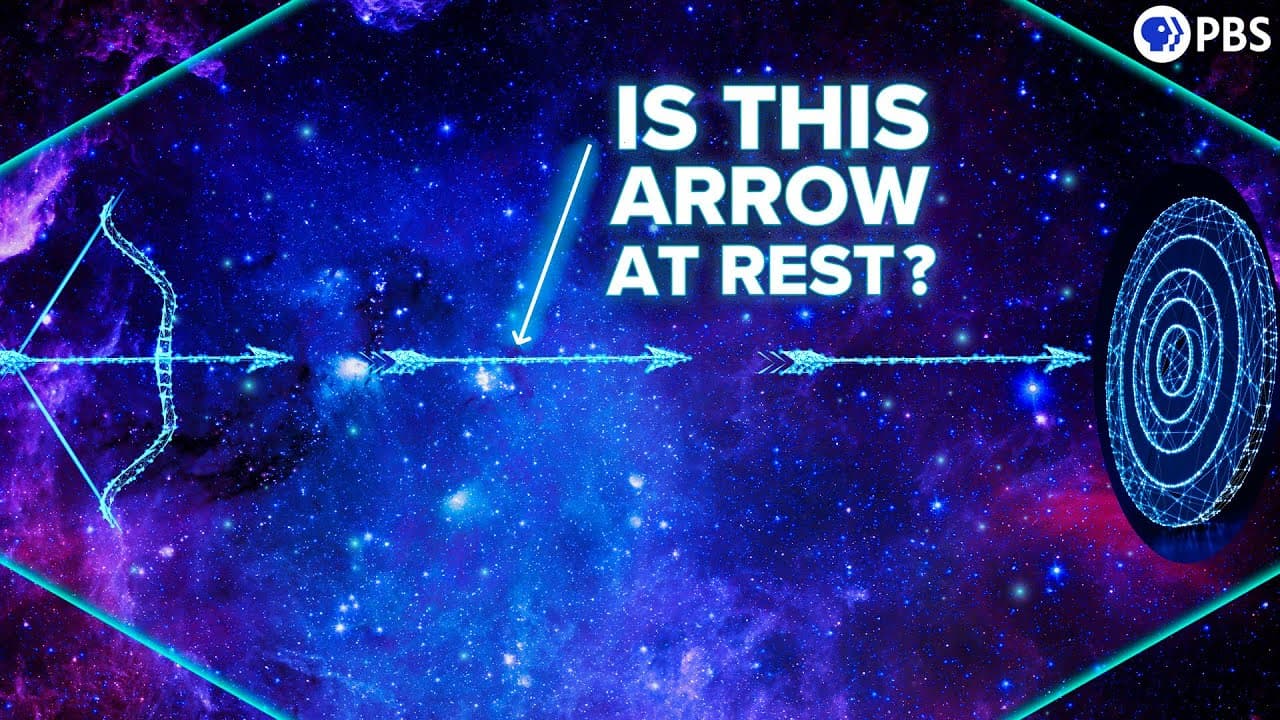
Thanks to Great Courses Plus for supporting PBS. They say that a watched pot never boils. This has now been proven true by quantum mechanics. “A moving arrow is at rest.” This is obviously a nonsensical contradiction. But Zeno, Greek philosopher famous for his metaphysical trolling, devised a paradox whose conclusion is just this. Here’s how it goe... Read More
Key Insights
- Zeno's paradox suggests that an arrow in motion is at rest when observed at any single point in time, challenging our perception of motion.
- The Quantum Zeno Effect posits that observing a quantum system can freeze its state, preventing transitions between states.
- Experiments have attempted to demonstrate the Quantum Zeno Effect by halting electron transitions using rapid laser pulses.
- The interpretation of the Quantum Zeno Effect is debated, with some arguing it's due to interaction rather than observation.
- The effect has implications for understanding quantum mechanics and could affect phenomena like radioactive decay and chemical reactions.
- The Many Worlds interpretation suggests the effect results from decoherence, creating multiple realities based on observation outcomes.
- The Quantum Zeno Effect challenges traditional notions of wavefunction collapse in quantum mechanics.
- Future experiments may provide deeper insights into the nature of quantum mechanics and the role of observation.
Install to Summarize YouTube Videos and Get Transcripts
Explore YouTube Video Summarizer or Get YouTube Transcript Extractor
Questions & Answers
Q: What is Zeno's paradox?
Zeno's paradox is a philosophical argument that challenges the concept of motion. It posits that if you observe an arrow in flight at any single point in time, it appears to be at rest. This paradox suggests that if time is composed of infinite snapshots, the arrow never truly moves, highlighting contradictions in our understanding of motion.
Q: What does the Quantum Zeno Effect propose?
The Quantum Zeno Effect proposes that continuous observation of a quantum system can prevent it from transitioning between states. This effect implies that by observing a quantum system, such as an electron moving between energy levels, its state can be frozen, effectively halting its natural evolution.
Q: How has the Quantum Zeno Effect been demonstrated experimentally?
The Quantum Zeno Effect has been demonstrated experimentally by using rapid laser pulses to halt electron transitions between energy levels. By continuously measuring the electron's state, researchers have shown that the electron's wavefunction can be frozen, preventing it from moving to a different energy state, thus demonstrating the effect.
Q: What are the implications of the Quantum Zeno Effect?
The Quantum Zeno Effect has significant implications for quantum mechanics, potentially affecting processes like radioactive decay and chemical reactions. It challenges traditional notions of wavefunction collapse and suggests that observation can alter a quantum system's evolution, raising questions about the role of measurement in quantum mechanics.
Q: How does the Many Worlds interpretation view the Quantum Zeno Effect?
In the Many Worlds interpretation, the Quantum Zeno Effect results from decoherence, where observation causes interaction with the wavefunction, creating multiple realities. This perspective suggests that observation doesn't collapse the wavefunction but instead generates separate realities for each possible outcome, with the observer experiencing one of these realities.
Q: What is the debate surrounding the interpretation of the Quantum Zeno Effect?
The debate centers around whether the Quantum Zeno Effect is due to observation or interaction with the system. Some argue that the effect is a physical consequence of interacting with the system, such as using laser pulses, rather than the abstract act of measurement, challenging traditional views on wavefunction collapse.
Q: What is the role of decoherence in the Quantum Zeno Effect?
Decoherence plays a crucial role in the Quantum Zeno Effect by disrupting the coherence of a quantum system's wavefunction. It occurs when interaction with the environment spreads information, causing the wavefunction to lose coherence and resulting in the appearance of wavefunction collapse or the creation of multiple realities in the Many Worlds interpretation.
Q: What future research is needed to understand the Quantum Zeno Effect?
Future research should focus on conducting more precise and innovative experiments to explore the Quantum Zeno Effect further. Understanding the nuances of measurement, interaction, and wavefunction collapse, as well as developing new interpretations of quantum mechanics, will be crucial in unraveling the complexities of this phenomenon.
Summary & Key Takeaways
-
The Quantum Zeno Effect suggests that continuous observation of a quantum system can prevent it from evolving, effectively freezing its state. This phenomenon challenges traditional views on wavefunction collapse and has been demonstrated in experiments involving electron transitions.
-
Debate surrounds the interpretation of the Quantum Zeno Effect, with some arguing that it's the result of interaction with the system rather than mere observation. The Many Worlds interpretation offers a different perspective, suggesting decoherence creates multiple realities.
-
The Quantum Zeno Effect has significant implications for quantum mechanics, potentially affecting processes like radioactive decay and chemical reactions. Future experiments may help unravel the mysteries of observation and wavefunction collapse in quantum systems.
Read in Other Languages (beta)
Share This Summary 📚
Summarize YouTube Videos and Get Video Transcripts with 1-Click
Try YouTube Summary with ChatGPT & Claude or YouTube Transcript Generator
Explore More Summaries from PBS Space Time 📚
Summarize YouTube Videos and Get Video Transcripts with 1-Click
Try YouTube Summary with ChatGPT & Claude or YouTube Transcript Generator