Why Did Tucker Carlson Criticize Trump?
TL;DR
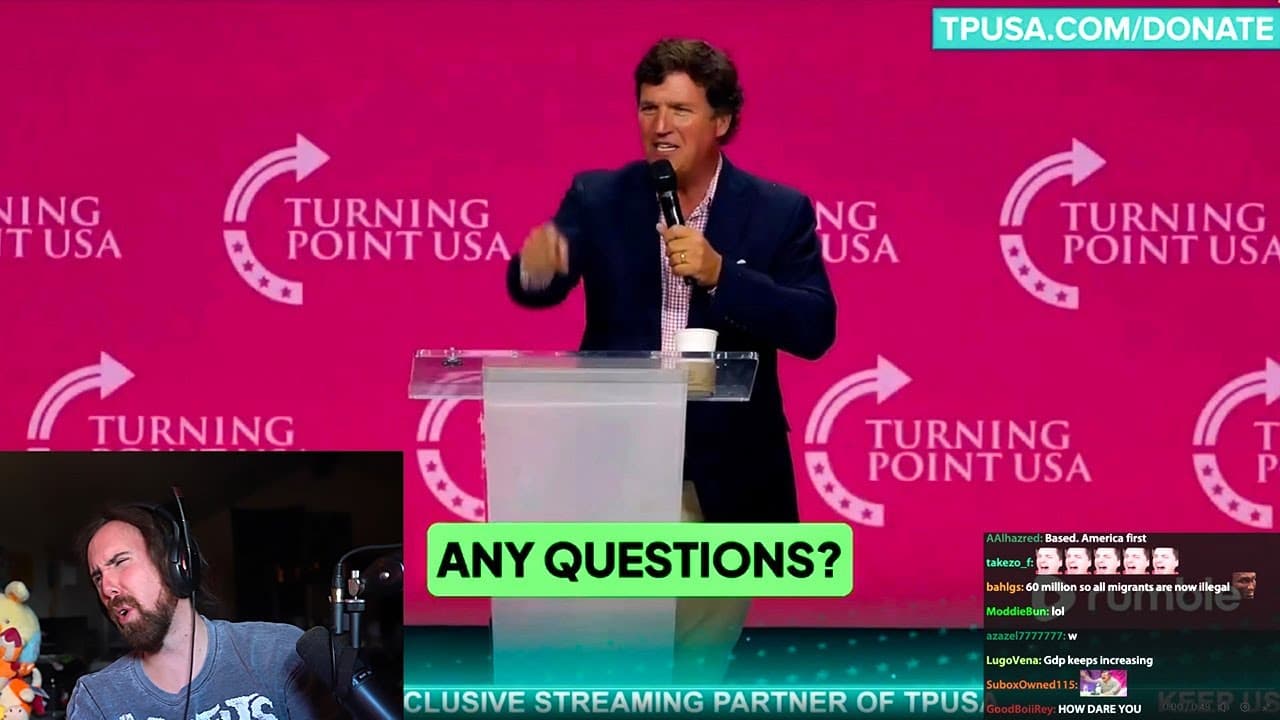
Tucker Carlson argues that Trump owes the public an explanation for promoting claims about Jeffrey Epstein and then treating further questions as closed. Asmongold agrees that dismissing legitimate concerns can destroy trust and radicalize people, while cautioning that Carlson’s theory about intelligence services and a foreign government remains speculative and requires evidence.
Transcript
Tucker Carlson made some pretty interesting comments about a certain individual. I don't like to vote and uh but I did vote this time and um I don't like to vote because I don't believe in any of them and this time I I really felt like I know Trump well. I love Trump personally and what we were looking at was just so awful and totalitarian and stup... Read More
Key Insights
- Carlson’s stated reason for supporting Trump is opposition to a political culture that dismisses questions through labels rather than answering them. He presents respectful engagement as a moral obligation for officials, even when they strongly disagree with the person asking the question.
- Asmongold’s central explanation for political radicalization is that people become more distrustful when obvious questions appear forbidden. He argues that suppressing discussion does not eliminate doubt, but instead convinces some people that institutions fear open examination of their decisions.
- The government’s handling of COVID is presented by Asmongold as a major source of damaged public trust. He believes restrictions on questioning and dissent radicalized a substantial part of the population and set confidence in government back by roughly 20 years.
- Trump’s previous statements about Prince Andrew and Bill Clinton are treated as requiring accountability. Asmongold argues that Trump should either explain why he named them or apologize if his implications were wrong, because such allegations can cause complete reputational destruction.
- Carlson’s explanation for the absence of incriminating Epstein videos is that authorities may never have obtained them. He alleges that the original search warrant around 2007 was structured to protect Epstein, but the discussion provides no documentary evidence establishing that interpretation.
- Carlson’s theory is that Epstein may have acted for an intelligence service, possibly connected to a foreign government. He supports the suspicion by asking how Epstein accumulated airplanes, a private island, and a large Manhattan residence after beginning as a math teacher without a college degree.
- Asmongold’s comparison between Epstein and Rasputin is explicitly tentative. He suggests both figures may have entered powerful circles, become confidants, and gained leverage through incriminating information, but he acknowledges that the analogy could be a large stretch and that greater knowledge might disprove it.
- Criticism of a government or intelligence agency is framed by Carlson as an exercise of citizenship rather than proof of hatred or disloyalty. He argues that Americans may question the CIA, Israel, foreign influence, or domestic agencies while still supporting their country or other legitimate government actions.
Install to Summarize YouTube Videos and Get Transcripts
Explore YouTube Video Summarizer or Get YouTube Transcript Extractor
Questions & Answers
Q: Why did Tucker Carlson say he voted for Trump?
Tucker Carlson says he voted for Trump because he opposed what he considered a totalitarian and dismissive political culture surrounding the previous administration. Although he also cites wars, border policy, illegal immigration, and benefits for newcomers, he identifies the refusal to answer legitimate questions as the issue he hated most. He describes labels such as “racist” and “conspiracy theorist” as tools used to end discussion.
Q: How can suppressing political questions radicalize people?
Asmongold argues that people can become radicalized when they believe they are prohibited from discussing obvious concerns or asking dissenting questions. A refusal to engage can make institutional authorities appear afraid of scrutiny and can deepen suspicion instead of resolving it. He identifies the handling of COVID as a major example, claiming that restrictions on dissent severely damaged public trust in government.
Q: Why does Carlson believe officials must answer direct questions?
Carlson argues that a person in authority is morally obligated to acknowledge and answer a legitimate direct question, although that person does not have to agree with the questioner. He treats an answer as a basic sign of respect for another human being. In his view, dismissing citizens through stigmatizing labels denies them the respect owed to adults who participate in and support their country.
Q: Why does Asmongold think Trump owes an Epstein explanation?
Asmongold says Trump previously named Prince Andrew and Bill Clinton while discussing Jeffrey Epstein, creating serious implications about their possible involvement. He argues that Trump must explain why he made those statements or apologize if they were wrong. In Asmongold’s view, implying that someone collaborated with a generational sexual abuser can destroy a reputation, so the claims cannot responsibly be abandoned without clarification.
Q: What does Carlson claim happened to Epstein evidence?
Carlson claims the Justice Department may not possess the incriminating sex videos that people expect it to release. He speculates that a search warrant served around 2007 was written in a way that prevented federal authorities from obtaining the most damaging evidence, suggesting that protection of Epstein began nearly 20 years earlier. The transcript presents this as Carlson’s conclusion, not as a demonstrated fact supported by documents.
Q: What unanswered questions does Carlson raise about Epstein?
Carlson asks why Jeffrey Epstein abused girls, whether he acted on another party’s behalf, and where his money originated. He questions how someone described as a former math teacher at the Dalton School without a college degree acquired multiple airplanes, a private island, and the largest residential house in Manhattan. Carlson argues that investigators and officials have never adequately resolved these financial and institutional questions.
Q: Why does Asmongold compare Epstein with Rasputin?
Asmongold tentatively compares Epstein with Rasputin because he believes both may have entered elite circles, become trusted confidants, and developed influence through compromising information. He suggests Epstein established himself as a source of power within a network of important people. However, Asmongold openly admits that the comparison may be a large stretch and that learning more about Rasputin could show that his analogy is wrong.
Q: Does criticizing Israel or the CIA necessarily express hatred?
Carlson argues that criticizing the conduct of Israel, the CIA, or another government institution does not automatically make someone hateful, disloyal, anti-American, anti-Israel, or anti-Semitic. He uses his own criticism of alleged CIA wrongdoing to illustrate that citizens can love their country while condemning an agency’s conduct. The broader principle advanced in the discussion is that citizenship includes the right to question both domestic and foreign influence.
Summary & Key Takeaways
-
Tucker Carlson says he voted for Trump largely because he opposed a political culture that dismissed questions and dissent through labels instead of providing answers. He describes censorship and refusal to engage as dehumanizing, while Asmongold argues that suppressing discussion can radicalize people and severely damage public trust in government.
-
The discussion shifts to Jeffrey Epstein, with Carlson condemning the government and Trump for failing to address unresolved questions. Asmongold argues that Trump should explain or retract his earlier implications involving Prince Andrew and Bill Clinton because unsupported accusations of collaboration with a sexual abuser can cause severe reputational harm.
-
Carlson speculates that Epstein worked for a foreign intelligence service and argues that questions about his wealth, connections, and possible sponsors remain unanswered. He says criticizing Israel, the CIA, or another government does not inherently express hatred, while Asmongold distinguishes the right to criticize from the strength or validity of any claim.
Read in Other Languages (beta)
Share This Summary 📚
Summarize YouTube Videos and Get Video Transcripts with 1-Click
Try YouTube Summary with ChatGPT & Claude or YouTube Transcript Generator
Explore More Summaries from Asmongold TV 📚



Summarize YouTube Videos and Get Video Transcripts with 1-Click
Try YouTube Summary with ChatGPT & Claude or YouTube Transcript Generator