What Does OpenAI’s Identity Crisis Mean? Datacenter Wars, Market Up on Iran News, Mamdani’s First Tax, and Swalwell Out

TL;DR
OpenAI’s identity crisis is its shift from consumer products toward enterprise solutions as Anthropic grows faster by targeting coding and business markets. The discussion also covers public and regulatory resistance to data centers, the market’s positive reaction to Iran news, a proposed New York tax on second homes worth over $5 million, and Eric Swalwell’s withdrawal. Read on for the specific arguments behind each issue.
Transcript
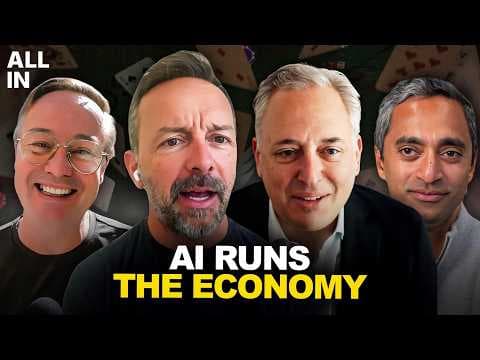
All right, everybody. Welcome back to the number one podcast in the world. We've got the core four here and dare I say, >> the king of Adams. >> The king of Adams. Yes. Captain Travis Kalanick is here. How you doing, brother? >> I'm pretty good. Pretty good. I'm uh sitting here doing the podcast just next door to David. >> Ah, yes. There you go. >>... Read More
Key Insights
- OpenAI is shifting focus from consumer products to enterprise solutions, targeting business customers.
- Anthropic is growing faster than OpenAI, focusing on coding and enterprise markets.
- The market is reacting positively to geopolitical developments, including the situation in Iran.
- Data centers face challenges due to public opposition and regulatory hurdles.
- AI's impact on big tech is mixed, with some companies benefiting more than others.
- The valuation of startups and tech companies is high, leading to concerns about market sustainability.
- The Democratic Party's influence in political races, such as Eric Swalwell's withdrawal, is significant.
- The efficiency gains from AI are not yet fully realized in large enterprises, posing challenges for widespread adoption.
Install to Summarize YouTube Videos and Get Transcripts
Explore YouTube Video Summarizer or Get YouTube Transcript Extractor
Questions & Answers
Q: What is OpenAI’s identity crisis?
OpenAI is shifting its focus from consumer products toward enterprise solutions. The change is linked to competition from Anthropic, which is growing faster through its emphasis on coding and enterprise markets.
Q: How is Anthropic growing faster than OpenAI?
Anthropic is concentrating on coding and enterprise customers. The discussion contrasts that approach with OpenAI’s consumer-focused model and presents Anthropic’s strategy as a source of faster growth.
Q: What challenges are slowing data-center expansion?
Data centers face public opposition and regulatory hurdles that complicate expansion. These constraints matter because data centers provide infrastructure needed by AI and technology companies.
Q: Why did the market rise on news about Iran?
The market reacted positively to developments involving the conflict in Iran. The speakers interpret the rebound as a signal that investors expect the conflict to move toward resolution.
Q: What is Mamdani’s proposed tax on New York second homes?
The discussion describes a proposed annual tax on second homes valued above $5 million. A rate of 3.9% is mentioned as speculation rather than a final figure.
Q: How could the proposed second-home tax affect New York housing?
The speakers argue that the tax could reduce demand from people considering second or third homes in New York. They also debate whether lower demand would improve affordability or instead weaken incentives to build more housing.
Q: Why are high technology-company valuations a concern?
High startup and technology-company valuations raise questions about whether current market levels are sustainable. The concern is that expected AI efficiency gains and revenue growth may not materialize as anticipated.
Q: Why is AI adoption difficult for large enterprises?
Large enterprises face complex change-management and integration challenges when implementing AI. The discussion notes that AI efficiency gains have not yet been fully realized across large companies, making scaled adoption and profits difficult to demonstrate.
Summary & Key Takeaways
-
OpenAI is undergoing an identity crisis, shifting its focus from consumer to enterprise solutions. This pivot is driven by competition with Anthropic, which is experiencing faster growth by targeting coding and enterprise markets. The market's reaction to geopolitical events, such as the Iran conflict, is also discussed, along with AI's impact on big tech and the challenges faced by data centers.
-
Data centers are facing public opposition and regulatory hurdles, impacting their expansion. The video also touches on the high valuation of tech companies, raising concerns about market sustainability. The Democratic Party's influence in political races, like Eric Swalwell's withdrawal, highlights the complexities of political dynamics.
-
AI's efficiency gains are not yet fully realized in large enterprises, posing challenges for widespread adoption. The video concludes with a discussion on the potential impact of AI on big tech, with some companies benefiting more than others, and the implications of high valuations in the tech industry.
Read in Other Languages (beta)
Share This Summary 📚
Summarize YouTube Videos and Get Video Transcripts with 1-Click
Try YouTube Summary with ChatGPT & Claude or YouTube Transcript Generator
Explore More Summaries from All-In Podcast 📚




Summarize YouTube Videos and Get Video Transcripts with 1-Click
Try YouTube Summary with ChatGPT & Claude or YouTube Transcript Generator