What Is Drinking in ZERO-G Like, and What Other Challenges Would a Trip to Mars Involve?
TL;DR
Traveling to Mars would mean enduring eight months of microgravity, adapting to gravity only about 37% as strong as Earth’s, and managing muscle loss, bone loss, liquids, radiation, and nausea. Astronauts typically exercise two and a half hours every day, yet still face physical deterioration. Read on to see how elastic exercise, spacecraft shielding, and even heavy spacesuits could help address these challenges.
Transcript
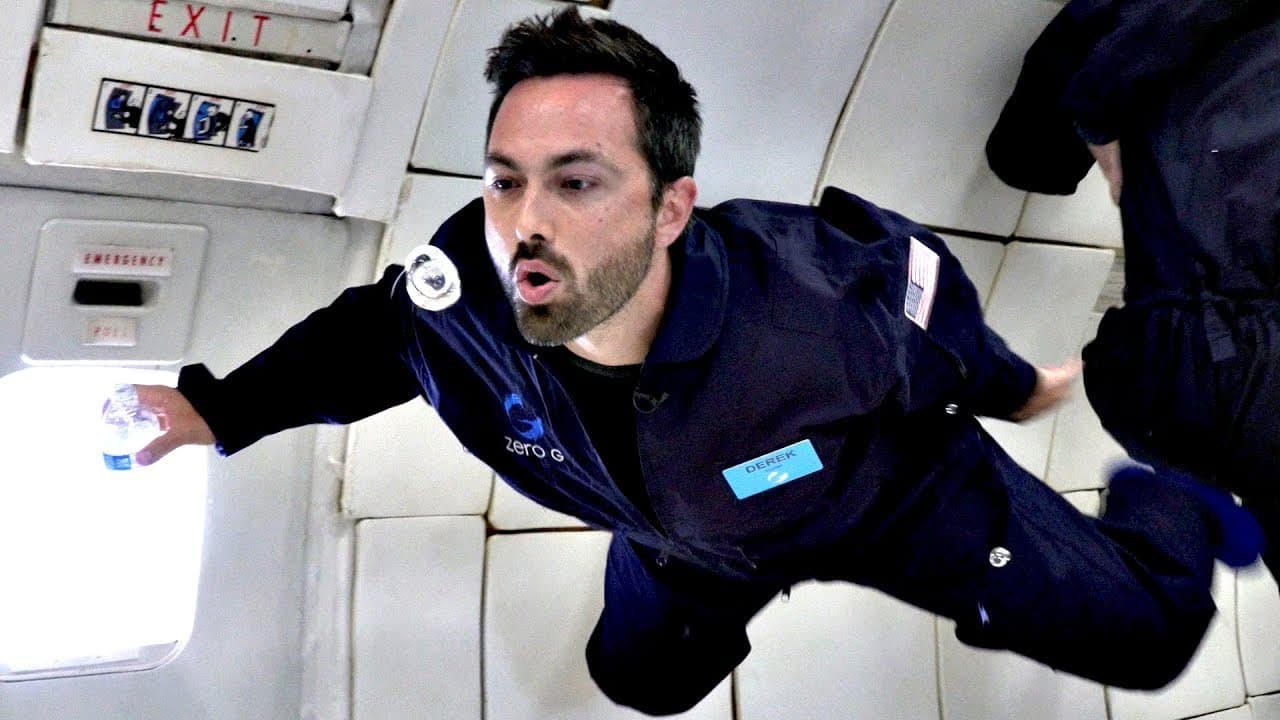
What would it be like to travel to Mars and be one of its first colonists? well to get a small taste National Geographic is sponsoring this video and sending me on a Microgravity experience - a vomit comet Come on this plane flies in a series of parabolic arcs so that if and everything inside can essentially be in freefall creating a microgravity e... Read More
Key Insights
- Parabolic flight creates freefall: The aircraft flies repeated parabolic arcs so the plane and everything inside can effectively fall together. This produces a microgravity environment for about 30 seconds at a time. Changing the shape of the parabola allows the flight to reproduce conditions associated with both the Moon and Mars.
- Mars travel extends the exposure: The brief aircraft experience represents only a small taste of an actual journey. A traveler going to Mars would experience eight months of microgravity, rather than approximately 30 seconds. That enormous difference in duration turns temporary novelty into a sustained challenge affecting exercise, health, hygiene, and comfort.
- Martian gravity changes movement: Surface gravity on Mars is about 37% of Earth’s gravity. An average jumper would receive double the airtime there and could dunk on a regulation basketball hoop without difficulty. The apparent athletic advantage comes directly from reduced gravity, although equipment such as a heavy spacesuit could largely offset it.
- Lunar gravity is even weaker: Gravity on the Moon is only one-sixth of the level experienced on Earth. Under those conditions, a person could perform unusual aerobics without becoming exhausted as quickly. The comparison helps distinguish the simulated environments and shows that reduced gravity exists on a spectrum rather than as a single weightless condition.
- Everyday movement normally exercises muscles: Under regular Earth gravity, an arm weighs about 5% of a person’s body weight. Simply lifting it therefore provides a small amount of muscular work. That routine resistance disappears during a weightless journey and returns only partially on Mars, helping explain why muscles weaken and shrink.
- Muscle loss begins quickly: Studies mentioned in the transcript found that muscle mass can decrease by as much as 20% on space flights lasting only 5 to 11 days. A Mars trip lasts far longer, so exercise becomes essential. The problem is not merely reduced strength on arrival, but sustained atrophy throughout the journey.
- Elastic resistance replaces weights: Conventional weightlifting is ineffective when weights have no meaningful weight. Astronauts instead create resistance through elastic systems. On the space station, they are elastically tethered to a treadmill and typically exercise for two and a half hours every day, recreating forces that microgravity no longer supplies naturally.
- Bone loss persists despite exercise: A lack of weight pressing through the skeleton decreases bone density. Astronauts can lose one to two percent of their bone mass per month, with much of that loss occurring in the lower extremities. The stated rate is more than 10 times faster than bone loss from osteoporosis on Earth.
- Surface tension controls floating water: In microgravity, water does not fall or flow in the familiar Earthbound way. Surface tension holds it together, creating floating masses that can reach the face or nose. This makes drinking and washing harder because the liquid must be deliberately controlled rather than allowed to drain under gravity.
- Routine hygiene becomes complicated: Showering, brushing teeth, washing the face, and using the bathroom all become harder when liquids float. The microgravity demonstration shows water clinging together and moving unpredictably around the face. The challenge comes from the absence of gravity-driven drainage, not from a shortage of water itself.
- Intermediate-axis rotation is unstable: The spinning disc repeatedly flips in microgravity, alternating which side and hole orientation faces the observer. This demonstrates that rotation around an intermediate axis, rather than the axis with the least or greatest moment of inertia, is unstable. Even a tiny disturbance can introduce rotation around another axis.
- Protection must address multiple hazards: Spacesuits weighing up to 310 pounds could restore an Earth-like feeling of heaviness on Mars and may help maintain muscles and bones. Spacecraft insulation can incorporate radiation shielding, and water is described as a terrific radiation absorber. These measures can reduce risks, but the hazards cannot simply be ignored.
Install to Summarize YouTube Videos and Get Transcripts
Explore YouTube Video Summarizer or Get YouTube Transcript Extractor
Questions & Answers
Q: What is drinking in ZERO-G like, and why is it difficult?
Drinking in ZERO-G is difficult because water does not fall into a container or toward the mouth as it does on Earth. Surface tension holds the liquid together in floating masses. During the demonstration, water moves around the face and even reaches the nose. Liquids must therefore be carefully controlled because gravity no longer directs their movement.
Q: How does a parabolic flight create microgravity?
The plane flies through a series of parabolic arcs. During each arc, the aircraft and everything inside effectively enter freefall together, creating microgravity for about 30 seconds. The parabola can be modified to simulate the gravity of the Moon or Mars. This works because the flight pattern changes how strongly occupants experience support from the aircraft.
Q: What would gravity feel like on the surface of Mars?
Gravity on Mars is about 37% of Earth’s gravity. An average Earth jumper would get roughly double the airtime and could dunk on a regulation basketball hoop. Movement would feel easier because the body and other objects would exert less weight. However, a spacesuit weighing up to 310 pounds could make a person feel about as heavy as on Earth.
Q: How does microgravity affect muscles during a trip to Mars?
Muscles weaken and shrink because ordinary movement no longer works against normal body weight. Studies cited in the transcript found losses of up to 20% on flights lasting just 5 to 11 days. A Mars traveler would spend eight months in microgravity, making regular exercise necessary. Elastic resistance substitutes for the force that gravity normally provides.
Q: Why can astronauts not rely on ordinary weightlifting?
Ordinary weightlifting becomes useless because weights do not provide their normal downward resistance in microgravity. Astronauts instead use elastic resistance to load their muscles. On the space station, they are elastically tethered to a treadmill. They typically exercise for two and a half hours each day because routine movement no longer supplies enough muscular work.
Q: How quickly do astronauts lose bone mass?
Astronauts can lose one to two percent of their bone mass each month. The loss occurs mainly in the lower extremities because weight is no longer pushing through those bones. The transcript says this is more than 10 times faster than bone loss associated with osteoporosis on Earth. Exercise helps address physical deterioration, but it does not fully prevent reduced bone density.
Q: Why might astronauts see flashes with their eyes closed?
Astronauts sometimes see flashes of light while lying with their eyes closed before falling asleep. The transcript attributes this experience to a bodily reaction to radiation from the universe. Heavy particles or individual bursts of energy may pass through the eyeball or the optic nerve. The perceived flash therefore signals radiation exposure rather than visible light entering the open eye.
Q: How could Mars travelers reduce radiation and low-gravity risks?
Radiation protection can be incorporated into the spacecraft’s insulation. Water can also be used because the transcript describes it as a terrific radiation absorber. On Mars, a spacesuit weighing as much as 310 pounds could restore an Earth-like sense of heaviness and help maintain muscle and bone mass. These measures treat the dangers as manageable challenges, although they cannot be ignored.
Summary & Key Takeaways
-
Experiencing simulated Martian gravity: National Geographic sponsors a microgravity flight that follows parabolic arcs, putting the aircraft and everything inside into freefall. Modified parabolas can also simulate gravity on the Moon and Mars. Unlike each roughly 30-second experience aboard the plane, a real traveler would spend eight months in microgravity before reaching Mars. On the Martian surface, gravity is about 37% of Earth’s, giving an average jumper double the airtime and making a regulation basketball dunk easy.
-
Confronting physical deterioration: Low gravity removes much of the effort normally involved in moving the body, since an arm alone weighs about 5% of total body weight under Earth gravity. During a Mars journey, muscles would weaken, shrink, and atrophy. Studies cited in the transcript found muscle mass decreases of up to 20% during flights lasting just 5 to 11 days. Ordinary weightlifting becomes useless without weight, so astronauts use elastic resistance and spend two and a half hours exercising each day.
-
Managing bones and liquids: Exercise does not eliminate every consequence of weightlessness. Without weight pressing on bones, astronauts can lose one to two percent of bone mass each month, primarily in their lower extremities. The transcript describes this as more than 10 times the rate experienced through osteoporosis on Earth. Surface tension also becomes unusually important, holding water together in floating masses. Consequently, washing the face, showering, brushing teeth, drinking, and using the bathroom become substantially more difficult.
-
Observing motion and radiation: A spinning disc behaves unexpectedly in microgravity, repeatedly flipping so its hole alternates between facing toward and away from the observer. The same behavior has been seen with a T-bar handle on the space station. It demonstrates the intermediate axis theorem, where rotation around the intermediate moment of inertia is unstable. Mars travelers would also encounter significant radiation, sometimes perceived with closed eyes as flashes caused by energy passing through the eyeball or optic nerve.
-
Considering practical countermeasures: The difficulties are presented as challenges to overcome, rather than reasons to abandon Mars settlement. A spacesuit weighing as much as 310 pounds would feel approximately as heavy on Mars as a person does on Earth, potentially helping preserve muscle and bone mass. Radiation protection could be incorporated into spacecraft insulation, while water can serve as an effective absorber. Nausea remains another concern because human bodies evolved for millions of years under Earth’s gravity of 9.8 meters per second squared.
Read in Other Languages (beta)
Share This Summary 📚
Summarize YouTube Videos and Get Video Transcripts with 1-Click
Try YouTube Summary with ChatGPT & Claude or YouTube Transcript Generator
Explore More Summaries from Veritasium 📚






Summarize YouTube Videos and Get Video Transcripts with 1-Click
Try YouTube Summary with ChatGPT & Claude or YouTube Transcript Generator